
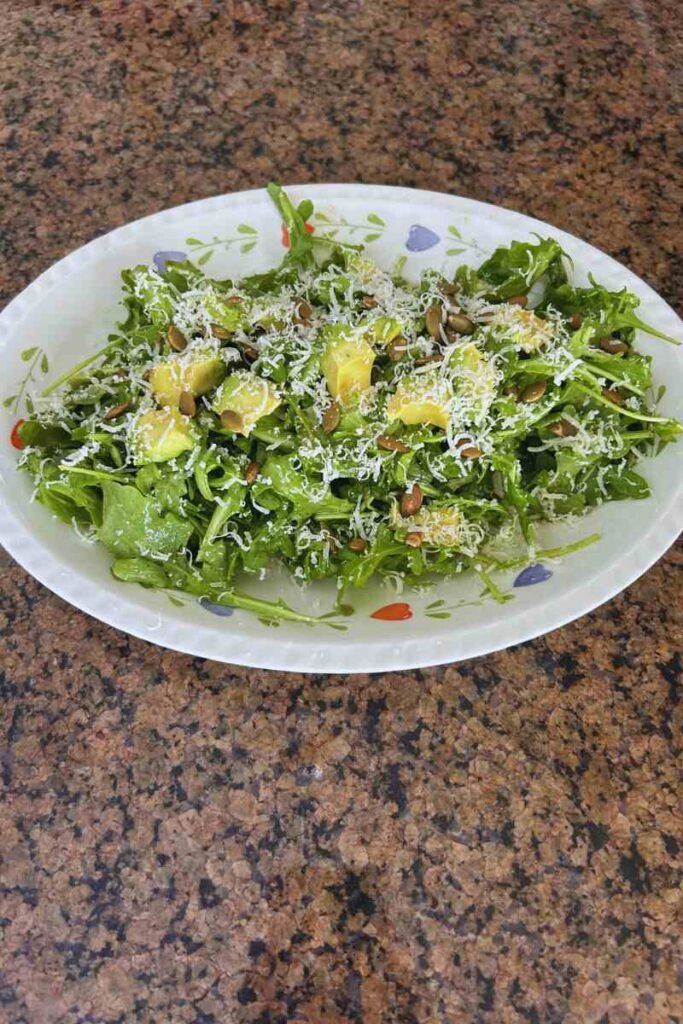
This Arugula Salad with Honey Dijon Lemon Vinaigrette is a perfect example of balanced salad construction: the peppery arugula pairs beautifully with the sweet-tart vinaigrette, creamy avocado adds texture, toasted seeds provide crunch, and aged cheese brings savory depth. The honey-Dijon lemon vinaigrette demonstrates classic French emulsification, suspending oil in acid for a smooth, flavorful coating. Quick to prepare—just five minutes of hands-on work—this salad delivers layered flavors and thoughtful ingredients that make every bite satisfying.
Understanding Vinaigrette Construction
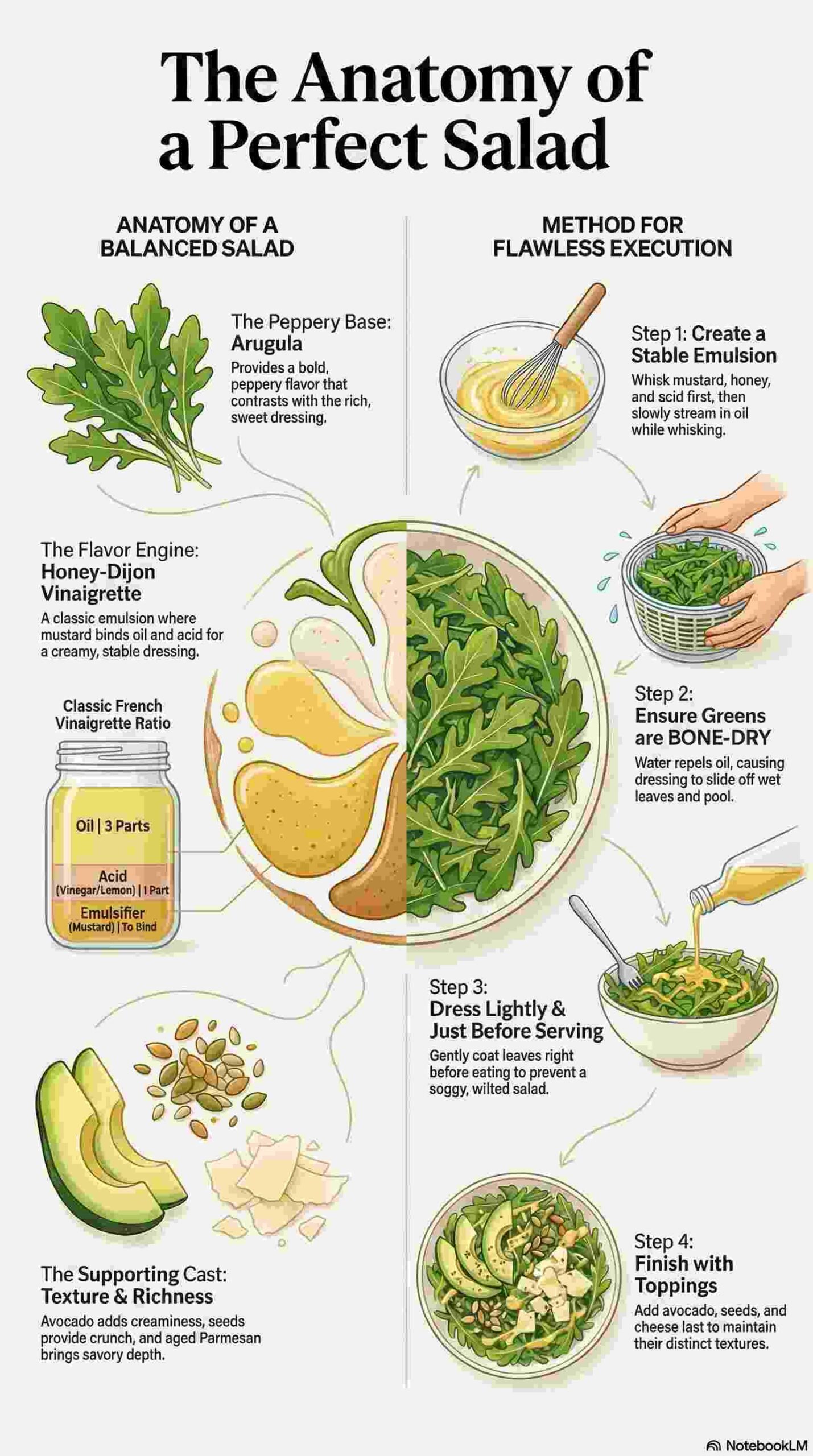
A vinaigrette is fundamentally an emulsion: tiny droplets of oil suspended in an acidic liquid. Without an emulsifier, oil and vinegar separate immediately after mixing. Dijon mustard contains mucilage and proteins that act as emulsifiers, coating oil droplets and preventing them from coalescing. This creates a stable, creamy dressing that clings to greens rather than pooling at the bowl’s bottom.
The classic vinaigrette ratio is three parts oil to one part acid, though this varies based on the acid’s strength and personal preference. According to culinary science research, proper vinaigrette technique involves whisking the emulsifier with the acid first, then adding oil gradually while whisking constantly to create small, stable oil droplets throughout the mixture.
Ingredients
Ingredients for Arugula Salad with Honey-Dijon Lemon Vinaigrette
For the Vinaigrette- 1 teaspoon Dijon mustard
- 2 teaspoons honey
- Juice of ½ lemon (approx. 1½–2 tablespoons)
- Zest of ½ lemon (approx. 1 teaspoon)
- 1 teaspoon white wine vinegar
- 3–4 tablespoons extra virgin olive oil
- Salt and freshly ground black pepper to taste
- 150–200g arugula (approx. 4–5 large handfuls)
- ½ ripe avocado, sliced
- 2–3 tablespoons roasted sunflower seeds
- 30–40g Parmesan cheese, freshly grated (approx. ⅓ cup)
Ingredient Selection and Quality
Arugula Characteristics and Selection
Arugula (also called rocket or rucola) belongs to the Brassicaceae family, related to mustard greens and horseradish. Its distinctive peppery, slightly bitter flavor comes from glucosinolates—sulfur-containing compounds that provide characteristic bite. Young, small-leaf arugula offers milder, more delicate flavor, while mature, larger leaves taste more assertive and can be quite spicy.
Fresh arugula should appear vibrant green with no yellowing, wilting, or sliminess. The leaves should feel crisp and dry. Baby arugula requires only brief rinsing and drying, while mature arugula may need stem removal if the stems are thick and fibrous. Store arugula loosely wrapped in paper towels inside a plastic bag in the refrigerator crisper, where it keeps for 3-4 days maximum.
Dijon Mustard Function
Dijon mustard provides three essential functions in this vinaigrette: emulsification (as discussed above), sharp, tangy flavor, and slight heat. Traditional Dijon mustard from Burgundy, France, uses brown or black mustard seeds, white wine or wine vinegar, and salt. The wine gives Dijon its characteristic flavor that distinguishes it from yellow American mustard.
Quality matters significantly. Authentic Dijon brands like Maille or Grey Poupon offer superior flavor and emulsifying properties compared to generic mustards. The mustard should taste sharp and complex, not flat or overly vinegary.
Honey Selection
Honey contributes sweetness that balances the vinaigrette’s acidity and mustard’s sharpness. Different honey varieties create different flavor profiles. Mild honeys like clover or acacia provide pure sweetness without overwhelming other flavors. Stronger honeys like buckwheat or chestnut add distinctive character but may dominate delicate greens.
Raw, unfiltered honey offers more complex flavor than highly processed varieties, though either works functionally. The honey should be liquid enough to whisk easily; if crystallized, warm it gently in a water bath or microwave briefly.
Olive Oil Quality and Selection
Extra virgin olive oil serves as the vinaigrette’s body and contributes significant flavor. For vinaigrettes served raw (unlike cooking applications where heat mutes oil flavor), oil quality directly impacts the final taste. Look for fresh extra virgin olive oil with a harvest date within the past year, stored in dark glass bottles to protect it from light degradation.
The oil’s flavor profile should complement rather than overwhelm the salad. Robust, peppery oils (often from Tuscany or Sicily) can be too aggressive for delicate greens, while mild, buttery oils (often from Liguria or Spain) provide richness without dominating. A balanced, fruity oil with moderate pepperiness works best for most applications. According to the North American Olive Oil Association, proper storage in a cool, dark place preserves olive oil quality, as light and heat degrade flavor compounds.
Lemon Considerations
Fresh lemon juice provides bright, clean acidity that tastes markedly different from vinegar. The combination of lemon juice and white wine vinegar creates more complex acidity than either alone. Choose heavy, thin-skinned lemons for maximum juice content. Organic lemons are preferable for zesting, as conventional lemons may carry pesticide residues and wax coatings on the peel.
Room-temperature lemons yield more juice than cold lemons. Roll the lemon firmly on the counter before cutting to break internal membranes and release more juice.
Avocado Selection and Preparation
Ripe avocados should yield to gentle pressure without feeling mushy. The skin color varies by variety—Hass avocados turn dark green to nearly black when ripe, while other varieties may remain green. Avoid avocados with large soft spots or dark blemishes, which indicate overripeness or bruising.
To prevent browning after slicing, brush avocado with a small amount of the lemon vinaigrette immediately after cutting. The acid slows enzymatic oxidation that causes browning.
Sunflower Seeds
Roasted, unsalted sunflower seeds provide the best base for seasoning. Pre-salted seeds may oversalt the salad. If using raw seeds, toast them briefly in a dry pan over medium heat for 3-4 minutes until fragrant and lightly golden, then cool before using. Toasting dramatically improves flavor by developing nutty, complex notes through the Maillard reaction.
Parmesan Quality
Authentic Parmigiano-Reggiano from Italy offers incomparably superior flavor and texture compared to domestic “parmesan.” The aged cheese should have a granular, crystalline texture and complex, nutty, savory flavor. Grate it fresh just before serving—pre-grated Parmesan loses flavor quickly and contains anti-caking agents that affect texture.
Aged Parmesan (24+ months) provides more intense, complex flavor than younger versions (12-18 months). For salads, slightly younger Parmesan often works better, as its milder flavor doesn’t overwhelm the greens.
Method
Make the Vinaigrette
1. Combine the base ingredients: In a small bowl, add 1 teaspoon Dijon mustard, 2 teaspoons honey, the juice of half a lemon (approximately 1½-2 tablespoons), the zest of half a lemon (approximately 1 teaspoon), and 1 teaspoon white wine vinegar. Whisk these ingredients together vigorously until the honey dissolves completely and the mixture becomes homogeneous.
The mustard and honey should blend smoothly with the acids, creating a slightly thickened, pale yellow base. This combination forms the continuous phase of the emulsion—the liquid in which oil droplets will be suspended.
2. Emulsify the oil: While whisking constantly and vigorously, begin adding the extra virgin olive oil in a very thin, steady stream—just a few drops at first. The whisking motion breaks the oil into tiny droplets, while the mustard coats these droplets and prevents them from recombining. As the emulsion stabilizes (after adding about 1 tablespoon of oil), you can increase the oil stream slightly while continuing to whisk.
Add 3-4 tablespoons total oil, adjusting based on your preference for richness versus acidity. More oil creates a mellower, richer vinaigrette, while less oil maintains sharper, brighter acidity. The finished vinaigrette should be thick enough to coat the back of a spoon and appear creamy and opaque rather than separated.
If the vinaigrette breaks (oil separates and pools), start fresh with another teaspoon of mustard in a clean bowl, add a few drops of the broken vinaigrette while whisking, and gradually incorporate the rest once the emulsion re-establishes.
3. Season to taste: Add salt and freshly ground black pepper, starting conservatively (approximately ¼ teaspoon salt, several grinds of pepper). Whisk to incorporate, then taste. The vinaigrette should taste bright and balanced—neither too acidic nor too oily, with noticeable sweetness from honey but not cloying. Adjust seasoning as needed. Remember that the Parmesan adds significant salt to the finished salad, so slightly underseasoning the vinaigrette itself often produces better final balance.
The vinaigrette can be made several hours ahead and refrigerated. If it solidifies (olive oil solidifies when cold), bring it to room temperature and whisk briefly before using.
Assemble the Salad
1. Prepare the arugula: If not pre-washed, rinse the arugula thoroughly in cold water and dry completely using a salad spinner or by patting gently with clean kitchen towels. Even small amounts of water on the leaves prevent vinaigrette from adhering properly—water and oil repel each other, so wet greens result in dressing that slides off and pools at the bowl bottom.
Place the dry arugula in a large salad bowl. The bowl should be capacious enough to toss the greens without crushing them—at least three times the volume of the greens themselves.
2. Dress the greens: Add approximately 2-3 tablespoons of vinaigrette to the arugula—start with less rather than more. Using your hands or salad tongs, toss the greens gently but thoroughly, ensuring every leaf receives light coating. The goal is to enhance the greens, not drown them. Well-dressed salad should have a light, even sheen on each leaf with no pooling dressing at the bowl bottom.
Add additional vinaigrette only if needed. Overdressed salad becomes soggy and unpleasant, with flavors muddled rather than distinct. You’ll likely have leftover vinaigrette; refrigerate it for up to one week and use for other salads or as a marinade.
3. Add the avocado: Gently fold in the avocado slices, taking care not to mash them. The avocado should remain in distinct pieces that provide creamy contrast to the crisp greens rather than turning into an avocado purée mixed throughout.
4. Finish with toppings: Transfer the dressed salad to serving plates or a serving platter. Scatter the roasted sunflower seeds evenly over the top—they should remain on the surface rather than being mixed in, maintaining their crunch. Using a microplane grater or fine grater, grate fresh Parmesan generously over the entire salad. The cheese should fall in light, fluffy shavings that blanket the greens.
The “generous shower” of Parmesan is not mere hyperbole—the aged cheese’s umami richness ties all the salad components together and balances the arugula’s peppery bite. Don’t be shy here.
Technical Notes on Salad Success
Several principles separate excellent salads from mediocre ones:
Dry greens are essential: Water prevents dressing adhesion and dilutes vinaigrette flavor. Invest in a salad spinner or take time to thoroughly pat greens dry.
Dress at the last moment: Acid in vinaigrette begins breaking down delicate greens immediately upon contact. Dress salad no more than 5-10 minutes before serving to maintain textural integrity. For advance preparation, keep components separate and assemble just before serving.
Underdress rather than overdress: You can always add more dressing, but you cannot remove excess. Start with less, toss thoroughly, evaluate, and add more only if needed.
Room temperature dressing flows better: Cold vinaigrette, particularly olive oil-based ones, is thick and doesn’t coat greens evenly. Bring refrigerated dressing to room temperature before using.
Salt the dressing, not the salad: Salting greens directly causes them to wilt and release water through osmosis. Salt in the vinaigrette provides seasoning without damaging leaf structure.
Serving Suggestions and Meal Context
This salad serves 2-3 people as a side salad or light lunch, or 4 people as a starter course. Its bright, peppery character pairs well with rich main courses where it provides refreshing contrast:
With grilled or roasted meats: The salad’s acidity cuts through fatty meats like lamb, steak, or pork.
Alongside pasta dishes: Particularly cream or cheese-based pastas that benefit from sharp, fresh counterpoint.
With pizza: The classic Italian combination of pizza followed by simple salad.
As a light lunch: Add protein (grilled chicken, seared tuna, chickpeas, or additional cheese) to make the salad more substantial.
Before rich desserts: A palate-cleansing salad course between main course and dessert is traditional in formal meals.
Variations and Adaptations
Different greens: Replace or supplement arugula with:
- Mixed baby greens for milder flavor
- Spinach for earthier, less peppery taste
- Watercress for similar peppery character with more delicate texture
- Frisée or escarole for bitter notes and crisp texture
- Mixed herbs (parsley, basil, cilantro) for aromatic complexity
Additional vegetables: Enhance with:
- Shaved fennel for anise notes and crunch
- Cherry tomatoes, halved, for sweetness and acidity
- Shaved radishes for peppery bite and color
- Roasted beets for earthy sweetness
- Cucumber ribbons for refreshing coolness
Protein additions: Transform into a main course with:
- Grilled chicken breast, sliced
- Seared salmon or tuna
- Poached shrimp
- Chickpeas or white beans for vegetarian protein
- Prosciutto or other cured meat
Nut and seed variations: Replace sunflower seeds with:
- Toasted pine nuts for buttery richness
- Candied walnuts or pecans for sweet-savory contrast
- Toasted pumpkin seeds (pepitas) for similar crunch
- Toasted sliced almonds for delicate nuttiness
Cheese alternatives: Experiment with different cheeses:
- Pecorino Romano for sharper, saltier flavor
- Aged Manchego for nutty, complex notes
- Crumbled goat cheese for tangy creaminess
- Shaved aged Gouda for caramel-like sweetness
- Blue cheese crumbles for bold, pungent character
Vinaigrette variations: Modify the dressing:
- Add minced shallot for subtle onion flavor
- Include fresh herbs (basil, tarragon, thyme)
- Use different vinegars (red wine, sherry, champagne)
- Replace honey with maple syrup or agave
- Add a small clove of minced garlic for pungency
Fruit additions: Sweet-tart fruits complement peppery arugula:
- Fresh pear or apple slices for crisp sweetness
- Orange segments for citrus brightness
- Fresh figs for luxurious sweetness
- Pomegranate seeds for jewel-like bursts of tartness
- Dried cranberries or cherries for concentrated sweetness
Vinaigrette Storage and Uses
Leftover vinaigrette keeps refrigerated in a sealed jar for up to one week. The emulsion may separate during storage; simply shake or whisk vigorously before using. Beyond salad applications, this honey-Dijon lemon vinaigrette serves multiple purposes:
As a marinade: For chicken, fish, or vegetables before grilling or roasting. The acid tenderizes while the oil keeps food moist.
As a sauce: Drizzle over roasted vegetables, grain bowls, or grilled proteins.
For grain salads: Toss with quinoa, farro, or couscous along with vegetables and herbs.
As a sandwich spread: Especially effective on sandwiches containing greens, as it adds moisture and flavor without the heaviness of mayonnaise.
For crudités: Use as a dipping sauce for raw vegetables.
Nutritional Considerations
This salad provides significant nutritional value while remaining relatively light. Arugula contains vitamins A, C, and K, plus calcium and folate. Avocado contributes healthy monounsaturated fats, fiber, and potassium. Sunflower seeds provide vitamin E, selenium, and additional healthy fats. Parmesan offers protein and calcium.
The vinaigrette’s oil contributes most of the calories, making portion control important if watching caloric intake. However, the fats are primarily heart-healthy monounsaturated fats from olive oil and avocado. The small amount of honey adds minimal sugar while providing significant flavor impact.
For those following specific dietary patterns, this salad is naturally gluten-free, low-carb (excluding the honey if desired), and vegetarian. It can be made vegan by omitting the Parmesan and honey, substituting maple syrup for honey and nutritional yeast or vegan parmesan for the cheese.
This arugula salad with honey-Dijon lemon vinaigrette exemplifies how fundamental technique—properly emulsifying a vinaigrette, appropriately dressing greens, balancing flavors and textures—elevates simple ingredients into something refined. The combination of peppery greens, sweet-tart dressing, creamy avocado, crunchy seeds, and salty aged cheese creates a complete sensory experience that satisfies despite its apparent simplicity. It’s the kind of salad that demonstrates how proper execution of basics produces results equal to far more complex preparations.