

These traditional Italian pastries, known as zeppole di San Giuseppe, represent one of Italy’s most beloved sweets, particularly associated with Father’s Day (March 19th) celebrations. The pastry consists of light, crispy choux dough baked into rings, filled with smooth lemon-scented vanilla custard, and topped with a bright red cherry.
Despite their elegant appearance and delicate texture, zeppole rely on fundamental pastry techniques: making pâte à choux (choux pastry) and preparing pastry cream (crema pasticcera). Understanding these techniques transforms what seems intimidating into an achievable celebration-worthy dessert that showcases Italian pastry tradition 😋.
Understanding Zeppole and Choux Pastry
Zeppole exist in numerous regional Italian variations. Some are fried rather than baked, others use ricotta filling instead of custard, and shapes vary from rings to mounds to twisted forms. The Neapolitan version, baked choux pastry filled with custard, has become most widely recognized outside Italy.
Choux pastry (pâte à choux in French, pasta choux in Italian) represents one of pastry’s fundamental preparations. Unlike most doughs that use chemical leaveners, choux relies entirely on steam for lift. When the wet dough hits high oven heat, the moisture rapidly converts to steam, inflating the pastry into hollow shells with crispy exteriors and slightly custardy interiors. This unique structure makes choux pastry ideal for filling with creams, custards, and other soft preparations.
The technique requires precision but not complexity. Following proper ratios, cooking the dough adequately on the stovetop, and baking without opening the oven prematurely all contribute to success. According to culinary science research, the protein structure developed during the stovetop cooking phase creates the framework that traps steam during baking, enabling the dramatic rise characteristic of properly made choux.
Ingredients for Zeppole di San Giuseppe
Ingredients for Zeppole with Lemon Vanilla Custard
For the Choux Pastry (Zeppole Dough)- 125ml water
- 50g unsalted butter, cut into pieces
- Pinch of salt (approximately ⅛ teaspoon)
- 75g all-purpose flour, measured accurately
- 2 large eggs, at room temperature
- 500ml whole milk
- Peel of 1 lemon, removed in wide strips with no white pith
- 4 large egg yolks
- 80g granulated sugar
- 40g cornstarch (approximately ⅓ cup)
- 2 teaspoons vanilla extract
- Powdered sugar (icing sugar/confectioners’ sugar) for dusting
- 8 to 12 Amarena cherries or maraschino cherries (one per zeppola)
Ingredient Selection and Quality
Flour Considerations
All-purpose flour with moderate protein content (10 to 12%) works ideally for choux pastry. Higher protein (bread flour) creates tougher texture, while lower protein (cake flour) may not provide sufficient structure. Measure flour accurately by weight if possible, as volume measurements can vary significantly and affect the dough’s consistency.
Egg Temperature and Size
Room temperature eggs incorporate more easily into the warm choux paste than cold eggs, which can cause the mixture to separate or cool too quickly. Large eggs are standard for this recipe. If using medium or extra-large eggs, adjust quantities slightly or judge by the dough’s final consistency, which should be smooth, glossy, and hold soft peaks when the spoon is lifted.
Milk Quality for Custard
Whole milk provides richness essential to proper custard texture and flavor. Low-fat or skim milk produces thinner, less satisfying custard. The milk should be fresh, not close to expiration, as older milk can curdle when heated.
Lemon Peel Preparation
Use organic lemons if possible when zesting for custard, as conventional lemons may have pesticide residues and wax coatings on the peel. Remove the peel in wide strips using a vegetable peeler, taking only the colored outer layer and leaving behind all white pith, which tastes bitter. The peel infuses the milk with essential oils that provide delicate lemon character without the acidity that juice would contribute.
Cornstarch vs. Flour in Custard
This recipe uses cornstarch as the thickener for the custard. Cornstarch creates smoother, more delicate texture than flour-thickened custards and has neutral flavor. Some traditional Italian recipes use all flour or a combination of flour and cornstarch. Pure cornstarch custards set firmly when chilled, making them ideal for piping into pastries.
Cherry Selection
Amarena cherries, Italian sour cherries preserved in syrup, are traditional and offer superior flavor to standard maraschino cherries. They provide tart-sweet contrast to the rich custard. If Amarena cherries are unavailable, use quality maraschino cherries (preferably those made without artificial colors or flavors). The cherry serves both decorative and functional purposes, signaling the pastry’s identity and providing a contrasting flavor element.
Method
Prepare the Lemon Vanilla Custard
1. Infuse the milk: Pour the 500ml whole milk into a medium saucepan. Add the lemon peel strips. Place over medium heat and warm until the milk just begins to steam and tiny bubbles form around the edges, but do not let it boil. Remove from heat immediately and let the lemon peel infuse for 5 to 10 minutes. The longer infusion extracts more lemon flavor, so adjust based on preference.
2. Prepare the egg mixture: While the milk infuses, place the 4 egg yolks, 80g sugar, and 40g cornstarch in a medium bowl. Whisk vigorously for 1 to 2 minutes until the mixture becomes smooth, thick, and pale yellow. This whisking incorporates air and ensures the cornstarch dissolves completely without lumps.
3. Temper the eggs: Remove the lemon peel from the warm milk and discard it. While whisking the egg mixture constantly, slowly pour the warm milk into the bowl in a thin, steady stream. This gradual addition (called tempering) raises the egg temperature slowly, preventing the eggs from scrambling. Continue whisking until all the milk is incorporated and the mixture is smooth.
4. Cook the custard: Pour the entire mixture back into the saucepan. Place over medium heat and cook, whisking constantly and thoroughly, scraping the bottom and corners of the pan. The mixture will remain thin initially, then suddenly begin to thicken. Continue whisking vigorously for 1 to 2 minutes after it thickens, ensuring the cornstarch cooks completely. The custard should become very thick, smooth, and glossy. If lumps form, whisk more vigorously or strain through a fine-mesh sieve.
5. Add vanilla and cool: Remove from heat and stir in the 2 teaspoons vanilla extract. Transfer the custard to a clean bowl. Press plastic wrap directly onto the surface of the custard (this prevents a skin from forming). Refrigerate for at least 2 hours, or until completely chilled and firm. The custard can be made up to 2 days ahead.
Make the Choux Pastry
1. Preheat and prepare: Preheat the oven to 200°C (400°F) and position a rack in the center. Line a large baking sheet with parchment paper or a silicone baking mat.
2. Boil the liquid mixture: In a medium saucepan, combine the 125ml water, 50g butter (cut into pieces), and a pinch of salt. Place over medium-high heat and bring to a full, rolling boil, stirring occasionally to ensure the butter melts completely before the water boils.
3. Add flour all at once: Once the mixture reaches a vigorous boil, remove the pan from heat and immediately add all 75g flour at once. Using a wooden spoon or sturdy spatula, stir vigorously and continuously. The mixture will look shaggy initially but will quickly come together into a smooth, cohesive ball that pulls away from the pan sides.
4. Cook the paste: Return the pan to medium-low heat and continue cooking the paste, stirring constantly and pressing it against the pan bottom and sides, for 1 to 2 minutes. This additional cooking evaporates excess moisture and gelatinizes the starch in the flour. You should see a thin film forming on the pan bottom. The paste should be smooth, slightly glossy, and hold together as a single mass.
5. Cool briefly: Remove the pan from heat and transfer the paste to a bowl (or leave it in the pan if preferred). Let it cool for approximately 5 minutes, stirring occasionally. The paste should cool enough that it’s no longer steaming hot but still quite warm to the touch. If too hot, it will scramble the eggs; if too cool, it won’t incorporate them properly.
6. Add eggs one at a time: Beat the first egg in a small bowl, then add it to the warm paste. Using a wooden spoon or electric mixer, beat vigorously until the egg is completely incorporated. Initially, the mixture will look separated and lumpy, but with continued beating, it will become smooth and cohesive again. Repeat with the second egg, beating thoroughly until the mixture is smooth, glossy, and falls from the spoon in a thick ribbon that holds soft peaks when lifted. The consistency should be pipeable but hold its shape.
Pipe and Bake the Zeppole
1. Prepare the piping bag: Transfer the choux paste to a piping bag fitted with a large star tip (approximately 1.5 to 2cm opening). If you don’t have a star tip, a large round tip works, though the ridges from the star tip create more attractive, traditional appearance and increase surface area for crisping.
2. Pipe the rings: Pipe the paste onto the prepared baking sheet in rings approximately 7 to 8cm (3 inches) in diameter. To pipe a ring, start at one point and pipe in a continuous circular motion, overlapping slightly where the ends meet. Space the rings at least 5cm (2 inches) apart, as they will expand during baking. You should get 8 to 12 zeppole depending on size. If any peaks or irregularities form, smooth them gently with a damp finger.
3. Initial high-heat bake: Place the baking sheet in the preheated 200°C (400°F) oven. Bake for 10 minutes without opening the oven door. During this time, the high heat creates rapid steam that inflates the pastries dramatically.
4. Reduce heat and continue baking: After 10 minutes, reduce the oven temperature to 175°C (350°F) without opening the door. Continue baking for an additional 15 to 20 minutes, still without opening the door, until the zeppole are deeply golden brown, appear dry, and feel hollow and light when carefully lifted. The total baking time is typically 25 to 30 minutes.
Opening the oven prematurely releases steam and causes the pastries to collapse. The extended baking at lower temperature ensures the interiors cook through and dry out, preventing sogginess after cooling.
5. Cool completely: Once baked, turn off the oven. You can either remove the zeppole immediately to cool on a wire rack, or crack the oven door slightly and leave them inside for 10 minutes to dry further (this helps ensure very crisp shells). Cool completely before filling, at least 30 minutes.
Fill and Finish
1. Prepare the custard for piping: The chilled custard will be quite firm. If it seems too stiff to pipe, whisk it vigorously for 30 seconds to loosen it slightly, or transfer it to a piping bag and let it sit at room temperature for 10 minutes. Transfer the custard to a piping bag fitted with a medium round or star tip.
2. Fill the zeppole: Insert the piping tip into the center of each cooled zeppola ring and pipe custard generously into the hollow center, creating a mound or rosette. The custard should fill the center cavity and rise slightly above the pastry. Alternatively, you can slice each zeppola horizontally, fill the bottom half with custard, and replace the top, though the piped method is more traditional and visually appealing.
3. Dust with powdered sugar: Place powdered sugar in a fine-mesh sieve and dust it generously over all the filled zeppole, coating them evenly.
4. Top with cherries: Place one Amarena or maraschino cherry on top of the custard in the center of each zeppola. The bright red cherry against white powdered sugar and golden pastry creates the classic, recognizable appearance.
5. Serve: Zeppole are best served within a few hours of filling, while the pastry remains crisp and the custard fresh. Refrigerate if not serving immediately, but bring to cool room temperature before serving for best flavor and texture.
Deconstructing the Perfect Zeppole Infographic
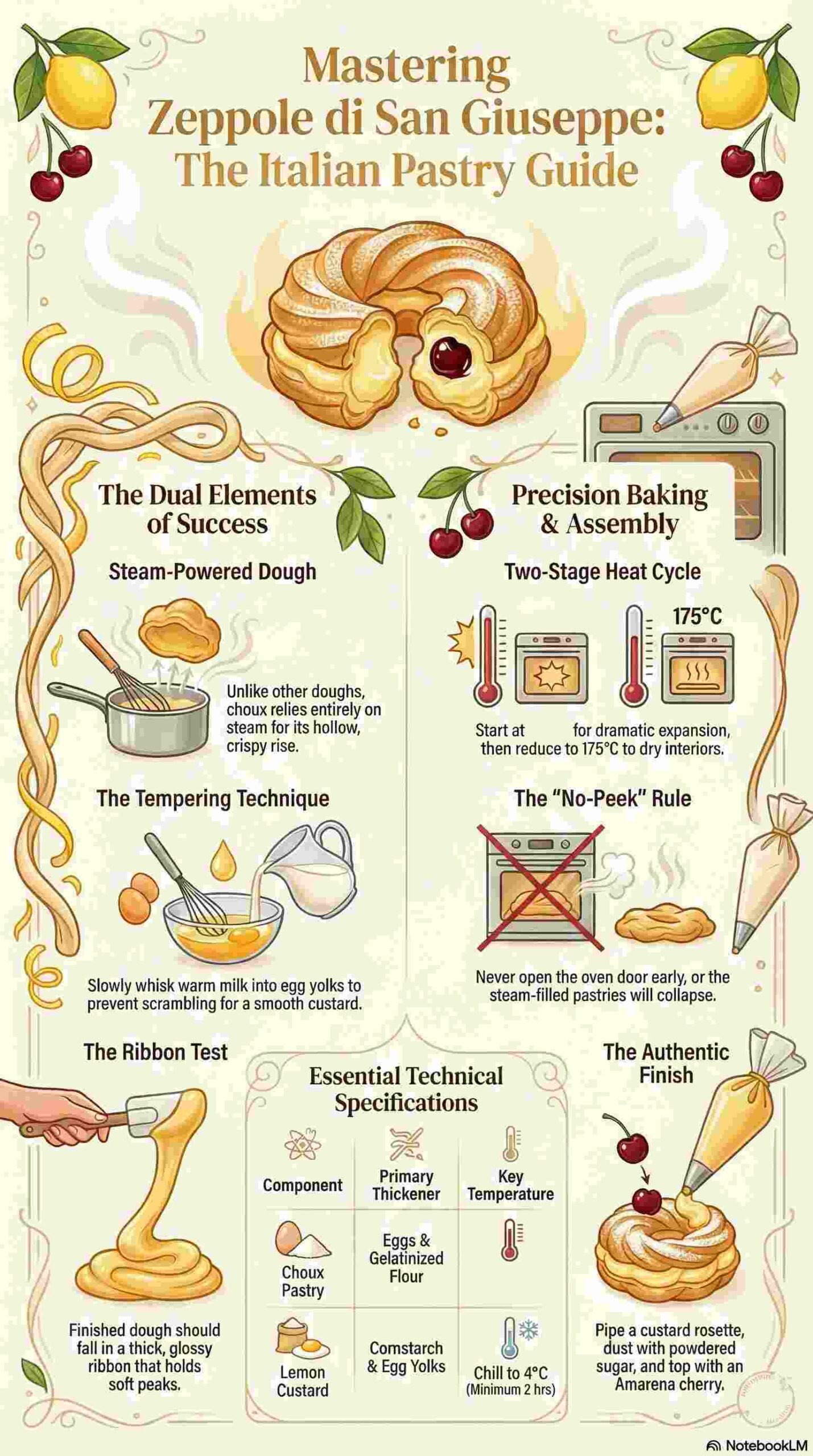
Technical Notes on Success
Several factors determine whether zeppole achieve proper texture and appearance:
Accurate measurements matter: Choux pastry relies on precise ratios. Measure ingredients carefully, particularly flour and liquid.
Complete incorporation at each step: When adding flour, stir until no dry flour remains. When adding eggs, beat until completely smooth before adding the next egg.
Proper paste consistency: The final choux paste should be smooth, glossy, and hold soft peaks. Too thick (insufficient egg) produces heavy, dense pastries. Too thin (too much egg) causes spreading and poor rise.
High initial heat is essential: The 200°C (400°F) temperature creates the rapid steam necessary for dramatic rise.
Never open the oven early: Opening releases steam and causes collapse. Wait until baking is complete.
Adequate baking time: Underbaked zeppole collapse when removed from the oven. They should be deeply golden and feel hollow.
Complete cooling before filling: Warm pastry will melt the custard and become soggy.
Custard consistency: The custard should be thick enough to pipe and hold its shape but not so stiff it’s difficult to work with.
Serving and Timing
This recipe makes 8 to 12 zeppole depending on size. They work beautifully for:
Celebrations: Traditional for St. Joseph’s Day (March 19), Father’s Day in Italy, but appropriate for any special occasion.
Dessert parties: Elegant individual portions that impress guests.
Gift giving: Lovely presented in a bakery box for sharing.
Make-ahead strategy: The custard can be made 2 days ahead. The choux shells can be baked early in the day and stored in an airtight container at room temperature. Fill just before serving for optimal texture.
Beverage pairings: Espresso, cappuccino, sweet dessert wine like Moscato d’Asti, or Prosecco all complement zeppole beautifully.
Storage
Unfilled shells: Store baked, cooled shells in an airtight container at room temperature for 1 day. They can also be frozen for up to 1 month; refresh in a 180°C (350°F) oven for 5 minutes after thawing.
Custard: Keeps refrigerated in an airtight container for up to 3 days.
Filled zeppole: Best consumed within 3 to 4 hours of filling. Refrigerate if necessary, but the pastry will soften. They do not store well overnight once filled.
Variations and Adaptations
Fried zeppole: The traditional method involves deep-frying the choux paste in hot oil (180°C/350°F) instead of baking. Fried versions have richer flavor and different texture.
Ricotta filling: Some regional versions use sweetened ricotta mixed with chocolate chips instead of custard.
Chocolate variation: Add cocoa powder to the custard or drizzle chocolate sauce over the finished zeppole.
Different citrus: Replace lemon peel with orange peel for different aromatic character.
Cream filling: Use whipped cream instead of custard for lighter, less rich version.
Miniature zeppole: Pipe smaller versions for bite-sized treats, adjusting baking time accordingly.
Cultural Context and Italian Tradition
Zeppole di San Giuseppe honor St. Joseph, patron saint of fathers, workers, and families. The tradition of making these pastries for his feast day (March 19) extends throughout Italy, with regional variations reflecting local preferences and available ingredients. In Naples and southern Italy, the baked custard-filled version predominates, while other regions favor fried versions or different fillings.
The pastries represent festive, celebratory food meant for sharing with family and community. Making zeppole is often a communal activity, with multiple generations gathering to prepare, fill, and enjoy them together. This social aspect reinforces family bonds and transmits culinary traditions across generations.
These zeppole with lemon vanilla custard demonstrate how classic pastry techniques, when properly executed, create impressive results from simple ingredients. The contrast between crispy, buttery choux pastry and smooth, lemon-scented custard, crowned with a bright cherry, produces a dessert that delights visually and gastronomically. It’s baking that honors tradition while remaining accessible to home cooks willing to learn fundamental techniques and follow them carefully.