
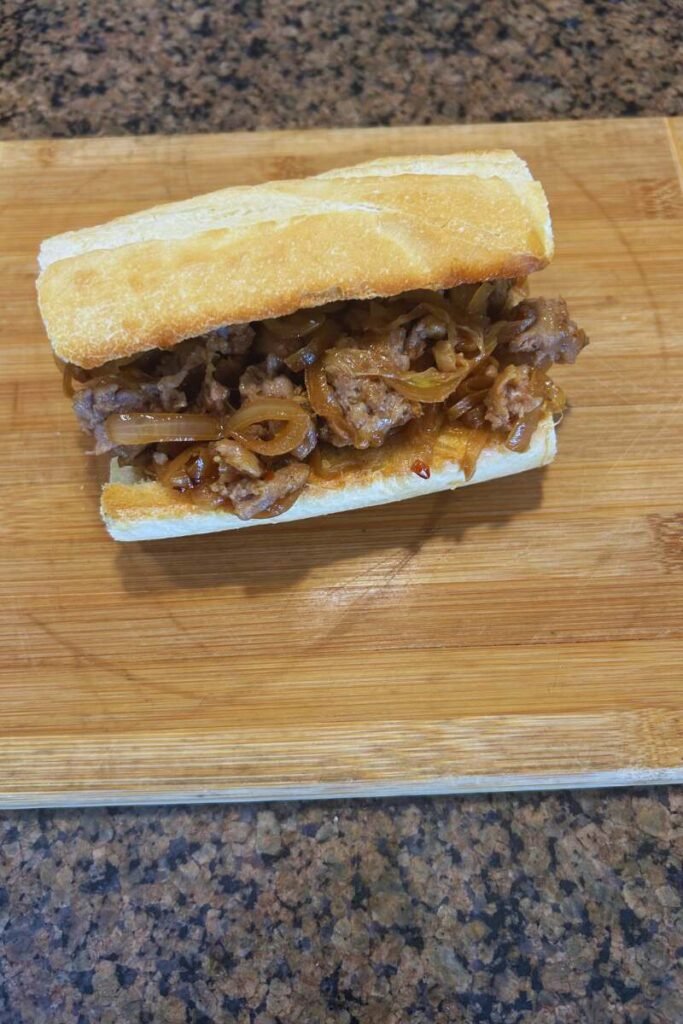
This Italian fennel sausage ciabatta transforms simple ingredients into something deeply satisfying through patient technique: fennel-scented sausages paired with sweet, jammy caramelized onions, all piled into crispy-crusted bread. The dish exemplifies how proper execution of fundamental techniques elevates everyday components.
Caramelizing onions properly requires time and restraint, allowing natural sugars to develop rich, complex sweetness without burning. The fennel sausage provides savory depth and subtle anise notes that complement the onions’ sweetness. Ciabatta’s sturdy structure and open crumb contain the filling without becoming soggy while providing textural contrast. The result is a sandwich that satisfies both as a quick lunch and a casual dinner 😋.
Understanding Caramelization and Flavor Development
Caramelization refers to the chemical transformation that occurs when sugars are heated, breaking down into hundreds of new flavor compounds that taste sweet, nutty, and complex. True caramelization requires sustained heat over extended time. The onions also undergo the Maillard reaction (browning of proteins and sugars together), creating additional savory, umami-rich flavors.
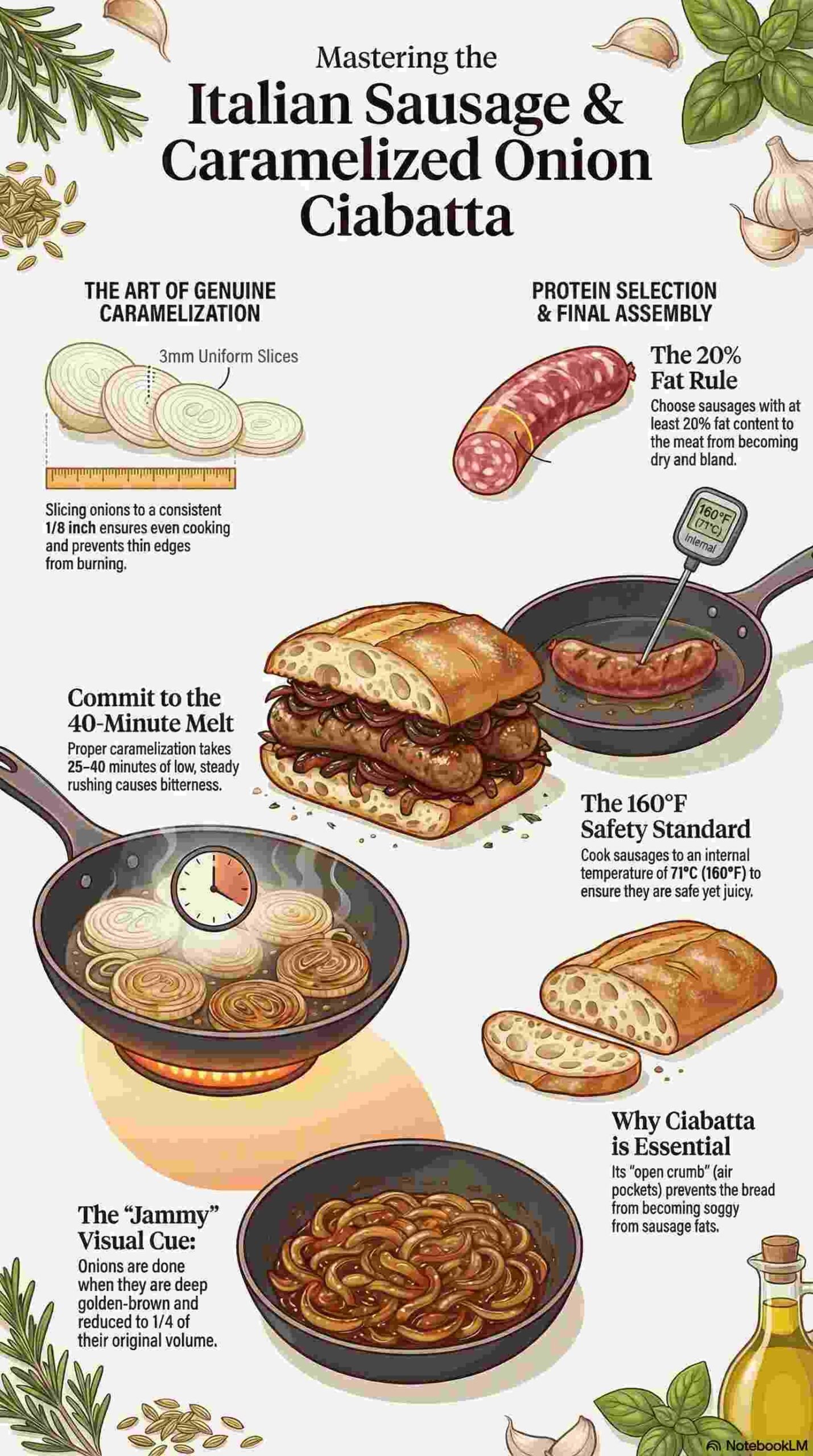
Many recipes claim caramelized onions in 10 to 15 minutes, but properly caramelized onions require 25 to 40 minutes of patient cooking. Rushing the process with high heat burns the exterior while leaving the interior raw, creating bitter rather than sweet flavors. Low, steady heat allows the onions to slowly release moisture, soften completely, and develop deep golden-brown color and jam-like consistency that defines genuine caramelization.
Italian sausage, particularly varieties containing fennel seed, provides traditional flavor that appears throughout Italian cooking from Sicily to Tuscany. The sausage’s fat renders during cooking, basting the meat and creating flavorful fond in the pan that can enhance the onions if cooked in the same vessel.
Ingredients
Ingredients for Italian Fennel Sausage Sandwich
For the Sandwich- 3 Italian fennel sausages (approximately 300–350g total)
- 2 large yellow or white onions (approximately 400–500g)
- 2–3 ciabatta rolls (or 1 large ciabatta loaf cut into portions)
- 3–4 tablespoons extra virgin olive oil
- Salt to taste
- Optional additions: provolone or fontina cheese, roasted red peppers, arugula
Ingredient Selection and Quality
Sausage Selection
Italian fennel sausage (salsiccia) provides authentic flavor with its characteristic fennel seed, garlic, and sometimes white wine or red pepper flakes. Look for fresh sausages from a quality butcher or Italian market rather than mass-produced supermarket varieties, which often contain fillers and inferior meat.
Sweet vs. hot: Italian sausage comes in sweet (mild) and hot (spicy) varieties. Sweet sausage contains no or minimal red pepper, while hot sausage includes significant red pepper flakes. Choose based on preference, or use a combination. Both work equally well with caramelized onions.
Meat quality matters: Quality sausage should contain at least 20% fat for proper flavor and moisture. Too-lean sausage becomes dry and bland. The meat should smell fresh and slightly spiced, never sour or off.
Casings: Natural casings (from animal intestines) provide superior texture and traditional appearance compared to collagen casings, though both work functionally. The casings should appear taut but not overstuffed.
If fennel sausage is unavailable, substitute other flavorful sausages like bratwurst or chorizo, though the flavor profile will differ from traditional Italian character.
Onion Selection and Preparation
Yellow or white onions work best for caramelizing due to their higher sugar content compared to red onions. Choose firm onions with papery, intact skins and no soft spots or sprouting. Larger onions are easier to slice uniformly than small ones.
The onions should be sliced relatively thin (approximately 3mm or ⅛ inch) but not paper-thin. Too-thick slices take longer to caramelize and may remain slightly crunchy, while too-thin slices can burn before developing proper flavor. Uniform thickness ensures even cooking.
Ciabatta Bread
Ciabatta, meaning “slipper” in Italian, offers ideal characteristics for this sandwich: crisp, flour-dusted crust and open, irregular crumb with large air pockets. The sturdy structure prevents the bread from becoming soggy from the sausage fat and onions, while the airy interior provides substantial texture without excessive density.
Fresh ciabatta from a bakery provides superior results to pre-packaged supermarket versions. The bread should feel relatively light for its size (indicating proper fermentation) with a crisp crust that yields to firm pressure. Day-old ciabatta works acceptably, particularly if toasted before assembly.
Olive Oil Quality
Extra virgin olive oil serves multiple functions: cooking medium for the onions, flavor contributor, and moisture element that prevents sticking. Use good-quality oil, though it need not be your finest bottle since extended cooking will mute its delicate flavors. According to the USDA Food Safety and Inspection Service, proper cooking of sausages to an internal temperature of 71°C (160°F) ensures food safety.
Method
Caramelize the Onions
1. Prepare the onions: Peel the onions and cut them in half from root to stem. Lay each half flat-side down and slice into thin half-moons approximately 3mm (⅛ inch) thick. Uniform slicing ensures even cooking.
2. Heat oil and add onions: Heat 2 to 3 tablespoons extra virgin olive oil in a large skillet or sauté pan (at least 25 to 30cm/10 to 12 inches in diameter) over medium-low heat. Add all the sliced onions and a generous pinch of salt (approximately ½ teaspoon). The salt helps draw out moisture and promotes even softening. Stir to coat the onions evenly with oil.
3. Begin slow cooking: Cook the onions over medium-low to low heat, stirring every 3 to 5 minutes. Initially, the onions will seem voluminous and raw. As they cook, they release moisture and begin to soften and reduce in volume. This process takes patience. The goal is gentle, sustained heat that slowly transforms the onions without burning.
4. Monitor and adjust heat: After 10 to 15 minutes, the onions should be significantly softened and translucent but still pale. If they’re browning quickly or sticking to the pan, reduce the heat. If they seem to be steaming rather than cooking, increase the heat slightly. The pan should maintain a gentle sizzle with occasional wisps of steam.
5. Continue cooking: Continue cooking, stirring every few minutes, for another 15 to 20 minutes. The onions will gradually turn golden, then light brown, then deep golden-brown. They should develop a jammy, soft consistency and sweet, complex aroma. If any bits stick to the pan bottom, add a splash of water and scrape them up (this fond adds flavor). The total cooking time is typically 25 to 35 minutes, sometimes longer depending on onion moisture content, pan size, and heat level.
6. Finish: The onions are done when they’re uniformly deep golden-brown, very soft and jammy in texture, and reduced to approximately one-quarter of their original volume. They should taste intensely sweet with no raw onion sharpness. Remove from heat and set aside. If making ahead, caramelized onions keep refrigerated for up to 5 days and reheat beautifully.
Cook the Sausages
1. Choose cooking method: You can cook the sausages in the same pan used for onions (after removing them) to capture flavorful fond, or use a separate pan. If using the same pan, there’s no need to clean it first; the sausage fat will incorporate any remaining onion bits.
2. Heat and add sausages: If using a clean pan, add 1 tablespoon olive oil and heat over medium heat. Add the sausages and cook, turning occasionally with tongs, for 12 to 18 minutes depending on thickness, until browned on all sides and cooked through completely. The sausages should reach an internal temperature of 71°C (160°F) when measured with an instant-read thermometer inserted into the center.
Properly cooked sausages feel firm when pressed and release clear (not pink) juices when pierced. The casings should be browned and slightly crispy, while the interior remains moist and flavorful.
3. Rest and slice: Transfer the cooked sausages to a cutting board and let rest for 2 to 3 minutes. This allows juices to redistribute. Slice each sausage lengthwise (butterfly-style) to open it flat, or cut into thick diagonal slices. Butterflying creates more surface area and makes the sandwich easier to eat, while slicing maintains more traditional sausage presentation.
Assemble the Sandwiches
1. Prepare the bread: Slice the ciabatta rolls or loaf portions horizontally to create top and bottom halves. If desired, lightly toast the cut sides under the broiler or in a dry pan for 1 to 2 minutes until slightly crisp. Toasting creates additional textural contrast and helps prevent the bread from absorbing too much moisture, though it’s optional.
Some people prefer to drizzle the cut bread lightly with olive oil before or after toasting for additional richness.
2. Layer the sausage: Place the sausages (sliced lengthwise or into pieces) on the bottom half of each ciabatta. If you butterflied them, lay them flat for maximum coverage. The sausage should cover most of the bread surface.
3. Add caramelized onions: Spoon the caramelized onions generously over the sausages. Be generous; the sweet onions provide essential contrast to the savory, fatty sausage. Distribute them relatively evenly so each bite receives onion.
4. Optional additions: At this point, you can add cheese (provolone or fontina work beautifully, melting slightly from the warm sausage), roasted red peppers for sweetness and color, or a handful of fresh arugula for peppery contrast and freshness.
5. Close and serve: Place the top half of the ciabatta over the filling and press down gently. The sandwich is ready to eat. For easier handling, wrap the sandwich in parchment paper or foil, which helps hold everything together during eating and contains any drips. Cut large sandwiches in half diagonally if desired.
Technical Notes on Success
Several factors determine whether this sandwich achieves proper balance and flavor:
Patience with onions is essential: Rushing caramelization produces onions that taste sharp, bitter, or merely sautéed rather than sweet and complex. Allow adequate time.
Low heat prevents burning: High heat creates surface browning before the interior softens, resulting in burnt, bitter flavor. Sustained low heat develops proper caramelization.
Stir regularly but not constantly: Stirring every few minutes allows the onions to develop some browning between stirs. Constant stirring prevents browning; insufficient stirring causes burning.
Cook sausages thoroughly but not excessively: Undercooked sausage poses food safety risks, while overcooked sausage becomes dry and tough. Use a thermometer for certainty.
Quality bread matters: Stale, dense, or overly soft bread compromises the sandwich. Proper ciabatta with crisp crust and open crumb makes significant difference.
Generous onion application: The onions aren’t merely a condiment but a co-star. Use plenty to balance the rich sausage.
Serving Suggestions
This recipe makes 2 to 3 substantial sandwiches depending on bread size. The sandwich works for various occasions:
Casual lunch: Serve with potato chips, pickle spears, or a simple green salad.
Game day food: The sandwich travels well and satisfies hungry crowds.
Quick dinner: Pair with soup or roasted vegetables for a complete meal.
Picnic fare: The sandwich holds together well if wrapped tightly. Pack the components separately and assemble on-site for maximum freshness if preferred.
Beverage pairings: Italian beer, red wine (Chianti, Barbera, or Sangiovese), or sparkling water with lemon all complement the sandwich well.
Variations and Adaptations
This basic formula accommodates numerous variations:
Cheese additions: Provolone (sharp or mild), fontina (nutty and melting), mozzarella (mild and stretchy), or gorgonzola (bold and creamy) all work beautifully.
Pepper additions: Sautéed bell peppers (red, yellow, or green) add sweetness and color. Pickled pepperoncini or cherry peppers contribute heat and acidity.
Greens: Fresh arugula, spinach, or shredded radicchio add freshness and textural contrast.
Mustard: Whole-grain or Dijon mustard spread on the bread adds tangy complexity.
Different sausages: Bratwurst, chorizo, merguez, or other flavorful sausages create different ethnic variations.
Balsamic addition: A drizzle of aged balsamic vinegar over the onions adds acidity and complexity.
Garlic enhancement: Add minced garlic to the onions during the last 5 minutes of caramelization for additional depth.
Apple or pear: Thin apple or pear slices add fruity sweetness that complements the onions and sausage.
Different breads: Focaccia, baguette, hoagie rolls, or rustic sourdough all work well if ciabatta is unavailable.
Storage and Make-Ahead Strategy
Caramelized onions: Prepare up to 5 days ahead. Store in an airtight container in the refrigerator. Reheat gently before using or use at room temperature.
Cooked sausages: Cook up to 2 days ahead. Store refrigerated and reheat before assembling sandwiches, or slice and use cold.
Assembly timing: For best results, assemble sandwiches just before serving. Pre-assembled sandwiches can become soggy as the bread absorbs moisture from the filling. If you must assemble ahead, wrap tightly and refrigerate for no more than 2 to 3 hours.
Leftover sandwiches: Refrigerate wrapped sandwiches for up to 1 day. The bread will soften but the sandwich remains edible. Reheat in a 180°C (350°F) oven for 10 minutes to restore some crispness.
Cultural Context and Italian Sandwich Tradition
Italian sandwich culture emphasizes quality ingredients simply prepared rather than elaborate constructions with excessive condiments. Regional Italian sandwiches like porchetta rolls, sausage and peppers, and panini variations all follow similar principles: excellent bread, flavorful proteins, minimal but strategic additions, and respect for ingredient quality.
Sausage and onions represent a classic Italian-American combination that originated with Italian immigrants adapting traditional preparations to new contexts. The pairing appears at street fairs, festivals, and casual eateries throughout Italian-American communities, becoming iconic comfort food that bridges Old World techniques with New World accessibility.
The sandwich also demonstrates efficient home cooking: the components can be prepared separately and combined quickly, making it ideal for weeknight meals or weekend gatherings. The caramelized onions in particular exemplify cook-once-use-multiple-times efficiency, as a large batch enriches sandwiches, pasta, pizza, and numerous other preparations throughout the week.
This sausage and caramelized onion ciabatta demonstrates how fundamental techniques elevate simple ingredients into something memorable. The interplay of savory, fatty sausage with sweet, jammy onions, all contained in crispy-crusted bread, creates satisfaction that belies the straightforward preparation. It’s cooking that honors quality ingredients through proper technique, producing results that taste considerably more complex than the minimal effort required.