
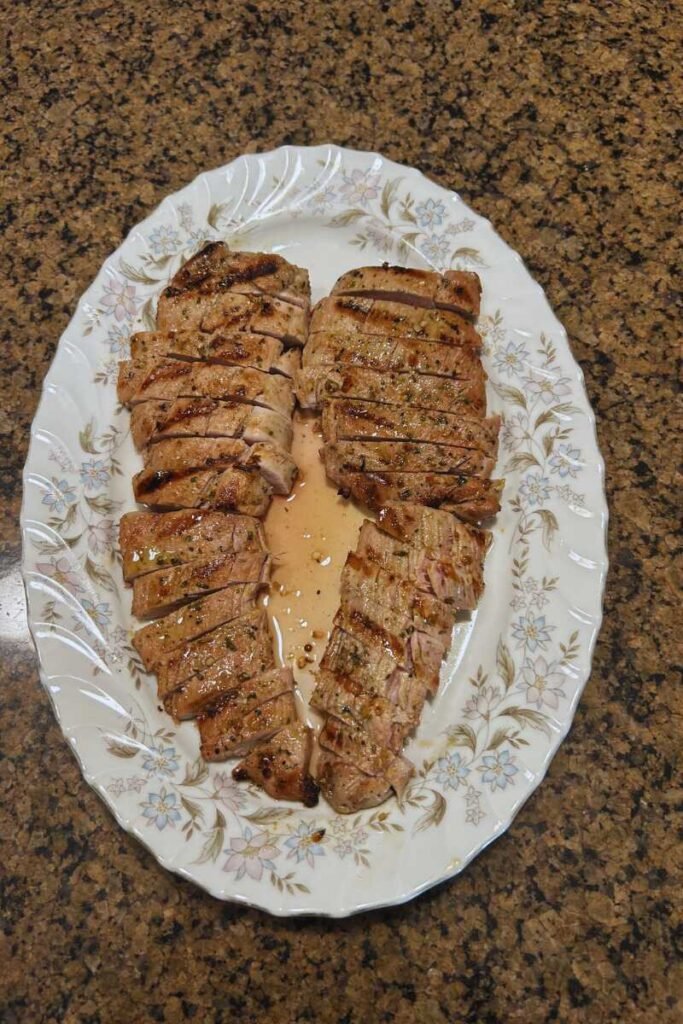
BBQ Grilled Pork Loin with Herb Marinade & Olive Oil Finish transforms a lean, often dry cut into succulent, flavorful meat through strategic marinating, two-zone grilling, and a finishing touch of quality olive oil and flaky salt. Cutting the loin into smaller pieces before marinating increases surface area for flavor absorption and reduces cooking time, while the marinade’s combination of olive oil, vinegar, and aromatics helps tenderize and season the meat.
The two-zone grilling technique, searing over high heat followed by gentle finishing over indirect heat, creates a beautifully caramelized exterior while keeping the interior moist and perfectly cooked. The final drizzle of raw extra virgin olive oil and a sprinkle of salt add richness and a clean, bright finish that takes the pork from simple to standout.
Understanding Pork Loin and Grilling Technique
Pork loin, a long, cylindrical cut from the back of the pig, offers lean, mild-flavored meat that’s economical and feeds crowds efficiently. However, its leanness (containing minimal intramuscular fat) makes it prone to drying out with improper cooking. Unlike fattier cuts like pork shoulder that remain moist through long cooking, pork loin requires careful attention to temperature and resting.
The two-zone grilling method addresses pork loin’s challenges: high heat creates flavorful browned crust through the Maillard reaction, while indirect heat allows the interior to reach proper doneness without burning the exterior. Cutting the loin in half before cooking reduces the thick diameter that would otherwise require excessive cooking time, during which the exterior overcooks while the center reaches temperature.
Modern food safety guidelines have updated pork cooking temperatures. According to the USDA Food Safety and Inspection Service, pork can be safely consumed at 145°F (63°C) followed by a 3-minute rest, a significant reduction from older recommendations of 160°F that produced dry, overcooked meat.
Ingredients
Ingredients
For the Pork- 1 whole pork loin (approximately 1 to 1.5kg), cut into 2 equal pieces
- Salt for seasoning before grilling and finishing (use flaky sea salt for finishing if available)
- 3 tablespoons extra virgin olive oil
- 2 tablespoons red wine vinegar
- 1 teaspoon garlic powder
- 1 teaspoon onion powder
- 1 to 2 teaspoons fresh rosemary, finely chopped (or 1 teaspoon dried rosemary, crushed)
- 1 teaspoon freshly ground black pepper
- 2 to 3 tablespoons high-quality extra virgin olive oil
- Flaky sea salt (such as Maldon) or coarse salt
Ingredient Selection and Quality
Pork Loin Selection
Choose pork loin with some visible fat cap (the thin layer of fat on one side), which helps keep the meat moist during cooking. The meat should be pink-red with firm texture and no off odors. “Center-cut” pork loin offers the most uniform thickness, though any pork loin works with this method.
Pork labeled “enhanced” or “self-basting” has been injected with salt solution and is best avoided, as the added liquid affects texture and makes controlling seasoning difficult. Look for “natural” pork without additives.
Heritage breed pork (such as Berkshire or Duroc) offers superior marbling and flavor compared to conventional pork, though it costs more. Organic or pasture-raised pork provides better flavor and texture than conventional factory-farmed pork.
Marinade Components
Extra virgin olive oil carries fat-soluble flavors into the meat while helping the pork stay moist during grilling. Use good quality oil, though not your finest bottle as high heat will mute delicate flavors.
Red wine vinegar provides acidity that tenderizes the meat’s proteins while adding tangy brightness. Balsamic vinegar or apple cider vinegar can substitute if preferred.
Garlic and onion powder distribute evenly in marinades better than fresh minced garlic and onion, which can burn during searing. Quality powders without anti-caking agents offer best flavor.
Fresh rosemary provides aromatic, slightly piney character that pairs classically with pork. Dried rosemary works but should be crushed between fingers to release oils. Other herbs like thyme, sage, or oregano can supplement or replace rosemary.
Finishing Olive Oil
Reserve your best extra virgin olive oil for the finishing drizzle, where its flavor will be showcased without heat damage. Look for fresh oil (harvest date within the past year) with fruity, complex character. According to the North American Olive Oil Association, high-quality extra virgin olive oil should be stored properly away from heat and light to maintain its flavor and beneficial properties.
Method
Prepare the Marinade
1. Combine marinade ingredients: In a small bowl, whisk together the 3 tablespoons olive oil, 2 tablespoons red wine vinegar, 1 teaspoon garlic powder, 1 teaspoon onion powder, 1 to 2 teaspoons chopped fresh rosemary (or 1 teaspoon crushed dried rosemary), and 1 teaspoon black pepper until well combined. The mixture should emulsify slightly, creating a relatively smooth liquid.
Prepare and Marinate the Pork
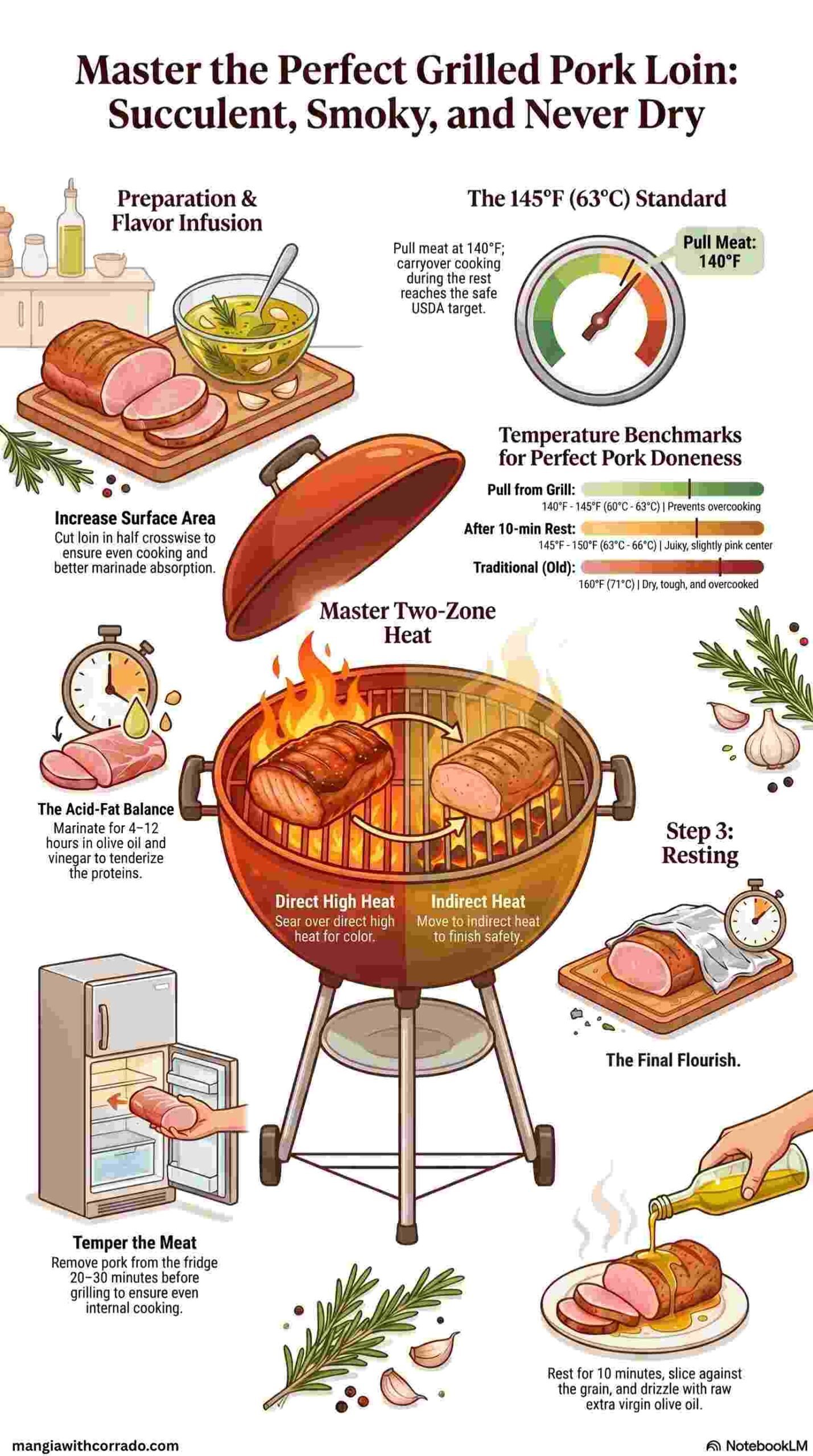
1. Cut the pork loin: Using a sharp knife, cut the pork loin crosswise into 2 equal pieces. This creates two shorter, more manageable portions that cook more evenly than one long piece.
2. Apply marinade: Place the pork pieces in a large zip-top bag or shallow dish. Pour the marinade over the pork, turning and rubbing to coat all surfaces thoroughly. If using a bag, seal it and massage the marinade into the meat. If using a dish, turn the pieces several times to ensure even coating.
3. Marinate: Refrigerate for at least 1 hour, though 4 to 12 hours produces best results. Longer marination allows flavors to penetrate more deeply and the acid to tenderize the meat. Turn the pork pieces once or twice during marination if possible. Don’t marinate longer than 24 hours, as excessive acid exposure can make the exterior mushy.
4. Bring to room temperature: Remove the pork from refrigeration 20 to 30 minutes before grilling. This allows the meat to come closer to room temperature, promoting more even cooking. Cold meat straight from the refrigerator cooks unevenly, with overcooked exterior and undercooked center.
Prepare the Grill
1. Set up two-zone fire: Preheat your grill (gas or charcoal) to 190 to 205°C (375 to 400°F). Create two distinct heat zones:
Hot zone (direct heat): For gas grills, leave burners on high on one side. For charcoal grills, bank all coals to one side, creating a hot zone where flames are directly under the grate.
Cool zone (indirect heat): For gas grills, turn off or set to low the burners on the other side. For charcoal grills, leave the other side empty of coals, creating an area without direct flame underneath.
2. Clean and oil grates: Brush the grill grates clean with a wire brush. Fold a paper towel, dip it in oil, and using tongs, rub it across the grates to create a non-stick surface.
Season and Grill
1. Pat and season: Remove the pork from the marinade and lightly pat off excess marinade with paper towels. You want some marinade clinging to the meat but not dripping excessively, which causes flare-ups. Season both pieces generously on all sides with salt just before grilling.
2. Sear over high heat: Place the pork pieces over the hot zone of the grill. Close the lid and sear for 2 to 3 minutes undisturbed. Open the lid, turn the pork 90 degrees to create crosshatch grill marks, close the lid, and sear another 2 to 3 minutes. Flip the pork and repeat on the other side. The goal is deeply browned, caramelized exterior on all sides. Watch for flare-ups from dripping marinade; if flames become excessive, temporarily move the pork to the cool zone.
3. Move to indirect heat: Once all sides are nicely seared, move the pork pieces to the cool zone (indirect heat area) of the grill. Close the lid.
4. Cook to temperature: Continue cooking over indirect heat, turning the pieces every 5 to 7 minutes for even cooking, for 15 to 25 minutes total (including searing time) depending on the thickness of your pork pieces. The pork is done when an instant-read thermometer inserted into the thickest part reads 60 to 63°C (140 to 145°F).
Cooking times vary based on several factors: initial meat temperature, grill temperature, piece thickness, and weather conditions. Start checking temperature after 15 minutes total cooking time. The pork will continue cooking during rest (carryover cooking), reaching final temperature of approximately 63 to 66°C (145 to 150°F).
Rest, Slice, and Finish
1. Rest the pork: Remove the pork from the grill when it reaches 60 to 63°C (140 to 145°F). Transfer to a cutting board and tent loosely with aluminum foil. Let rest for 10 minutes. This resting period allows juices to redistribute throughout the meat; cutting immediately causes juices to run out, creating dry pork.
2. Slice against the grain: After resting, examine the pork to identify the direction of the muscle fibers (the grain). Using a sharp knife, slice the pork against (perpendicular to) the grain into pieces approximately 1 to 1.5cm (⅜ to ½ inch) thick. Slicing against the grain shortens the muscle fibers, creating more tender texture than slicing with the grain.
3. Arrange and finish: Arrange the sliced pork on a serving platter, slightly overlapping the slices. Drizzle generously with high-quality extra virgin olive oil (2 to 3 tablespoons total). Sprinkle with flaky sea salt or coarse salt. The raw olive oil adds luxurious richness and fruity flavor, while the salt provides bursts of bright salinity that enhance every bite.
4. Serve: Serve immediately while warm. The pork can also be served at room temperature, which actually showcases the olive oil’s flavor more prominently.
Technical Notes on Success
Several factors determine whether grilled pork loin achieves proper texture and flavor:
Don’t skip marinating: Even 1 hour makes significant difference in flavor and tenderness. Longer is better up to 12 to 24 hours.
Bring to room temperature: Cold meat from the refrigerator cooks unevenly. The 20 to 30 minute rest at room temperature promotes even cooking.
Two-zone grilling is essential: Searing over direct heat followed by indirect heat finishing prevents burnt exterior with raw interior.
Use a thermometer: Guessing doneness leads to overcooked, dry pork. An instant-read thermometer ensures perfect results.
Don’t overcook: Modern safe temperature for pork is 145°F (63°C), significantly lower than outdated guidelines. Pork at this temperature is slightly pink in the center and juicy.
Rest before slicing: The 10-minute rest is non-negotiable for juicy results.
Slice against the grain: This creates tender texture. Slicing with the grain produces stringy, tough bites.
Quality finishing oil matters: The final olive oil drizzle is a primary flavor component, not optional garnish. Use your best oil.
Serving Suggestions
This recipe serves 6 to 8 people depending on portion sizes.
Side dishes: Grilled vegetables, roasted potatoes, coleslaw, green salad, grilled corn, or grain salads all complement the pork beautifully.
Sauces (optional): While the olive oil finish is traditional and delicious, you can also serve with chimichurri, salsa verde, or mustard sauce on the side.
Leftover uses: Sliced pork makes excellent sandwiches, tacos, salads, or pasta additions.
Wine pairings: Medium-bodied whites like Chardonnay or Viognier, or light to medium reds like Pinot Noir, Grenache, or Barbera complement the herb-marinated pork.
Variations and Adaptations
Different herb blends: Replace rosemary with thyme, sage, oregano, or a combination. Add fennel seeds for Italian character.
Citrus marinade: Add lemon or orange zest to the marinade for bright citrus notes.
Spicy version: Add red pepper flakes or cayenne to the marinade for heat.
Asian-inspired: Use sesame oil, soy sauce, ginger, and garlic in the marinade; finish with sesame oil and scallions instead of olive oil and salt.
Maple-Dijon: Add Dijon mustard and a touch of maple syrup to the marinade.
Balsamic version: Replace red wine vinegar with balsamic vinegar for sweeter, more complex marinade.
Oven-roasted adaptation: If grilling isn’t possible, sear the marinated pork in a hot oven-safe skillet, then transfer to a 200°C (400°F) oven to finish cooking to temperature.
Storage and Reheating
Refrigeration: Cool completely and refrigerate sliced or whole pork in an airtight container for up to 4 days.
Serving cold: Leftover pork tastes excellent cold or at room temperature in sandwiches or salads.
Reheating: Reheat gently in a 165°C (325°F) oven for 10 to 15 minutes until warmed through, or slice and reheat quickly in a skillet. Avoid microwave reheating if possible, as it can make the pork tough.
Freezing: Freeze cooked, cooled pork wrapped tightly for up to 3 months. Thaw in refrigerator before reheating.
Cultural Context and Grilling Tradition
Grilled pork loin represents modern outdoor cooking culture where proper technique transforms economical cuts into impressive results. The two-zone grilling method, finishing with quality olive oil, and understanding proper pork temperatures reflect how home cooks have elevated their skills through increased access to culinary education and quality ingredients.
The olive oil and salt finish draws from Italian tradition, where high-quality raw olive oil is considered essential to bringing out food’s best qualities. This simple finishing treatment, common in Italian cooking, demonstrates that luxury doesn’t require complexity when ingredients and technique are sound.
This BBQ grilled pork loin demonstrates how fundamental techniques—proper marinating, two-zone grilling, accurate temperature monitoring, and thoughtful finishing—transform a lean, potentially dry cut into succulent, flavorful meat.
The combination of caramelized exterior, juicy interior, aromatic herbs, and luxurious olive oil finish creates a dish that satisfies while remaining straightforward enough for regular preparation.
It’s cooking that respects the ingredient while understanding that pork loin achieves its full potential through techniques that protect its leanness while developing complex flavor.