
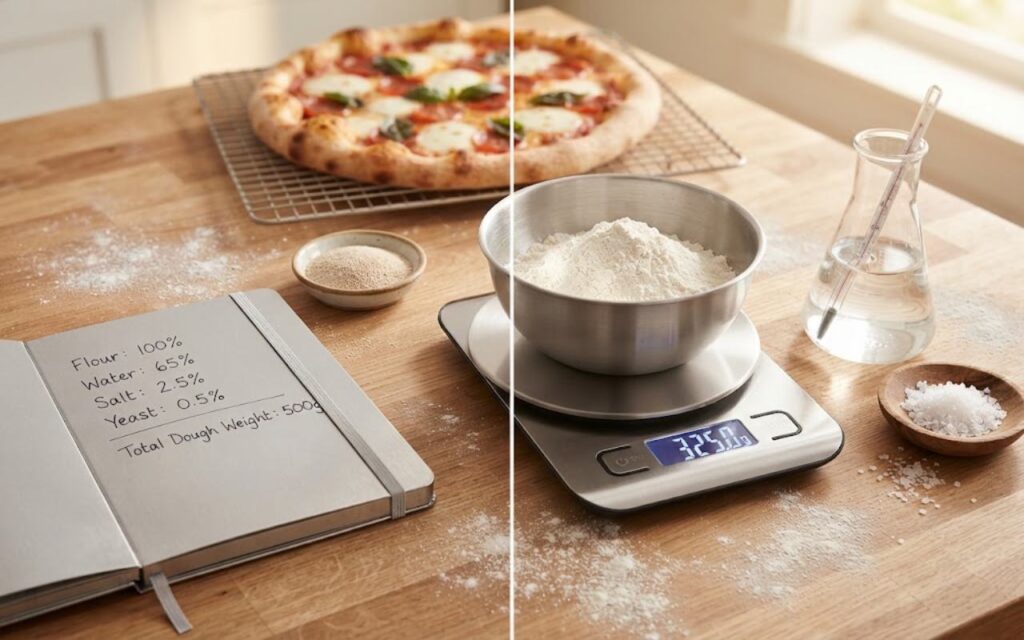
When stepping into the world of artisan baking, utilizing a traditional cookbook recipe written in cups, teaspoons, and fluid ounces will quickly lead to dense, unpredictable crusts. To achieve complete consistency every single weekend, you must master the mathematical language of the modern pizzaiolo. This foundational system is known as bakers percentages pizza dough formulation.
Baker’s percentages are not arbitrary fractions; they are a standardized mathematical ratio where the total weight of the flour always represents exactly 100%. Every other ingredient, whether it is water, salt, olive oil, or yeast, is calculated explicitly as a weight ratio relative to that initial flour base.
Using this interactive scaling engine allows you to bypass complex long-form division and visualize how individual ingredient ratios directly dictate your final batch mass. Below, we break down the simple molecular math of baking percentages and how to leverage this framework to scale any recipe flawlessly.
🧮 Baker’s Percentage Translator
Interactive Ratio-to-Grams Engine
Configure Custom Ratios
Translated Batch Ratios
The Core Math Principle: Flour is the 100% Invariant Anchor
The fundamental concept behind bakers percentages pizza dough formulation is that flour is always exactly 100%. It does not matter if you are using 500 grams of flour or 50 kilograms of flour; that total flour amount is the baseline integer anchor point that every single surrounding value is measured against.
This is where beginners often get completely tripped up. In standard arithmetic, percentages must add up to a combined final total of 100%. In professional culinary baker’s math, the total sum of your recipe percentages will regularly hit 165% to 180%.
For example, let’s look at a traditional, field-tested artisan pizza formulation matrix:
- Flour: 100% (The base anchor value)
- Water: 65% (Hydration ratio)
- Sea Salt: 2.5% (Salinity value)
- Instant Yeast: 0.5% (Leavening profile)
- Total Recipe Ratio Sum: 168%
To translate these flat percentage metrics into precise gram values, you do not calculate fractions of the total finished dough target weight. Instead, you determine the base weight of your flour first by dividing your target batch weight by the sum of your combined percentages (expressed as a decimal, e.g., 1.68).
If you are looking to run complex multi-stage fermentation calculations—such as automatically splitting your flour weights into an overnight preferment phase—head over to our full unrestricted master pizza dough calculator.
Why Volumetric Measurements Ruin Pizza Crusts
If you ask any professional baker why they refuse to use cups, spoons, or liquid ounces, they will explain the physical law of density variation. Flour is highly compressible. A cup of flour scooped straight from a tightly packed paper bag can weigh up to 160 grams. However, a cup of flour sifted into a bowl and lightly swept with a knife might weigh as little as 120 grams.
That is an invisible 33% variance inside a single cup measurement. If your recipe calls for three cups of flour, you could easily be off by over 100 grams of structural material without realizing it.
This variance completely breaks your hydration balance. If your flour weight runs high, a calculated 65% hydration recipe will drop to an actual 52% on your counter, leaving you with a stiff, dense dough ball that refuses to rise or stretch. Weighing your elements in grams down to two decimal places guarantees absolute replication, regardless of environmental factors.
Step-by-Step Baker’s Percentage Math Breakdown
If you want to manually run the math behind your interactive bakers percentages pizza dough translator, follow this exact arithmetic sequence:
- Step 1: Determine Your Combined Decimal Factor: Add all your targeted ingredient percentages together. For a standard recipe (100% flour + 65% water + 2.5% salt + 0.4% yeast), your total ratio sum is 167.9%. Convert this to a decimal divisor by moving the decimal point two spots to the left: 1.679.
- Step 2: Isolate the Master Flour Weight: Divide your targeted target batch weight by your decimal factor. If you want a 1,000-gram final dough yield, run:
1000 / 1.679 = 595.59 grams of flour.
- Step 3: Extract the Auxiliary Weights: Now that you know your flour mass represents 100%, multiply it by your individual component percentages to get your final gram limits:
Water Weight (65%): 595.59g × 0.65 = 387.13g
Salt Weight (2.5%): 595.59g × 0.025 = 14.89g
Yeast Weight (0.4%): 595.59g × 0.004 = 2.38g
Matching Your Formulas to Your Oven Architecture
Once you have mastered tracking and adjusting your baker’s ratios, you can customize your final recipe outputs to fit your specific heat source.
If your calculator targets a low hydration ratio (60% to 62%), your dough is highly optimized for extreme convective gas or wood configurations. If you choose to elevate your hydration levels past 66% up to 72%, your recipe becomes perfectly optimized for lower ambient household oven baking steel setups.
The excess moisture protects the crumb from drying out during the longer residential bake window, ensuring your interior stays beautifully light, pillowy, and soft.
🔥 Ready to take your artisan baking to the absolute limit? Tracking your baker’s percentages down to the exact decimal gram ensures your dough handles perfectly, but executing that recipe requires a balanced thermal engine. Check out my comprehensive, real-world testing review of the Best Pizza Ovens for Home Use to see how modern portable outdoor and countertop electric models manage precision floor deck temperatures to char artisan hydrations flawlessly.