
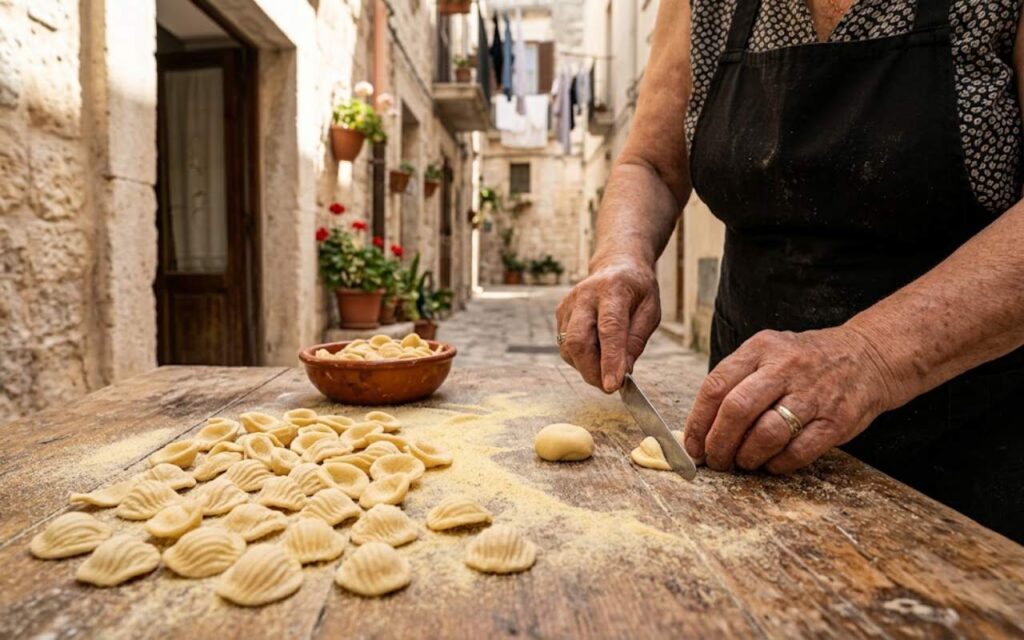
What is orecchiette? To truly answer that, you have to look past the textbooks and step into the sun-bleached alleys of Bari Vecchia, where local home cooks shape stiff semolina dough over worn wooden workbenches.
Translating literally to “little ears,” this concave pasta archetype represents one of southern Italy’s greatest functional engineering achievements in starch design. Its asymmetrical profile creates a dual-texture eating experience that industrial factory dies struggle to replicate.
While commercial dried alternatives line supermarket shelves, genuine hand-dragged orecchiette possesses a unique physical topography specifically developed to capture dense condiments. For home cooks struggling with watery vegetable sauces pooling at the bottom of the bowl, mastering this shape unlocks restaurant-level sauce integration.
Semolina Hydration Ratios and Gluten Structure in Apulian Dough
Traditional orecchiette relies entirely on durum wheat semola rimacinata, a re-milled durum flour characterized by an amber color and a high protein content between 12% and 14%. Unlike soft wheat flour, semolina absorbs warm water slowly, requiring an exact hydration threshold to form a cohesive, pliable mass.
Home cooks frequently encounter crumbling dough because they measure by volume rather than mass, or because their ambient room humidity pulls moisture out of the flour during kneading.
- Durum semola rimacinata: 100% base flour with a minimum 13% protein threshold.
- Water hydration target: 50% warm water (between 45 and 50 degrees Celsius) calculated by flour weight.
- Sodium chloride: 1% fine sea salt to tighten the protein matrix and enhance tensile strength.
- Bench rest duration: 30 to 45 minutes wrapped hermetically in plastic film to avoid skinning.
Because durum wheat contains high levels of glutenin and gliadin, the hydration requires warm water to accelerate protein bonding without eggs. The absence of egg fat is intentional; fat molecules would coat the starch granules and create a smooth, slick exterior that repels water-based vegetable purées.
A well-hydrated semolina dough feels stiff like modeling clay, offering enough resistance to hold its structural dome without slumping.
Surface Geometry and Cup Cavity Mechanics for Sauce Adhesion
| Pasta Shape | Geometric Profile | Primary Surface Texture | Hydrodynamic / Coating Role |
|---|---|---|---|
| Hand-Formed Orecchiette | Concave dome, thin center, thick rim | Coarse, striated exterior; smooth interior | Pockets heavy brassicas, coarse sausage meat, and chunky vegetable purées. |
| Bronze-Die Rigatoni | Linear hollow cylinder with external ridges | Uniform, micro-abrasive extruded surface | Traps smooth ragùs, dairy emulsifications, and suspended minced meats inside the tube. |
| Trofie | Tightly twisted solid spindle | Dense, tapered helical crevice | Grips highly emulsified herb pestos and light vegetable coatings. |
| Pappardelle | Wide, flat ribbon | Broad, flat surface plane | Carries heavy braised game reductions, ragùs, and rich animal fats via surface tension. |
The structural success of orecchiette relies entirely on hydrodynamic cupping and variable wall thickness. The recessed pocket acts as a physical scoop for particulate matter like braised turnip tops, softened garlic, and ground meat. Simultaneously, the thicker outer rim maintains a firm chew, preventing the pasta from collapsing into a flat disk during the final toss.
Industrial pasta extruders push dough through bronze dies to create a uniform, circular shape, but they miss the tactile variation created by hand friction. A machine-extruded orecchietta exhibits equal thickness across its entire diameter, which leads to overcooked edges or hard, chalky centers.
Hand-formed pieces possess a paper-thin center that cooks rapidly and a dense perimeter that delivers a persistent, toothsome bite.
Knife Drag Friction and Mechanical Texture Variances
The signature roughness of handmade orecchiette comes from dragging a serrated or straight table knife across a small nugget of dough on an unpolished surface. Home cooks often fail at this step by working on stainless steel or silicone baking mats, which offer zero frictional drag. Without friction, the dough skids rather than stretching, producing a smooth, dense lump instead of a textured curl.
- Table knife angle: 45-degree blade tilt relative to the work surface to generate mechanical drag without slicing.
- Wooden board selection: Unfinished birch or beech wood, avoiding polished marble or non-stick silicone mats.
- Inversion technique: Thumb-tip counter-pressure applied immediately to the convex side to pop the dome outward.
- Thickness gradient: 1 millimeter at the thin center, tapering up to 2 millimeters along the exterior circumference.
The drag motion creates micro-striations on the exterior face of the pasta, known locally as the riga. These tiny fissures dramatically increase the total surface area of each piece, giving vegetable starches and emulsified fats microscopic ledges to grip. When the piece is inverted over the thumb, the interior remains comparatively smooth, creating a pressure differential that pulls loose sauce directly into the cup.
Emulsification Dynamics with Brassica Greens and High-Polyphenol Fats
The definitive preparation for this shape is orecchiette con cime di rapa, a dish that demonstrates foundational food physics rather than culinary luxury. Brassica greens like broccoli rabe or turnip tops contain tough structural cellulose and bitter glucosinolates that soften only after boiling.
Cooking the greens directly in the salted pasta water leaches out water-soluble starches and plant pectins, creating a natural thickening broth.
- Rapini or broccoli rabe: Stems peeled and leaves trimmed into bite-sized segments.
- Cooking medium: 4 to 5 liters of boiling water salted at 10 grams per liter.
- High-polyphenol extra virgin olive oil: 60 milliliters featuring pungent green profiles like Coratina olives.
- Aromatic base: Thinly sliced garlic cloves and oil-cured anchovy fillets dissolved over low thermal heat.
When the blanched greens and parboiled orecchiette finish cooking together in a skillet of hot oil and dissolved anchovies, a rapid mechanical emulsion forms. The high levels of free amylose starch sloughed off the pasta join with the oil and plant pectins to create an opaque sauce.
Because orecchiette lacks dairy fats like butter or heavy cream, this starch-and-oil suspension provides the sole vehicle for rich, coating mouthfeel.
Thermal Retention and Skillet Mantecatura Troubleshooting
The final hurdle in cooking orecchiette is the mantecatura, the vigorous agitation phase where pasta and sauce marry in the skillet. Many cooks drain their pasta completely in a colander, discarding the cooking water and allowing the pasta surface to cool and dry out. Once the surface dries, the starch matrix re-hardens, preventing the sauce from penetrating the pasta wall.
- Skillet thermal baseline: Heavy stainless steel or carbon steel maintaining continuous bubbling without scorching.
- Starch transfer timing: Scooping orecchiette two minutes before full al dente to finish directly in the boiling sauce.
- Slurry correction: Adding reserved cooking water in 30-milliliter increments while continuously tossing the pan.
- Fat balance check: Removing the pan from direct flame before swirling in raw olive oil to prevent thermal phase separation.
If your sauce breaks into a pool of greasy oil beneath pale pasta, the skillet heat was either too high or the agitation was insufficient. Vigorously swirling the pan forces the hot cooking water and oil droplets into a stable suspension, aided by the mechanical tumbling of the curved pasta pieces. The finished orecchiette should emerge lacquered, with every concave pocket cradling a dense portion of greens and seasoned oil.