
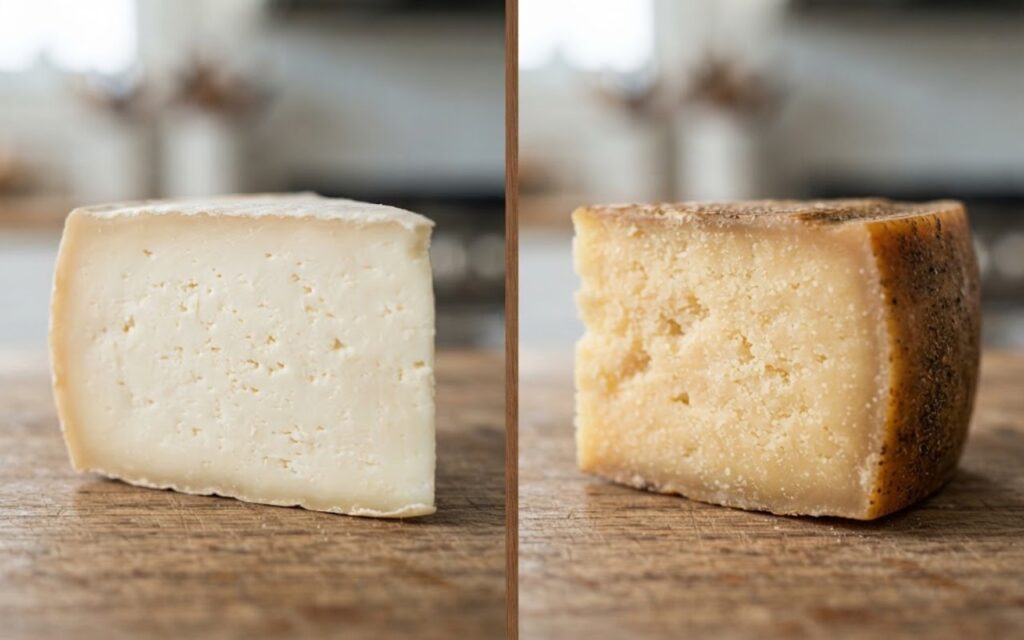
The debate between Asiago Pressato vs. Asiago D’Allevo trips up many home cooks at the cheese counter because these two Italian wheels share a single name but behave like completely different ingredients. One is a supple, buttery cheese that melts like fontina, while the other is a dry, aged powerhouse that competes directly with Parmigiano-Reggiano.
Grabbing the wrong wedge will derail your dinner, turning a creamy polenta into an oily split mess or leaving a baked pasta lacking punch. Sourcing the right variety comes down to understanding how milk skimming and cellar aging change their behavior in your kitchen.
Quick-Glance Kitchen Summary
Asiago Pressato uses whole cow milk aged under forty days to create a mild, high-moisture melting cheese.Asiago D’Allevo relies on part-skimmed milk aged from 60 days up to over two years to produce a firm, low-moisture grating cheese.
- Milk base for Pressato: Whole cow milk from lowlands or mountain plateaus
- Milk base for D’Allevo: Part-skimmed cow milk separated overnight
- Aging timeline for Pressato: 20 to 40 days
- Aging tiers for D’Allevo: Mezzano (4 to 6 months), Vecchio (10 to 15 months), Stravecchio (over 15 months)
- Moisture target: Pressato retains 40 to 45 percent water; D’Allevo drops below 30 percent
- Melting safety point: Pressato melts smoothly at 130 to 140 degrees Fahrenheit; Vecchio and Stravecchio tiers split above 150 degrees Fahrenheit without an emulsifier
Why One Name Covers Two Completely Different Cheeses
Both versions belong to the protected Asiago DOP zone spanning Vicenza, Trento, and parts of Padua and Treviso in northeastern Italy. The divergence starts immediately at the milking parlor with the fat and water content of the milk.
Pressato, also labeled as Asiago Fresco, uses raw or pasteurized whole milk from a single milking run. Cheesemakers cut the curds into hazelnut-sized clusters, transfer them to molds, and apply heavy mechanical pressure for several hours to expel whey quickly.
D’Allevo, which translates to “raised” or “nurtured”, uses traditional alpine methods where evening milk rests overnight to allow the cream to rise. The cheesemaker skims this top fat layer away, leaving a leaner milk whose curds can survive long aging cycles without turning rancid.
These leaner curds are cut much smaller, roughly the size of wheat grains, and cooked to higher temperatures before draining without heavy pressing. The low moisture content allows these wheels to rest on spruce shelves for months or years, developing tyrosine crystals and deep savory flavor.
| Cheese Classification | Aging Minimums & Milk Base | Texture & Flavor Profile | Optimal Culinary Response |
|---|---|---|---|
| Asiago Pressato (Fresh) | Matured 20 to 40 days; built completely from rich, whole pasteurized cow’s milk. | Soft, springy, and moist paste with small irregular holes; sweet, milky, and mild. | Elite everyday melter; ideal for uniform grilled cheese layers, panini bakes, and fondues. |
| Asiago D’Allevo (Aged) | Matured 3 to 24+ months; crafted from traditional raw, partially skimmed cow’s milk. | Hard, granular, and craggy paste with tiny crystals; intensely nutty, sharp, and pungent. | Premium finisher; best grated over rustic polenta, hot risottos, or sliced raw on charcuterie layouts. |
How to Spot the Differences on the Cutting Board
| Feature | Asiago Pressato (Fresh) | Asiago D’Allevo (Aged) |
|---|---|---|
| Rind | Thin, pliable, and light straw-colored. | Hard, dark, and thick brownish-yellow. |
| Interior Paste | Pale ivory with scattered irregular eyes. | Dense amber with granular tyrosine crunch. |
| Aroma | Fresh cream, sweet butter, and yogurt. | Toasted nuts, dried fruit, and broth. |
| Texture | Soft, elastic, and easily sliced with a wire. | Crumbly, dry, and split with a spade knife. |
| Heat Behavior | Melts into a smooth, elastic blanket. | Sweats oil and breaks into gritty clusters. |
When you slice into fresh Pressato, the knife glides through with almost no resistance. The paste yields like young Havarti or Taleggio, releasing a faint aroma of sweet grass and cultured butter.
D’Allevo resists the blade and fractures along natural crystalline faults when pressure is applied. Slicing with a standard chef knife will often crack the piece in half, which is why cheesemongers use almond-shaped scoring knives instead.
If you run your thumb across D’Allevo Mezzano, it feels leathery yet pliable. Once it ages into Vecchio or Stravecchio territory, the surface feels as dry and dense as slate.
Melting and Cooking Rules for Pan, Oven, and Sauce
Using Pressato in hot applications yields a glossy, unbroken stretch due to its intact casein network and high moisture. It acts as an exceptional table cheese for panini, smash burgers, and French onion soup toppings where you need elastic coverage without excessive grease pooling.
Keep the pan heat moderate when working with Pressato. Heating it above 160 degrees Fahrenheit without starch will cause its high fat and moisture content to separate into a watery puddle.
To build a cheese sauce using Pressato, toss shredded shreds with a pinch of cornstarch before folding them into warm milk. This starch coating traps freed milk fat droplets, maintaining an emulsion without requiring a heavy flour roux.
D’Allevo demands a precise approach in the kitchen based on its exact aging tier. Unlike younger versions, its moisture level in the later stages is far too low to melt into a stringy blanket; instead, direct high heat breaks down the aged proteins and releases clear butterfat.
Treat D’Allevo Mezzano as a direct stand-in for young Gouda or alpine Fontina in warm vegetable gratins, as it still retains enough moisture to melt smoothly into a dish. For fully matured D’Allevo Vecchio and Stravecchio, avoid direct pan cooking; instead, use a microplane to rain fine shavings over risotto, carbonara, or bitter chicory salads right before serving.
How to Pick the Right Wedge at the Grocery Store
Navigating the deli counter requires checking the official fire-branded stamps pressed into the rind. Real DOP Asiago features the word “ASIAGO” repeated vertically across the entire wheel edge alongside a dairy identification number.
Fresh Pressato packaging usually carries a blue label or blue lettering, marking its fresh category. Look for cut blocks where the cheese paste looks moist and springy, completely free of any greasy sheen or cracked borders.
Avoid Pressato wedges that look dull, dry around the plastic wrap, or show brownish discolored edges. These flaws mean the cheese has sat under display case heat lamps too long, which degrades the fresh milk flavors into sour, stale notes.
Aged D’Allevo wears a black or brown label and often lists its precise aging tier right on the front sticker. Check these aging brackets carefully:
- Mezzano: Matured between 4 and 6 months, delivering mild sweetness with light nuttiness
- Vecchio: Matured between 10 and 15 months, presenting sharp acidity, complex pasture notes, and light salt crunch
- Stravecchio: Matured over 15 months up to two years, featuring intensely savory, crumbly paste packed with tyrosine crystals
Specialty import brands like Agriform, Latterie Vicentine, or artisan alpine malga producers provide reliable benchmark quality. Supermarket generic pre-shredded cups labeled simply as “Asiago” almost always use cheap domestic cow curd cut with cellulose anti-caking powders, ruining both taste and sauce texture.
How to Store Cut Wedges and Save the Hard Rinds
Never suffocate authentic Italian cheese by wrapping it tightly in standard household plastic cling wrap. Trapped humidity causes Pressato to develop slimy surface mold, while D’Allevo suffocates and absorbs stale chemical plastic odors.
Wrap your cut wedges in two-ply cheese paper or parchment paper, then place the wrapped cheese loosely inside an unsealed food container or crisper drawer. This setup allows the cheese to breathe while shielding it from drying refrigerator fan drafts.
Pressato should be eaten within seven to ten days after opening because its high water content makes it vulnerable to spoilage. D’Allevo keeps for months if the cut surface stays dry; simply scrape away any tiny surface mold spots with a paring knife.
Never discard the stone-hard rinds from a wedge of D’Allevo Vecchio or Stravecchio. Scrub the exterior with a stiff kitchen brush under cold running water, pat dry, and store the rind scraps in a freezer bag.
Drop a frozen rind directly into simmering minestrone, braised lentils, or marinara sauce during the final forty minutes of cooking. The hot liquid slowly dissolves the concentrated glutamates and gelatinous rind edges, infusing the pot with profound savory depth without adding extra salt.