
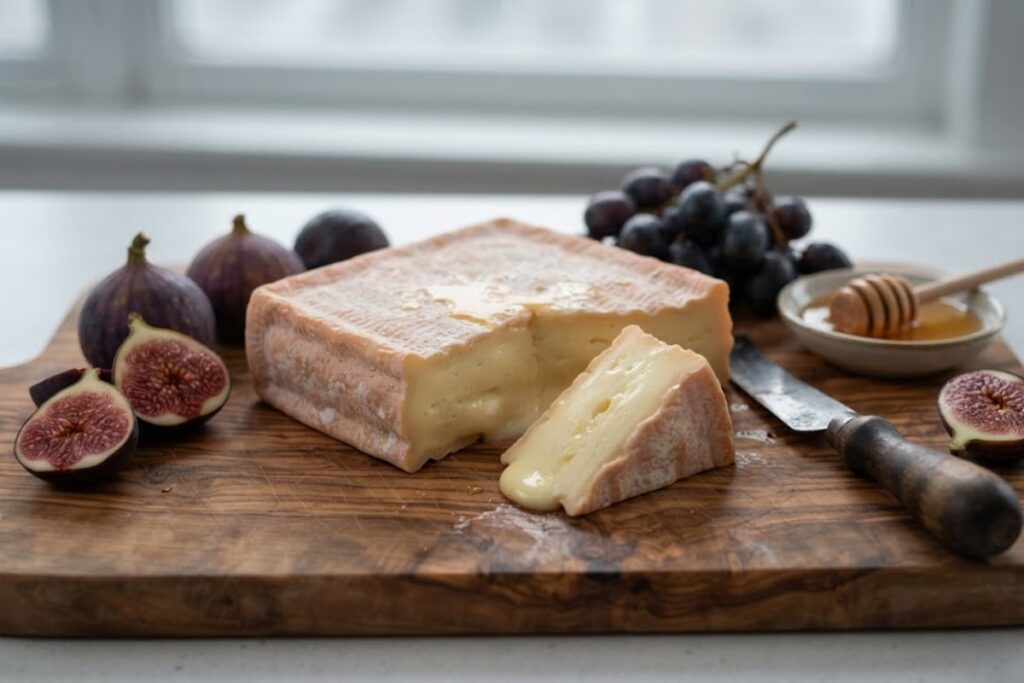
Discovering authentic Taleggio cheese can permanently elevate your culinary repertoire, bridging the gap between pungent artisan cave-ripened dairy and approachable, velvety comfort food. Originating from the Taleggio Valley in Lombardy, this ancient Italian classic has held protected designation of origin (DOP) status since 1996, guaranteeing traditional production standards across Northern Italy.
While newcomers are often intimidated by its pinkish, brine-washed exterior and barnyard aroma, the interior paste tells an entirely different story. Beneath the aggressive, yeasty fragrance lies a remarkably gentle, buttery, and slightly tangy cheese that functions as one of the culinary world’s finest melting agents.
Quick-Glance Kitchen Summary
Taleggio is a semi-soft, washed-rind Italian cow’s milk cheese defined by a pungent exterior aroma and an exceptionally mild, custard-like interior. When cooking, treat it with gentle residual heat to prevent the fat proteins from breaking into a greasy pool.
- Milk Base: Whole cow’s milk (pasteurized or raw milk under DOP standards)
- Moisture Content: Approximately 48 to 50 percent
- Fat in Dry Matter: Minimum 48 percent
- Ideal Melting Threshold: 130°F to 140°F (55°C to 60°C)
- Core Culinary Role: Off-heat emulsifier for risotto, polenta, pan sauces, and stuffed flatbreads
- Primary Substitutes: Fontina Val d’Aosta DOP, Stracchino, or young Reblochon
Smear-Ripened Biochemistry: Understanding the Funky B. Linens Rind
The striking personality of Taleggio stems directly from its washed-rind production method. During its minimum 35-day aging process on wooden shelves in humid cellars, cheesemakers repeatedly sponge the square blocks with a mild sea-salt brine. This wet, saline environment suppresses unwanted molds while cultivating colonies of Brevibacterium linens, the exact bacterium responsible for the cheese’s signature coral-orange hue and assertive aroma.
Home cooks frequently ask in culinary forums whether the gritty rind should be trimmed away before cooking. The short answer is that the rind is completely edible, deeply flavorful, and safe to consume. The slight grit encountered when biting into the rind is not dirt, but rather micro-crystals of sea salt left behind by repeated surface washings.
If you find the rind too assertive for delicate preparations, lightly scrape the surface with the back of a paring knife rather than carving away the underlying paste. Stripping the rind entirely strips away the complex, yeasty funk that balances the rich, milky core. For smooth sauces or creamy pasta fillings, home cooks often dice the rind finely so it dissolves uniformly into the base.
Melting Dynamics and Phase Separation: Taleggio vs. Alternative Cheeses
Understanding how Taleggio behaves under heat requires examining its protein matrix and moisture equilibrium. High moisture combined with moderate proteolysis makes Taleggio liquefy rapidly, yet it remains vulnerable to curd breakage under careless thermal stress.
| Cheese Variety | Texture Profile | Moisture Level | Melting Stability | Primary Kitchen Role |
|---|---|---|---|---|
| Taleggio DOP | Custardy, elastic paste | High (48-50%) | Melts quickly; breaks under direct high heat | Off-heat emulsification, pan sauces, polenta |
| Fontina Val d’Aosta DOP | Dense, semi-firm | Medium (40-42%) | Highly stable; elastic stretch | Fonduta, baked gratins, pressed sandwiches |
| Reblochon PDO | Supple, creamy | High (45-48%) | Melts evenly with moderate fat release | Tartiflette, layered root vegetable bakes |
| Fresh Mozzarella | Stringy, fibrous | Very High (52-60%) | Melts with significant free whey release | Neapolitan pizza, baked pasta bakes |
The comparison above highlights why substituting Taleggio directly into standard high-heat dishes can yield unpredictable results. While firm alpine cheeses like Fontina possess tighter protein structures that tolerate sustained baking, Taleggio behaves more like a thick, spreadable cream once warm.
When subjected to excessive heat, the delicate emulsion of milk fat and moisture collapses. The result is a puddle of yellow oil floating atop a rubbery mass of protein curds. Keeping cooking temperatures below the boiling point ensures the cheese remains a cohesive, glossy emulsion.
Thermal Control and Mantecatura: Incorporating Taleggio Into Risotto and Polenta
In authentic Northern Italian kitchens, Taleggio rarely encounters sustained boiling temperatures. Instead, cooks harness the cheese during the mantecatura phase, the crucial off-heat mounting process performed at the end of making risotto. The residual thermal mass of the rice starch is more than sufficient to melt the cheese smoothly without scorching it.
To execute this properly in a home kitchen, remove your risotto pan from the flame when the rice reaches a firm al dente. Allow the steam to subside for roughly sixty seconds before dropping in small, chilled cubes of Taleggio alongside cold unsalted butter. Vigorously agitate the pan using a wooden spoon to whip the melting cheese into the released rice starches, creating a velvety sauce that coats every grain.
- Pull the cooking vessel completely off the heat source before introducing cheese cubes
- Cut the cheese into uniform half-inch cubes directly from the refrigerator so they handle easily
- Agitate the mixture continuously using a wooden spoon to build a cohesive fat-starch emulsion
- Avoid adding excess salt until after the cheese has melted, as the brine-washed rind introduces natural salinity
Polenta concia relies on this identical thermodynamic principle. As coarse stone-ground cornmeal finishes its slow simmer in a heavy-bottomed pot, cooks fold in generous chunks of Taleggio away from direct flame. The ambient heat gently turns the paste into long, molten ribbons that lace throughout the grain without separating.
Pan Geometry and High-Heat Applications: Pizza, Panini, and Focaccia
Baking with Taleggio requires strategic placement to prevent the top heat of your oven from turning the delicate fats rancid. In home pizza ovens operating at high temperatures, raw Taleggio placed on top of a pie will burn before the dough can cook through.
The secret used by artisan pizzaiolos is subsurface tucking. Distribute pieces of Taleggio directly over the dough base and beneath other moisture-rich toppings, such as sauteed wild mushrooms, roasted squash, or thinly sliced potatoes. This physical shield protects the cheese from direct radiant heat, allowing it to liquefy gently into an unctuous sauce.
For grilled sandwiches and panini, cookware choice dictates your success rate. Standard lightweight pans heat unevenly, creating localized hot spots that scorch the bread before the cheese center warms.
- Choose heavy enameled cast iron or carbon steel skillets to provide even, radiant thermal conductivity
- Maintain medium-low surface heat to allow the internal temperature of the sandwich to reach 135°F naturally
- Pair the cheese with sweet, acidic counterpoints like fig preserves, sliced pears, or pickled shallots
- Layer slices between sturdy, open-crumb sourdough that can absorb melting fats without collapsing into mush
When assembling a pressed panino, keep the cheese layer centered between your cured meats or vegetables. This structural sandwich buffering ensures the cheese melts evenly across the entire surface without leaking onto the dry skillet floor.
Cold Storage Management: Preventing Anaerobic Ammonia Accumulation
Improper refrigerator storage is the fastest way to ruin a premium wedge of Taleggio. Because this is a living, smear-ripened cheese, the surface bacteria continue to respire long after the block is cut. Sealing Taleggio tightly in non-breathable plastic cling wrap suffocates the active cultures, causing trapped nitrogen compounds to convert rapidly into an offensive ammonia stench.
If you unwrap your cheese and detect a sharp smell reminiscent of household glass cleaner, the cheese has suffered from anaerobic confinement. You can often rescue the wedge by unwrapping it completely and letting it sit uncovered on a wooden board at room temperature for roughly forty-five minutes. In many cases, the volatile ammonia gases will disperse, revealing the rich, yeasty milk aromas beneath.
To store Taleggio correctly over several weeks, mimic the breathable environment of aging caves:
- Wrap the cut wedge snugly in two-ply specialty cheese paper, parchment paper, or waxed butcher paper
- Place the wrapped package inside a partially opened plastic food storage bag or a loose glass container
- Store the package inside the high-humidity vegetable crisper drawer of your refrigerator
- Maintain storage temperatures consistently between 38°F and 42°F (3°C to 5°C)
The porous paper wrapping allows vital oxygen exchange while preventing the cut paste from drying out into a hard rind. Kept in this manner, authentic Taleggio retains its supple texture, balanced funk, and phenomenal melting characteristics for up to two weeks in home conditions.