
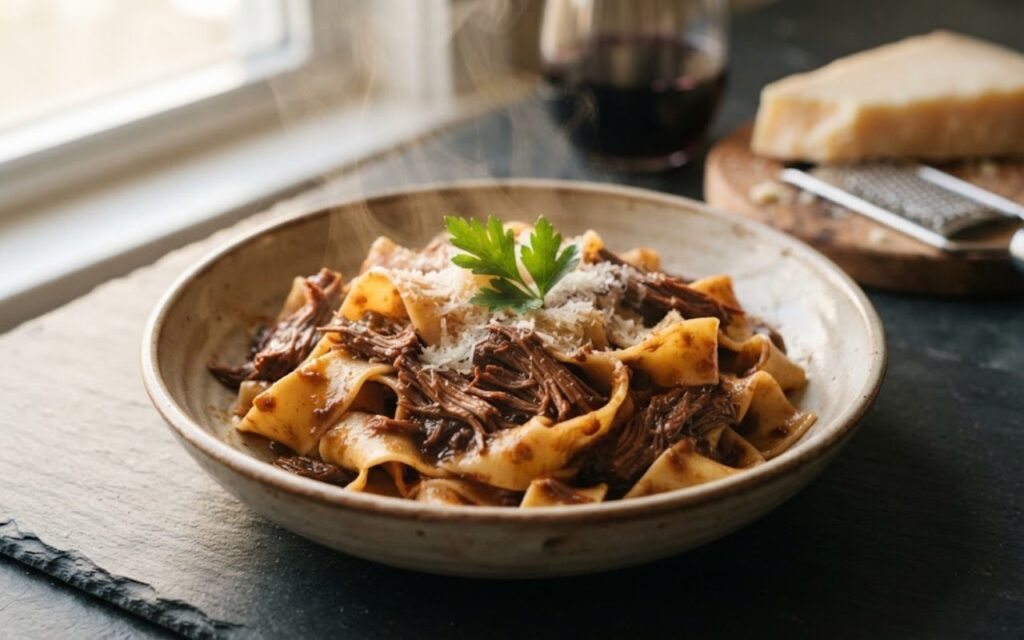
Mastering this classic Tuscan pairing begins with our comprehensive pappardelle pasta guide, engineered to help you pair broad egg ribbons with deeply developed, slow-simmered sauces. Wide noodles require substantial culinary architecture because light emulsified butter or thin purees simply slip off their broad surface area.
Home cooks frequently encounter two major pitfalls: greasy sauce pooling at the bottom of the bowl and delicate noodles tearing apart during final pan agitation. Understanding how rich ragus bond with broad ribbons transforms a heavy plate of braised meat into a cohesive, restaurant-grade standard.
Quick-Glance Kitchen Summary
Properly pairing wide egg noodles with slow-cooked ragu depends on extracting gelatin from connective tissue while maintaining sauce cling through pasta surface starch. Balancing fat emulsification with high-viscosity reductions prevents sauce separation and protects wide noodles from tearing during finishing.
- Fresh Egg Pasta Dimensions: Cut sheets into ribbons 20 to 25 millimeters wide and roughly 1 millimeter thick.
- Pasta Dough Hydration Baseline: Target 55 to 57 percent hydration, utilizing whole eggs combined with extra yolks for tensile strength.
- Tomato Paste Concentration: Use double-concentrated paste at 24 to 28 Brix (such as Mutti) or triple-concentrated at 36 Brix, substituting 1 part paste plus 2 parts water for standard 8 to 11 Brix canned passata.
- Primary Cooking Vessel: Heavy enameled cast iron Dutch oven or curved saucier to eliminate thermal hot spots and prevent corner scorching.
- Collagen Hydrolysis Window: Braise tough cuts between 160 and 185 degrees Fahrenheit to convert tough connective tissue into succulent gelatin without drying out lean fibers.
Thermal Mass and Pan Geometry for Proper Fond Development
Executing an authentic ragu base requires a cooking vessel with significant thermal conductivity and heat retention. Home cooks often run into scorched fond when using thin stainless steel or lightweight nonstick pans that produce localized hot spots.
A heavy enameled cast iron Dutch oven distributes burner heat across a thick floor, ensuring uniform browning of dense meat cuts like wild boar shoulder, beef shin, or lamb neck.
When reducing aromatics and browning tomato paste, pan wall geometry plays an active role. Saucier pans with rounded bottom perimeters prevent minced soffritto and concentrated tomato pastes from wedging into right-angle corners where wooden spoons cannot reach.
Before adding braising liquids, you must pincer your tomato paste by caramelizing it directly in the rendered rendered pork fat or olive oil. This fundamental technique produces a deep russet pinçage that rounds out harsh raw acid notes and introduces complex Maillard reactions.
Deglazing the bottom of the pan extracts these browned proteins into your aromatic matrix. Use a dry, high-acid red or white wine to break up stubborn fond deposits before introducing low-sodium stock. Maintain a steady simmer so that volatile alcohol vaporizes completely, leaving behind bright fruit acids without sharp ethanol fumes.
Collagen Hydrolysis and Meat Selection for Wide Ribbons
The mechanical weight of broad pappardelle noodles requires ragus packed with body, dissolved gelatin, and structural shred. Tender cuts like loin or tenderloin collapse into chalky, dry strands when subjected to prolonged simmering. Tougher primal cuts laden with intramuscular collagen yield superior results because thermal breakdown converts connective tissues into silky liquid gelatin.
| Meat Style | Target Cut | Primary Fat Base | Simmer Time | Sauce Texture Profile |
|---|---|---|---|---|
| Tuscan Cinghiale | Wild boar shoulder | Rendered pancetta | 3.5 to 4.5 hours | Rustic, gamey shreds bound with dense aromatics. |
| Classic Bolognese | Beef chuck and pork belly | Whole milk and lard | 2.5 to 3.5 hours | Fine, velvety curds with delicate dairy sweetness. |
| Braised Osso Buco | Bone-in veal shanks | Unsalted butter | 2.5 to 3 hours | High-gelatin glaze suspended with dissolved marrow. |
| Duck Sugo | Whole legs and thighs | Rendered duck fat | 2 to 2.5 hours | Rich, shreddable dark meat balanced with citrus zest. |
Selecting the right animal protein dictates the final mouthfeel of the ragu. Wild game offers muscular, iron-forward profiles that benefit from aromatics like juniper and rosemary, while domestic pork belly supplies baseline unctuousness.
When substituting concentrated commercial pastes, select recognized brands like Cento or Mutti to maintain clean tomato flavor without excess metallic bitterness. If processing fresh seasonal tomatoes for home canning, always follow strict National Center for Home Food Preservation guidelines by incorporating exactly one tablespoon of bottled lemon juice or one-quarter teaspoon of citric acid per pint to guarantee food safety below 4.6 pH.
Flour Hydration Ratios and Tensile Strength in Egg Pasta
A wide noodle demands greater tensile elasticity than narrow strands like tagliolini or angel hair. If the noodle lacks adequate structural protein, dragging it through a thick meat sauce will fracture the ribbons into mushy scraps. Formulate your dough using finely ground Tipo 00 soft wheat flour combined with high-protein durum semolina to provide balanced chew.
- High-Protein Flour Blend: Mix 70 percent Italian Tipo 00 flour with 30 percent fine durum semolina flour.
- Egg-to-Flour Proportion: Weigh out approximately 56 grams of whole egg liquid per 100 grams of flour blend.
- Yolk Enrichment: Replace one whole egg with two separated egg yolks to elevate dough fat content and boost golden hue.
- Resting Duration: Wrap tightly in plastic film and rest at room temperature for a minimum of 45 minutes before rolling.
Allowing the dough to rest properly lets the flour hydrate evenly while relaxing the dense gluten network. This crucial pause prevents the rolled dough sheet from snapping back aggressively as you pass it through pasta machine rollers.
When using an industry-standard home manual roller like the Marcato Atlas 150, pass the dough sequentially from the widest setting (#0, which measures 4.8 mm) down to your target thickness.
For robust pappardelle, roll the sheet down to setting #5 (~1.5 mm) or setting #6 (~1.2 mm). Wide noodles rolled past setting #7 (1.0 mm or thinner) tear under the weight of braised meats, while thick slabs skipped at setting #4 (1.9 mm) taste gummy and doughy at the core.
Surface Roughness and Extrusion Dynamics for Sauce Adhesion
The microscopic exterior texture of your pasta ribbon dictates whether braising juices cling to the noodle or slide to the bottom of the plate. Commercially extruded pasta pressed through slick Teflon dies creates a glassy, polished surface that repels emulsion sauces. Authentic artisan pastas utilize porous bronze dies that carve tiny fissures, microscopic pits, and micro-grooves into the noodle exterior.
When preparing homemade rolled egg noodles, replicate this bronze die texture by dusting your workspace generously with coarse semolina. Rolling pins made from non-porous stainless steel produce smooth ribbons, whereas traditional porous beechwood pins drag gently across the dough, introducing micro-textures that catch ragu fibers.
Maintain rolling friction by dusting the pasta sheets lightly rather than saturating them with dry white flour. Excess raw flour creates a pasty exterior jacket when submerged in boiling water, which dulls flavor clarity and muddles the sauce finish.
Emulsification Dynamics and The Final Mantecatura
The critical climax of cooking pappardelle with meat ragu occurs after boiling the pasta. Never plate naked boiled noodles with a ladle of sauce poured over top. This separation cools the pasta immediately, turns residual pasta water slick, and prevents the ragu fat from binding with the noodle starch.
- Parboil the Ribbons: Cook fresh pappardelle in salted water until approximately one minute shy of true al dente.
- Transfer Direct to Saucier: Lift the ribbons directly from boiling water with broad tongs, allowing clinging water to transfer into the simmering ragu.
- Starch Emulsification Water: Incorporate two to four fluid ounces of starchy boiling water into the sauce base over medium-high heat.
- Pan Agitation: Swirl the saucier vigorously in circular motions to mechanically bond free pan fats with suspended cooking water starches.
- Off-Heat Enrichment: Remove the vessel completely from the heat source before folding in cold butter cubes or microplaned Parmigiano-Reggiano.
Adding grated cheeses over an active flame causes the milk solids to split, separating dairy fat into an oily pool and tightening proteins into rubbery lumps. Performing this mantecatura off the flame guarantees that the cheese melts uniformly into the starch suspension.
This mechanical agitation forces dissolved collagen, tomato sugars, and cooking fats into a glossy, unified glaze. Every wide pappardelle ribbon emerges fully coated, carrying robust meat fibers from pan to fork with complete structural integrity.