
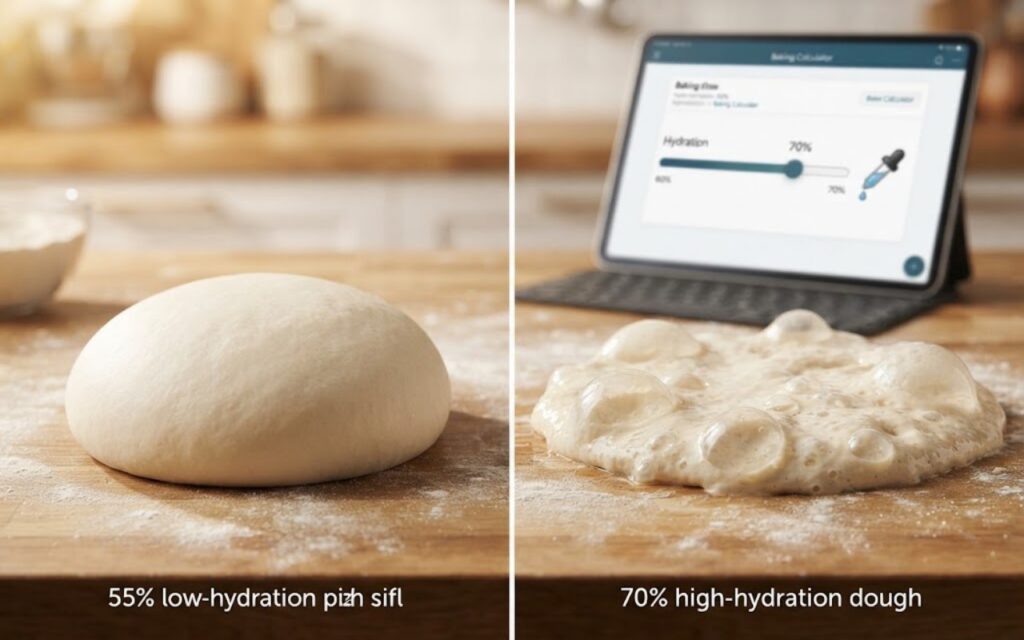
When troubleshooting a sticky, unmanageable mess of dough or a dense crust that refuses to rise, most home cooks blame their yeast or flour brand. Adjusting your formula with a professional pizza dough hydration calculator eliminates this guesswork before you ever touch a mixing bowl. In professional baking science, master water balance is the ultimate secret to crust texture.
Hydration is not an arbitrary fluid measurement; it is a precise calculation of total water weight divided by total flour weight. Shifting this single value from a stiff 55% ratio up to a wet, bubbly 70% ratio completely re-engineers the chemical, physical, and baking performance of your dough. This interactive simulator allows you to visualize and control these cellular shifts instantly.
Below, we break down the molecular science of water absorption and how to select the perfect fluid balance for your home kitchen oven setup.
💧 Hydration Scaling Matrix
Interactive Water Absorption Simulator
Precision Hydration Formula
The Molecular Science of Water Absorption
When water is poured into dry flour, it doesn’t just wet the surface—it triggers an immediate cellular transformation. Flour is packed with two primary insoluble proteins: gliadin (which provides stretch and extensibility) and glutenin (which provides strength and rubber-like elasticity).
When hydration levels hit 55%, there is barely enough moisture to hydrate these protein cells. The gluten strands cross-link tightly and densely, resulting in a firm, tough dough ball that is easy to shape but exhibits very little open airspace.
When you elevate the fluid ratio toward 70% using a professional pizza dough hydration calculator, you supercharge the gluten framework. Water molecules slip between the protein links, acting as a natural plasticizer that stretches the cellular matrix.
During baking, this excess moisture converts into high-pressure steam. Because wet gluten networks are highly elastic, they expand cleanly around these pocket pressures, setting into a light, glass-like interior structure filled with open, honeycomb gas chambers.
55% Low Hydration vs. 70% High Hydration Performance
Selecting the right level on your simulator slider isn’t just about choosing a number; it dictates your entire hand-shaping workflow, your fermentation strategy, and your equipment limits:
- The 55% Profile: This dough handles exceptionally dry, smooth, and tight. It resists sticking to a launching peel or wooden table, making it highly forgiving for beginners. Because it contains less water weight, it requires a careful, extended fermentation to relax the rigid protein bonds. While traditional Neapolitan styles utilize lower hydration ranges (55% to 62%) for rapid 90-second bakes at 850°F+ (454°C+), a poorly managed 55% batch can easily over-char or dry out under intense heat. In a standard home oven, a 55% dough tends to bake into a dense, overly crunchy crust rather than a light, airy crumb.
- The 70% Profile: This dough behaves like a highly fluid, sticky paste. Attempting to knead it traditionally will cause it to tear and glue itself to your fingers. It requires advanced handling mechanics (like the French slap-and-fold method) or long autolyse rests. However, this high fluid reserve makes it uniquely optimized for standard residential ovens operating at 500°F to 550°F (260°C to 288°C). The excess moisture provides a vital thermal buffer during the longer 6-to-10-minute bake cycle. It keeps the interior crumb soft and moist while the starches and sugars on the surface brown cleanly.
If you want to fully branch out beyond these baseline fluid sliders—such as introducing pre-ferments or manually calculating automated bowl residue multipliers—head back to our comprehensive master pizza dough calculator.
Advanced Troubleshooting: Managing Sticky High-Hydration Batches
If you move your slider up to 70% and find your final dough mix unmanageable, implement these three forum-tested field adjustments to restore control:
1. The Autolyse Rescue Window
If your high-hydration dough looks like wet soup inside your mixer, do not add extra raw flour. This alters your calculated baker’s percentages. Instead, turn off the mixer and let the shaggy wet mass rest completely undisturbed for 30 minutes. This pause allows the starch molecules to absorb water naturally via capillary action, initiating gluten chain links without mechanical friction. When you turn the machine back on, the dough will magically tighten and clear the sides of the bowl.
2. The Ice Water Temperature Counter-Balance
High-hydration dough requires prolonged mixing times to develop structural tension. Prolonged mechanical kneading causes friction, which heats your dough above the safe 78°F (26°C) threshold. When dough gets too warm, the gluten degrades, turning the dough into a loose puddle.
The Fix: When using a hydration level above 68%, always use ice-cold water (around 40°F / 4°C) straight from the refrigerator to offset mixer friction and keep your final exit temperatures stable.
3. Dusting with Coarse Semolina
Never use fine white flour on your table or peel when launching a wet pizza. Wet dough absorbs fine flour instantly, causing it to stick aggressively to your launcher surface. Instead, dust your work area with coarse semolina flour. Semolina consists of microscopic, round durum wheat spheres that act like tiny ball bearings beneath your dough skin, letting even a sticky 72% hydration pie slide off the peel effortlessly.
Matching Your Hydration to Your Heat Source
At the end of the day, managing your hydration levels is only half of the structural equation. You can calculate a technically perfect 70% high-moisture dough, but if your cooking setup cannot deliver intense, uniform radiant heat, those expanded gas pockets will slowly deflate before they can set into a crisp crust.
To prevent gummy centers or dense edges, you must pair your calculated water targets with an engine that manages extreme thermal floor stability.
🔥 Looking to upgrade your baking setup? Achieving an instant, dramatic oven spring on high-hydration mixes requires a massive shock of thermal energy. Check out my extensive, real-world field review of the Best Pizza Ovens for Home Use to see how modern portable outdoor and countertop electric models manage precision deck temperatures to bake artisan recipes flawlessly.