
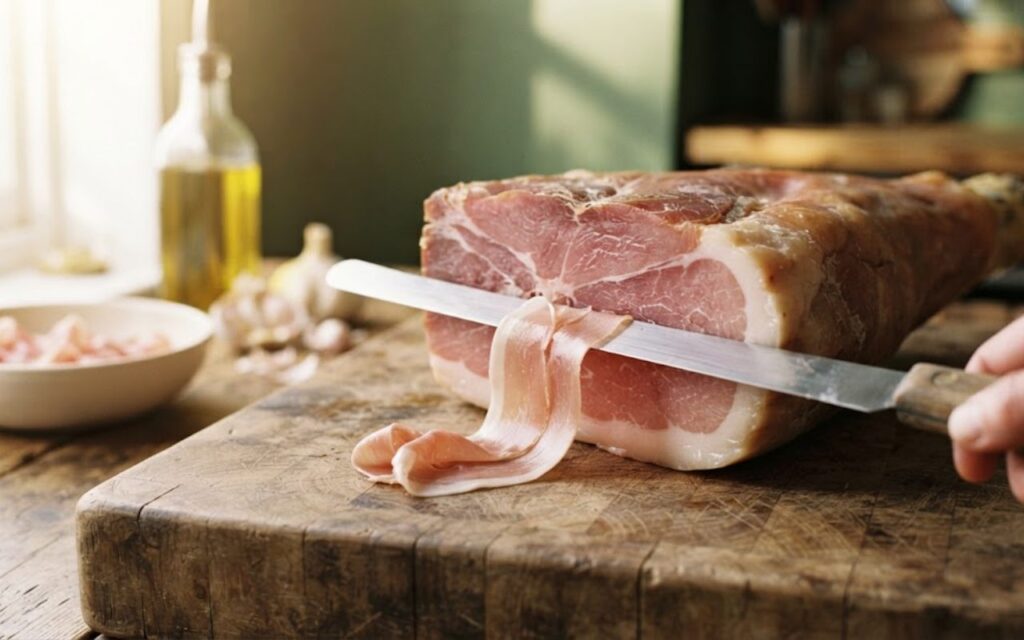
Getting clean cuts when figuring out how to slice prosciutto at home comes down to blade selection, ham temperature, and steady hand pressure. Learning how to properly slice cured prosciutto at home without a deli machine unlocks a premium skill that prevents home cooks from shredding expensive imported ham into thick, rubbery chunks.
Doing this on a standard home cutting board requires abandoning heavy downward force in favor of a gentle, full-length sawing stroke that produces translucent sheets of cured ham that melt instantly across the tongue.
Quick-Glance Kitchen Summary
Hand-slicing whole or chunked prosciutto requires a cold, firm piece of meat and a long, narrow, razor-sharp blade that glides without wedging. Slice slowly across the grain using light horizontal draw-strokes, letting the blade edge shave off paper-thin sheets without pressing downward.
- Meat internal temperature: 34 to 38 degrees Fahrenheit for initial slicing
- Ideal blade length: 10 to 12 inches with a narrow, flexible profile
- Blade edge geometry: Non-serrated, polished edge sharpened to a 15-degree angle
- Ham orientation: Fat cap facing upward or toward the blade heel
- Slice thickness target: Under 1 millimeter (translucent when held to light)
Picking the Best Knife for Thin Slices
A standard chef knife fails on dry-cured ham because the tall, wide blade face creates severe surface drag against the dense meat. As you push forward, the broad steel clings to the cured proteins and rendered fat, which tears the slice into thick, uneven chunks.
Specialty Italian carvers use a dedicated coltello da prosciutto, which features a long, slender blade measuring between ten and twelve inches. The reduced surface area eliminates friction, allowing the steel to slide smoothly between the slice and the main block without sticking.
If you do not own a specialized Italian ham knife, a flexible salmon slicer or a Japanese sujihiki serves as an ideal alternative. Make sure the edge is freshly polished on a fine water stone, because even microscopic teeth on a rough edge will snag cured fibers and shred the slice.
- Total blade length of 10 to 12 inches to allow complete, single-stroke draws
- Narrow blade height under 1.25 inches to minimize surface friction
- Straight, non-serrated edge to keep cuts smooth and uniform
- Moderate spine flexibility to help the blade follow the natural contours of the muscle
Keep your blade flat against the meat face to maintain an even line across the entire surface of the cut.
Comparing Blades and Tools for the Job
Different slicing tools produce widely varying results when applied to a dense, air-cured ham block.
| Tool Type | Primary Advantage | Main Limitation | Best Thickness Result |
|---|---|---|---|
| Dedicated Prosciutto Knife | Narrow blade profile eliminates surface suction against tacky cured proteins. | Requires dedicated storage space and manual sharpening technique. | Under 1 millimeter; semi-transparent sheets. |
| Japanese Slicing Knife (Sujihiki) | Hard carbon or tool steel takes an acute edge for smooth draw cuts. | Rigid spine can bind if forced through hardened outer fat layers. | Approximately 1 millimeter; clean and uniform. |
| Standard 8-Inch Chef Knife | Available in virtually every home kitchen without extra equipment purchases. | Wide blade creates severe suction that folds and tears delicate slices. | 2 to 3 millimeters; tends to produce thick slabs. |
| Adjustable Mandoline Slicer | Keeps a mechanically fixed thickness without requiring hand-carving skill. | High surface friction against soft fat causes jamming and safety risks. | Ragged edges; frequently binds on dense muscle. |
Manual slicing with a long blade remains the most reliable method for home cooks working with whole pieces. Rotary blades work well in deli settings, but high-speed friction can prematurely warm the delicate fat during small home runs.
Chilling the Ham to Keep the Fat Firm
Dry-cured hams like Prosciutto di Parma and Prosciutto di San Daniele contain high concentrations of oleic acid and unsaturated fats. These lipids begin softening at standard room temperatures between 68 and 72 degrees Fahrenheit, turning the exterior greasy and pliable.
When the fat becomes soft, the blade pushes the meat around rather than shearing through the fibers. Storing your prosciutto chunk in the refrigerator until its core reaches 34 to 38 degrees Fahrenheit hardens the lipid structure, giving you a firm cutting surface that resists dragging.
- Place the ham block in the coldest zone of the refrigerator for two hours before cutting.
- For very soft cuts, place the meat in the freezer for fifteen minutes directly before slicing.
- Never let the meat freeze solid, as expanding water crystals damage the silky texture of the cured muscle.
Once you carve the cold ham into sheer ribbons, let the finished slices rest on a serving plate for five minutes. Ambient air quickly warms the delicate ribbons, releasing the cured aromas and restoring their melting mouthfeel.
Trimming the Skin and Moving the Blade
Before cutting slices, inspect the exterior of the ham block to locate the cotenna, which is the thick, hardened outer rind. You must also identify the sugna, a traditional curing mixture of rendered lard, rice flour, and black pepper applied to protect the exposed meat during aging.
Trim away only the skin and lard covering the exact portion of meat you plan to carve during that specific meal. Leaving the remaining skin intact protects the rest of the ham block from drying out and oxidizing in cold storage.
Anchor your cutting board firmly to the counter by placing a damp cloth or silicone baking mat directly beneath it. Secure the ham with your non-dominant hand, using a piece of butcher paper between your skin and the meat to keep body heat from melting the surface fat.
- Rest the heel of your knife at the far edge of the ham surface with the blade tilted almost flat.
- Draw the blade backward toward your body in one smooth, sweeping motion using the full length of the steel.
- Apply almost zero downward pressure, letting the weight of the knife and the sharpness of the edge part the muscle fibers.
- Slice directly across the grain of the meat to guarantee a tender bite rather than a chewy ribbon.
If the knife stops moving forward mid-stroke, gently finish the draw without hacking back and forth. Sawing motions create rippled, uneven slices with shredded edges.
Storing Cut Slices and the Open Block
Sliced prosciutto oxidizes rapidly once exposed to oxygen, with delicate fats turning rancid and dry within hours. Lay finished slices in single layers separated by sheets of parchment paper or deli wax wrap to stop them from fusing together.
When protecting the leftover block, coat the exposed muscle face with a light film of olive oil or a thin layer of rendered pork fat. Press a sheet of plastic wrap directly against the cut face, smoothing out every air pocket to halt moisture loss and surface oxidation.
- Wrap the entire treated block tightly in a layer of moisture-resistant butcher paper.
- Place the wrapped ham inside the vegetable crisper drawer of your refrigerator to maintain stable humidity.
- Avoid storing open cured meat next to pungent foods like cut onions, as cured fat rapidly absorbs ambient odors.
Stored under proper moisture barriers, a trimmed block of prosciutto keeps in the refrigerator for up to two months. If the exposed surface turns dark or hard between carving sessions, shave away a paper-thin sliver to expose fresh meat before serving your guests.