
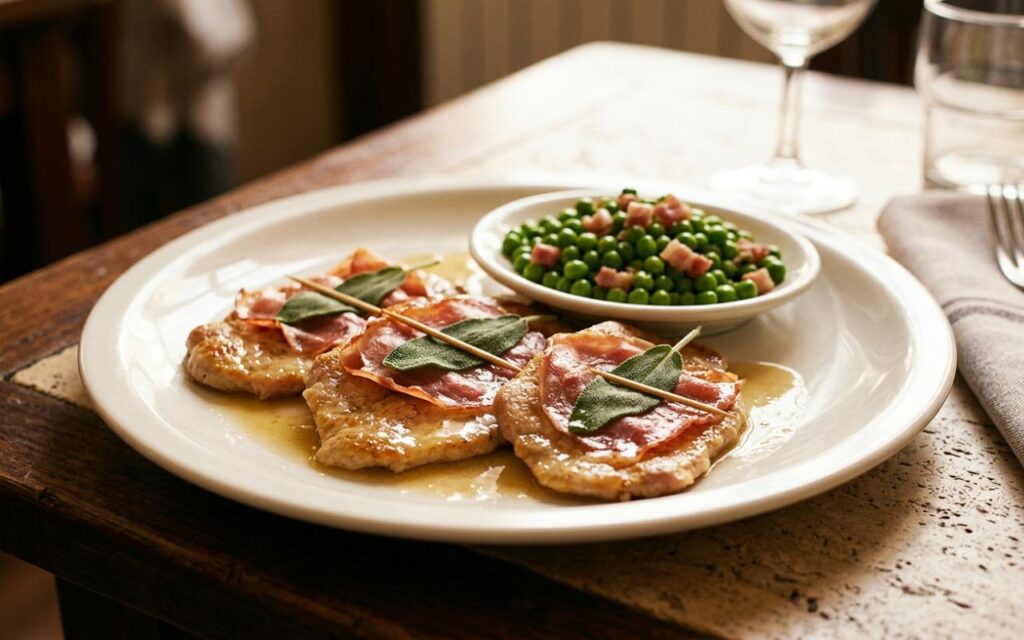
Saltimbocca is a classic Italian dish made from thin veal scaloppine topped with cured prosciutto and fresh sage leaves, pan-seared quickly in butter and deglazed with dry white wine. Translated literally from Italian as “jumps in the mouth” (salta in bocca), the dish delivers an immediate burst of savory, herbaceous, and bright flavors in under five minutes of cooking.
Most closely associated with Rome as Saltimbocca alla Romana, this iconic secondo (main course) proves how three simple, high-contrast ingredients can outperform complex sauces. Sweet milk-fed veal provides a tender canvas, dry-cured Prosciutto di Parma adds concentrated umami saltiness, and fresh sage leaves release aromatic oils when kissed by foaming butter.
Understanding the butcher cuts, layering order, and fast searing mechanics behind saltimbocca prevents the two biggest home-cooking mistakes: tough, overcooked veal and rubbery prosciutto.
Quick-Glance Summary: Italian Saltimbocca
- Literal Translation: “Jumps in the mouth” (from salta meaning jumps and in bocca meaning in the mouth).
- Core Ingredients: Thinly pounded veal cutlets (scaloppine), thinly sliced prosciutto crudo, fresh sage leaves (small leaves whole, large leaves halved), unsalted butter, and dry white wine.
- Best Veal Cut: Top round (fesa), sirloin tip (noce), or loin eye pounded evenly to 1/8 to 1/4 inch (3 to 6 mm) thick.
- Traditional Roman Style vs. Rolled Style: Authentic Roman trattorias cook the cutlets flat with prosciutto and sage pinned on top with a toothpick, whereas northern Italian and Italian-American variations sometimes roll the cutlets into bundles (involtini).
- Classic Side Pairings: Roman-style braised peas with pancetta (piselli alla romana), sautéed bitter greens like chicory (cicoria ripassata), or roasted potatoes.
Origins: From Brescia to Rome’s Historic Trattorias
Although Saltimbocca alla Romana is celebrated worldwide as a pillar of Roman cuisine, culinary historians trace its earliest roots to Brescia in northern Italy’s Lombardy region (saltimbocca alla Bresciana), where tender veal cutlets were layered with ham and sage.
By the late 19th century, Roman trattorias had adopted and perfected the dish. In his landmark 1891 cookbook La Scienza in Cucina e l’Arte di Mangiar Bene (Recipe #222), Italian gastronome Pellegrino Artusi documented eating saltimbocca alla romana at Rome’s historic Trattoria Le Venete near Via di Campo Marzio, praising its light, quick preparation with half a sage leaf, ham, butter, and pepper.
The Ingredient Chemistry: How Veal, Prosciutto, and Sage Interact
Saltimbocca succeeds because each component balances the others in fat, salt, and fat-soluble aroma extraction:
- Veal Scaloppine (The Tender Base): Mild, fine-grained veal top round (fesa) or knuckle (noce) cooks in roughly 90 seconds per side without releasing heavy juices that dilute the pan sauce.
- Prosciutto Crudo (Built-In Seasoning): Dry-cured Prosciutto di Parma or San Daniele seasons the meat naturally as it cooks, meaning you should never salt the prosciutto side of the cutlet.
- Fresh Sage Leaves (Fat-Soluble Aromatic Bloom): Common sage (Salvia officinalis) contains hydrophobic essential oils (thujone, 1,8-cineole, and camphor) that dissolve poorly in water or wine alone but bloom rapidly in foaming butterfat. Use small-to-medium sage leaves whole, and tear large, mature leaves in half so their camphor notes complement rather than overpower delicate milk-fed veal.
Flat Roman Saltimbocca vs. Rolled Saltimbocca vs. Chicken Variations
Depending on whether you dine in central Rome, northern Italy, or an Italian-American trattoria, you will encounter three main variations:
| Style | Assembly & Cut | Pan Sauce Base | Texture & Flavor Profile |
|---|---|---|---|
| Saltimbocca alla Romana (Traditional Flat) | Flat veal scaloppine layered with prosciutto and 1 small sage leaf (or half large leaf) pinned horizontally | Butter, dry white wine (such as Frascati), and pan fond | Crisp-edged prosciutto, velvety veal, bright wine-butter glaze |
| Rolled Saltimbocca (Involtini Style) | Veal pounded thin, layered inside with prosciutto and sage, and rolled tight | Butter, white wine or dry Marsala, plus a splash of veal stock | Juicy spiral cross-section; takes 4 to 6 minutes to cook through |
| Chicken or Pork Saltimbocca | Thinly butterflied chicken breast or pork tenderloin medallions | Butter, olive oil, white wine, and lemon juice | Heartier, budget-friendly alternative; requires full internal cooking |
Five Golden Rules for Cooking Authentic Saltimbocca
As demonstrated in Serious Eats’ Roman Veal Saltimbocca technique, because veal cutlets are thin, temperature, starch gelatinization, and timing control everything:
- Pound Cutlets to Uniform Thickness: Place veal scaloppine between two sheets of plastic wrap or parchment paper and gently tap outward with the flat side of a meat mallet until evenly 1/8 to 1/4 inch thick. Even thickness ensures every piece finishes cooking at the exact same second.
- Choose Your Sage Layering Order: Traditional Roman recipes (including Pellegrino Artusi’s) tuck the sage leaf underneath the prosciutto directly against the veal so the leaf steams gently in meat juices without scorching. Modern restaurant versions often pin the sage on top of the prosciutto so the leaf fries crisp when flipped into foaming butter. Both work well depending on whether you prefer soft herbal aroma or crisp fried sage.
- Flour Only the Underside: Dusting only the bare bottom veal side lightly in flour (and shaking off excess) gives you two mechanical advantages: the starch forms a golden sear crust that insulates the delicate meat from direct pan heat, and the residual toasted starch releases into the wine at the end to bind a glossy, cohesive pan emulsion without making the prosciutto pasty.
- Pin Horizontally Like a Sewing Stitch: Thread a wooden toothpick horizontally through the veal, prosciutto, and sage leaf rather than sticking it straight up vertically. Horizontal pinning keeps the cutlet flat against the skillet and makes flipping effortless.
- Sear Fast at 350°F–375°F and Emulsify Off-Heat: Heat butter (with a splash of olive oil to dilute the milk solids) over medium-high heat to 350°F to 375°F (175°C to 190°C), adding the cutlets as soon as the butter foam subsides so the milk solids toast into nutty beurre noisette rather than scorching. Sear the floured veal bottom side first for 60 to 90 seconds, flip prosciutto-side down for just 15 to 20 seconds (reaching the USDA recommended 145°F / 63°C internal temperature for whole-muscle veal), transfer to warm plates, and deglaze with dry white wine and a knob of cold butter.
Classic Roman Side Dishes to Serve with Saltimbocca
- Piselli alla Romana: Sweet green peas braised slowly with diced pancetta, onion, and olive oil, the quintessential Roman trattoria pairing.
- Cicoria Ripassata: Dandelion greens or chicory boiled until tender, then sautéed in olive oil with smashed garlic and a pinch of peperoncino to balance the rich butter sauce.
- Patate al Forno or Creamy Polenta: Crispy rosemary-roasted potatoes or soft cornmeal polenta soak up every drop of the white wine pan emulsion.
Frequently Asked Questions
What wine is best for making saltimbocca pan sauce?
Use a crisp, dry Italian white wine such as Frascati (the traditional Roman choice), Pinot Grigio, or Soave. Some cooks substitute dry Marsala for a deeper, slightly nutty sweetness, though authentic Roman versions rely on dry white wine.
Why did my prosciutto turn tough and chewy in saltimbocca?
Prosciutto turns leathery when seared on the prosciutto side for too long. Cook the veal bottom side for 90 percent of the total time, then flip prosciutto-side down for just 15 to 20 seconds before removing the cutlets from the skillet.
Can you substitute chicken or pork for veal in saltimbocca?
Yes. Thinly pounded chicken breast cutlets (pollo saltimbocca) or pork tenderloin medallions are popular, accessible alternatives. Just remember that chicken must be cooked thoroughly to an internal temperature of 165°F (74°C), whereas thin whole-muscle veal scaloppine reaches 145°F (63°C) in roughly two minutes total.