
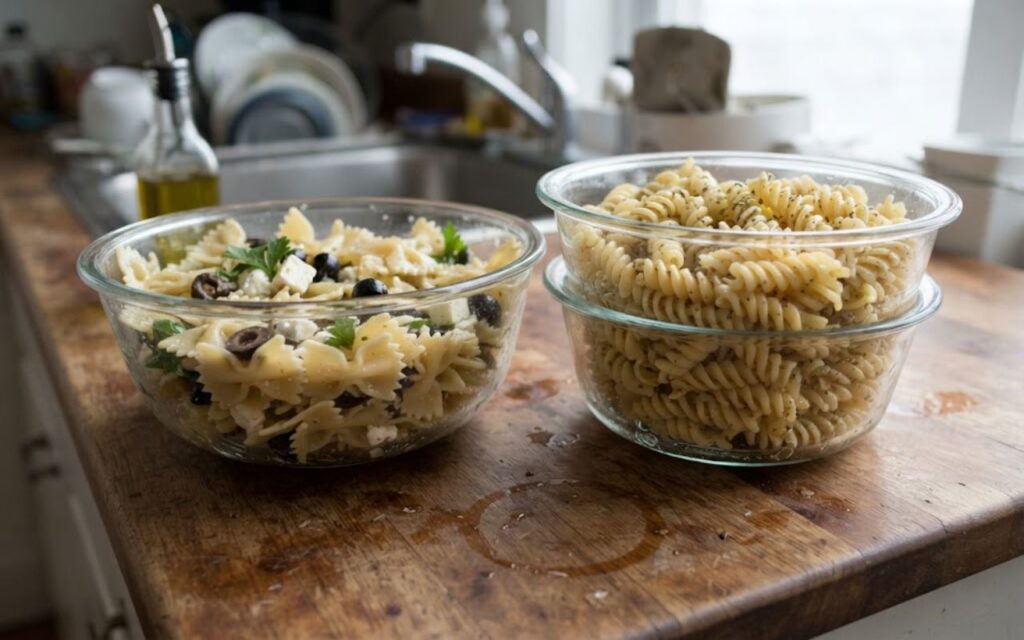
When building a summer cookout staple, deciding between Farfalle vs. Rotini directly determines whether your dish holds its structural integrity or turns into an oily, uneven mess. Home cooks frequently struggle with cold pasta salads because chilling starches fundamentally alters texture, mouthfeel, and fluid absorption.
While standard recipe blogs treat pasta shapes as interchangeable visual garnishes, the hydrodynamic physics of cold dressings and fork delivery require a precise structural match. Understanding the mechanical differences between bowties and corkscrews ensures your vinaigrette clings rather than pools at the bottom of the bowl.
Quick-Glance Kitchen Summary
Rotini outperforms farfalle in cold pasta salads due to its uniform extrusion thickness and helical grooves that trap vinaigrettes, whereas farfalle suffers from uneven center-to-edge cooking rates. Select rotini for acidic, emulsified oil dressings and reserve farfalle for lighter, room-temperature preparations tossed with whole pestos or larger antipasto cuts.
- Core shape selection: Rotini for maximum emulsion suspension, farfalle for lighter fork plating with broad ingredients.
- Boiling strategy: Cook 1 to 2 minutes past traditional warm al dente to offset amylose starch retrogradation upon cooling.
- Extrusion type: Teflon-die pasta prevents excessive liquid absorption in wet dressings, whereas bronze-die pasta works best for oil-based vinaigrettes requiring surface starch grab.
- Cooling protocol: Shock on a sheet pan with a light toss of finishing oil rather than submerging in cold tap water to preserve seasoned surface starches.
Geometric Thickness Discrepancies and Differential Starch Hydration
Farfalle presents a notorious engineering flaw in the context of cold salads: its central pinch. The pinched core contains three to four times the mass density of the delicate ruffled outer wings. Cooking farfalle until the center reaches true al dente invariably overcooks the delicate wings, causing them to shred during vigorous tossing.
If a cook removes farfalle from the boiling water early to preserve the perimeter, the center knot turns chalky and unpleasantly hard once chilled. This disparity worsens as amylose molecules recrystallize during refrigeration, an unavoidable biochemical process known as starch retrogradation. Rotini eliminates this issue because its continuous helical ribbon maintains a uniform cross-sectional thickness from end to end.
Because rotini cooks evenly throughout its entire spiral matrix, it retains a predictable, uniform chew across every forkful. The corkscrew extrusion allows water to circulate at identical flow rates across all surfaces, avoiding localized hydration gradients.
Vinaigrette Cling Mechanics and Helical Groove Performance
Cold pasta salads rely on viscous, acidic emulsions such as Italian vinaigrettes, mayonnaise, or yogurt bases. Rotini excels here because its screw threads act as capillary channels that physically trap suspended dressing components, finely minced herbs, and micro-diced aromatics. Farfalle offers two flat, slick planes that permit thin oil-and-vinegar emulsions to slide directly off the pasta body and pool at the bottom of the serving dish.
| Parameter | Rotini (Helical Extrusion) | Farfalle (Pinched Bowtie) |
|---|---|---|
| Wall Thickness Uniformity | Uniform cross-section ensures identical gelatinization throughout the entire shape. | Variable core thickness causes chalky centers or mushy outer wing margins. |
| Dressing Cling Mechanism | Helical channels physically capture emulsions via mechanical surface tension. | Flat planar surface sheds thin vinaigrettes into the bottom of the serving vessel. |
| Starch Retrogradation Resistance | Uniform chew prevents rock-hard focal points when refrigerated below 40 degrees Fahrenheit. | Center knot hardens severely due to dense amylose recrystallization in cold storage. |
| Micro-Add-In Suspension | Coils trap capers, minced shallots, crushed chili, and grated pecorino cheese. | Broad surface pushes micro-ingredients away, leaving them isolated in the bowl basin. |
| Mechanical Tossing Durability | Spiral structure withstands vigorous metal-spoon folding without tearing or fragmenting. | Fragile ruffled wings snap and fray under heavy mixing with dense vegetable additions. |
The structural geometry of rotini creates pockets of surface tension that hold emulsified dressings in place for hours. Farfalle requires significantly thicker, sticky binders like heavy mayonnaise or sour cream to achieve equivalent ingredient adhesion.
Extrusion Die Surface Profiles and Amylose Starch Retrogradation
The method of commercial extrusion plays a massive role in whether your chilled pasta absorbs dressing cleanly or turns into pasty mush. Bronze-cut pasta features a rough, porous, matte exterior that works wonders for clinging to warm emulsions like ragù. In cold applications, however, extremely porous bronze-cut pasta can over-absorb thin acidic dressings, leaving the dish dry and chalky within two hours of chilling.
Enthusiasts in culinary forums frequently report that teflon-extruded pasta from mainstream commercial producers performs exceptionally well in standard picnic salads. The smoother teflon-die exterior creates a controlled boundary layer that resists sogginess from vinegars while still accepting oil emulsions. When choosing between brands, consider how long the salad will sit before service:
- De Cecco (Bronze-Die): Best for same-day pasta salads eaten within two hours, providing high initial sauce grip without heavy mayo.
- Barilla or Ronzoni (Teflon-Die): Ideal for make-ahead overnight pasta salads because the smooth surface resists excessive liquid penetration.
- Garofalo (Heavy Bronze-Die): Produces a very firm, toothsome bite but requires double dressing volume to compensate for aggressive absorption.
Regardless of the die profile, chilling boiled pasta activates amylose starch retrogradation, wherein gelatinized starch chains realign into tight, crystalline structures. This molecular realignment naturally firms the pasta, which is why boiling the pasta roughly 60 to 90 seconds beyond standard hot al dente is essential for cold service.
Temperature Shock Cooling Protocols and Dressing Emulsion Timing
A pervasive debate across home cooking forums centers on whether to rinse cooked pasta under cold tap water. Rinsing pasta under running water immediately strips away surface starches and dilutes the residual salt absorbed during the boil. Furthermore, tap water can introduce chlorine off-flavors directly onto the stripped starch lattice.
The professional method involves spreading the drained pasta across a wide, parchment-lined half-sheet baking pan in a single layer. Drizzle the pasta immediately with one tablespoon of neutral olive oil or a small splash of the prepared vinaigrette to prevent sticking. This allows steam to evaporate rapidly without diluting the surface chemistry, yielding a pasta that stays springy rather than waterlogged.
Timing your dressing application is equally vital to balancing acidity and fat absorption across the pasta surface:
- Warm Phase Application: Toss one-third of the acidic dressing over the pasta while it is still warm to infuse flavor deep into the outer starch layer.
- Chilling Phase: Allow the dressed pasta to cool completely to room temperature before placing it into cold refrigeration below 40 degrees Fahrenheit.
- Final Service Refresh: Toss the remaining two-thirds of the dressing and fresh herbs directly before serving to restore a vibrant sheen and lively acidity.
This staging prevents the pasta from drinking up all your dressing fat while locking in clean flavor.
Ingredient Suspension Architecture and Fork-Capture Geometry
A truly great pasta salad delivers a balanced distribution of ingredients in every bite, which depends entirely on fork-capture dynamics. Rotini acts as a three-dimensional rake, catching cured meats, cubed provolone, halved kalamata olives, and diced bell peppers in conjunction with the pasta spiral. The coils wedge small dice directly against the tines of a fork, creating a self-assembling bite.
Farfalle, conversely, functions like a flat plane that pushes chunky ingredients away during the scooping motion. Diners eating farfalle salads often experience an uneven meal, consuming isolated pasta bowties first and then hunting for loose antipasto chunks at the bottom of the plate. If you choose farfalle for its charming visual presentation, you must calibrate your knife work to suit its flat, broad wings:
- Vegetable Cuts: Slice ingredients into wide, thin ribbons using a mandoline or vegetable peeler to mirror the flat wings of the bowtie.
- Alliums and Herbs: Avoid finely minced shallots or garlic, which slide off farfalle and sink to the base; use sliced scallions or torn fresh basil instead.
- Cheeses: Opt for shaved ribbons of aged parmesan or fresh torn bocconcini rather than dense, small cubes that easily roll away.
Matching the mechanical architecture of the pasta shape to the physical geometry of your mix-ins transforms an amateur cold pasta bowl into a cohesive, restaurant-grade dish. For effortless, forkable bites with standard antipasto ingredients, rotini remains the indisputable culinary champion.