
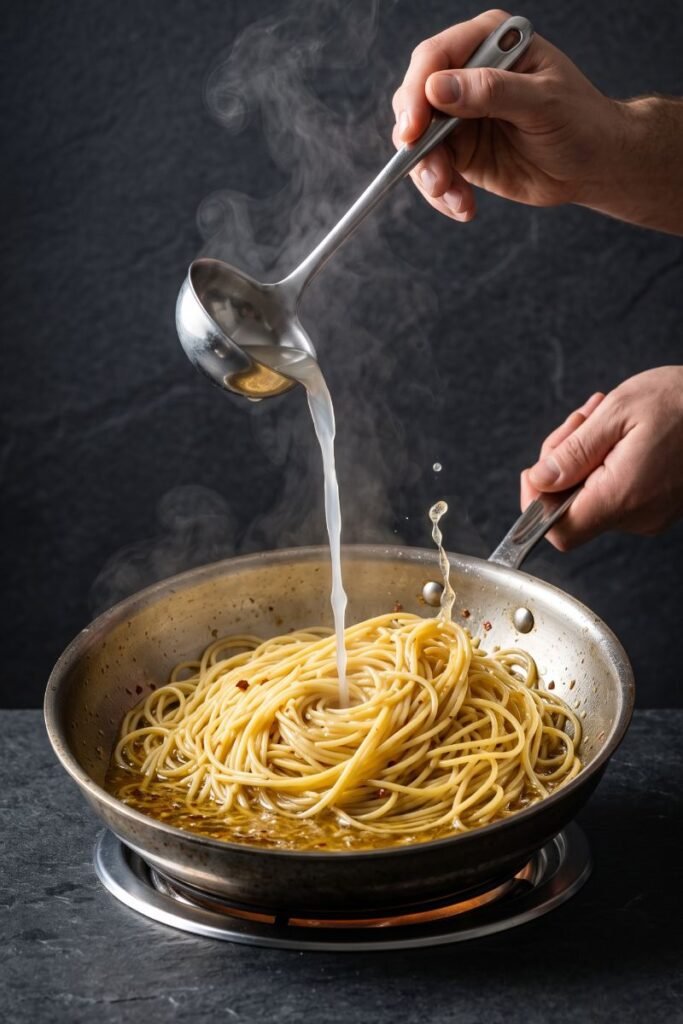
When I lift a long strand of spaghetti out of my boiling pot and look at the milky, clouded liquid left behind, learning how to properly use starchy pasta water is the single greatest technique for achieving a luxurious, restaurant-quality glaze. Over my years of executing regional Italian meals, I have treated this leftover cooking broth as a precious liquid binder rather than a waste product to dump down the sink drain.
Whenever I watch casual cooks completely drain their wheat into a colander and shake away every drop of moisture, I notice how their final sauce breaks down into a greasy, separated puddle at the bottom of the bowl. For me, pulling off a flawless dinner requires using those floating amylose starch strands to lock oil and water together into a uniform, velvety cream.
How Floating Wheat Molecules Create a Smooth Sauce
To understand why this cloudy broth carries such immense structural power inside the skillet, you have to look closely at how starches react to hot boiling water. As dried durum wheat cooks inside the pot, the intense heat forces the tightly packed amylose and amylopectin granules on the surface of the pasta to swell, crack open, and shed their proteins straight into the liquid.
When you combine plain extra virgin olive oil and water in a hot pan, the two elements naturally fight each other, causing the fat to float away in slick, unappetizing circles. Siphoning off that cloudy, starch-heavy boiling water introduces a natural physical bridge known to chefs as an emulsifier.
The floating starch strands wrap around the microscopic oil droplets, trapping them evenly inside the water layer so the fats can never group back together or separate. This structural binding completely changes the texture of the liquid, transforming a watery broth into a rich glaze that naturally thickens without requiring heavy flour thickeners or heavy cream.
Simple Stovetop Tricks to Maximize Your Starch Cloudiness
Because a high concentration of starches makes your final pan binding significantly stronger, my first rule is to purposefully use less water in my boiling pot than mass-market boxed directions recommend. Boiling your noodles in a smaller, concentrated volume of liquid forces the shed wheat proteins to pack tightly into the water, yielding a deeply clouded, yellowish broth that carries double the binding power.
I follow the beginner-friendly grain handling parameters and regional emulsion insights detailed in Barilla’s Official Kitchen Tips Guide to safely regulate my liquid-to-dough properties. To keep this dense, cloudy liquid fully accessible near my stove burner, I highly recommend using a high-walled strainer pot like the accessible designs highlighted inside my review of the Best Pasta Pot for Arthritis.
Using a built-in strainer basket allows me to lift the cooked wheat straight out of the vessel while leaving the precious pool of golden starch broth completely undisturbed at the bottom of the pot. I make sure to scoop out at least one full cup of this liquid roughly sixty seconds before my pasta reaches al dente to capture the starch at its absolute peak thickness.
The Method for Tossing Your Pasta Directly Inside the Skillet
Once my reserved cup of golden liquid is resting safely on my counter, my workflow shifts entirely toward an aggressive pan-tossing technique inside a wide skillet. I never drop my noodles into a cold bowl and dump sauce over the top; I transfer my under-cooked, firm strands directly into my simmering oils while they are still piping hot.
I immediately pour in a small splash of my starchy broth and begin vigorously shaking the handle of the skillet while folding the wheat over itself with long tongs. This rapid manual agitation creates intense physical friction, forcing the hot fats and the starchy liquid to rapidly bubble, fuse, and whip together in real time.
Watching this violent bubbling action change into a uniform, glossy sheen that wraps around each strand is my ultimate sensory cue of success. This exact friction technique is the precise foundation I use to fuse melted dairy fat and wheat into a creamy velvet coat when executing my Authentic Fettuccine Alfredo (Al Burro).
Preventing Over-Salting Blunders When Using Pasta Liquid
The final rule for mastering your starch additions requires keeping a close eye on your sodium accumulation to protect the clean balance of your dish. Because we salt our initial boiling water generously to season the inside of the wheat, that reserved broth carries a highly concentrated hit of sodium that reduces further on the skillet flame.
If you continue to dump multiple ladles of this liquid into a pan that has already been seasoned with salty cheeses or cured meats, your sauce can easily cross from perfectly seasoned to inedible. To avoid this trap, I never add raw table salt to my simmering sauce base until after my final pan-tossing emulsion phase is completely finished.
I use the starchy water strictly to adjust viscosity, adding it two tablespoons at a time if the pan dries out too quickly over the high heat. For me, using the natural starch cloud running through my boiling pots is the ultimate secret to delivering a flawless, cohesive Italian dinner to my family table.