
When I lift a clean kitchen towel off an overnight proofing bowl and spot a sunken, deflated expanse of flour pitted with weeping gas vents, learning exactly how to fix over-proofed dough is the ultimate line of defense protecting your baking day from total collapse. Over my years of managing live yeast populations and stretching delicate cell lines, I have treated gas exhaustion and weakened gluten matrices as basic material stress problems with predictable, logical answers.
Whenever I see amateur home bakers panic when their dough expands too far, watching it turn into a sour-smelling slurry before scraping the entire sticky batch directly into the trash can, I notice how a lack of structure management limits the kitchen. For me, breathing fresh life back into an over-extended yeast harvest requires deflating the weak pockets immediately, reshaping the gluten networks, and executing a controlled secondary counter fermentation.
Why Exhausted Yeast Cells Cause Your Crust to Collapse
To understand why an over-risen dough ball structurally caves inward when exposed to oven heat, you have to analyze the biological life cycle of standard bread yeasts. In the early stages of fermentation, microscopic organisms consume the raw sugars inside your flour, producing carbon dioxide gas bubbles that balloon the surrounding gluten sheets upward into a tall, plush dome.
If you leave the container sitting on a warm counter for too long, those ravenous yeast cells consume their entire food supply, running completely out of fuel while generating a massive excess of liquid alcohol and organic acids. This heavy chemical accumulation weakens the structural integrity of the surrounding protein walls, making them thin, brittle, and completely incapable of supporting their own weight.
When you move the fragile dough ball, those over-stretched cells pop like bubbles, causing the entire loaf to collapse instantly into a flat, gummy pancake that refuses to rise in the oven. I monitor these exact fermentation limits and carbon dioxide trapping mechanics carefully when stretching out low-stress starch foundations, a structure rule I balance precisely when rolling out the base for my Potato Pizza Recipe.
The Mechanical Power of Reshaping and Gas Evacuation
My absolute baseline technical rule for pulling an over-risen batch back from the brink of failure relies on a firm, manual degassing and reshaping session. I follow the technical fermentation curves, flour elasticity scales, and structural cell restoration parameters documented inside the official The Kitchn Dough Proofing Troubleshooting Guide to safely execute my kitchen rescues.
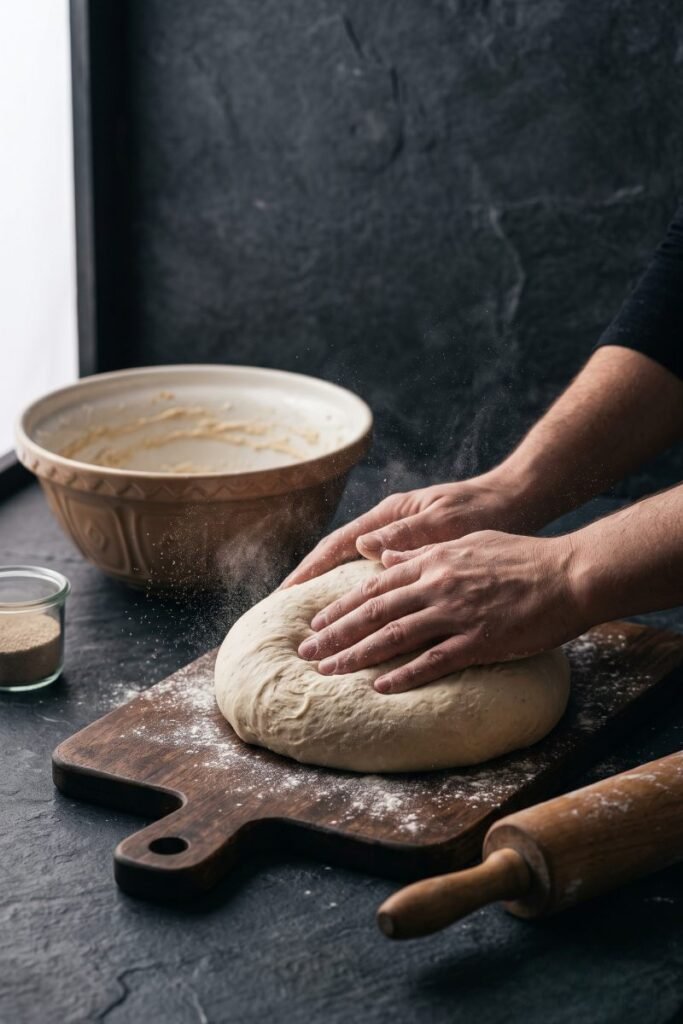
The exact second you see a wrinkled, flat top layer inside your bowl, tip the sticky dough mass out onto a bench duster with fine double-zero flour. Use the flats of your hands to press down across the dough, purposefully driving out the trapped, sour alcohol gasses that are breaking down the interior protein structures.
Once the dough is flat, gather the outer edges and fold them into the center, rolling the mass against the wood to build intense surface tension. This mechanical manipulation stretches the relaxed, weakened gluten proteins back into tight, organized lines, giving the dough ball a renewed structural frame that can hold fresh carbon dioxide gas during a brief 20-minute secondary rest.
Executing a Fast Sheet Pan Skillet Sear for Weak Batches
The final law for managing an over-extended batch requires adapting your final cooking method to account for the reduced sugar content inside the wheat. Because the yeast cells consumed the majority of the natural flour sugars during their long over-proofing session, the dough will struggle to form a beautiful, golden-brown crust inside a standard oven cavity.
If you notice your reshaped pizza or bread dough is still looking slightly slack or handles loosely on your wooden peel, bypass the baking stone completely and use a hot cast-iron skillet approach instead. Lightly oil the metal pan with a high-smoke point vegetable oil, press the dough flat into the skillet bottom, and let it cook over a medium stovetop flame for three minutes to blister the undercarriage.
Once the bottom sets into a firm, crispy shell, slide the entire skillet directly under your oven’s high broiler element for two minutes to brown the cheese toppings rapidly. This hybrid stovetop-to-broiler cooking strategy provides massive instant heat transfer that locks the shape of your weak dough into place before it can flatten out, ensuring you still deliver a delicious, restaurant-grade dinner to your table.