
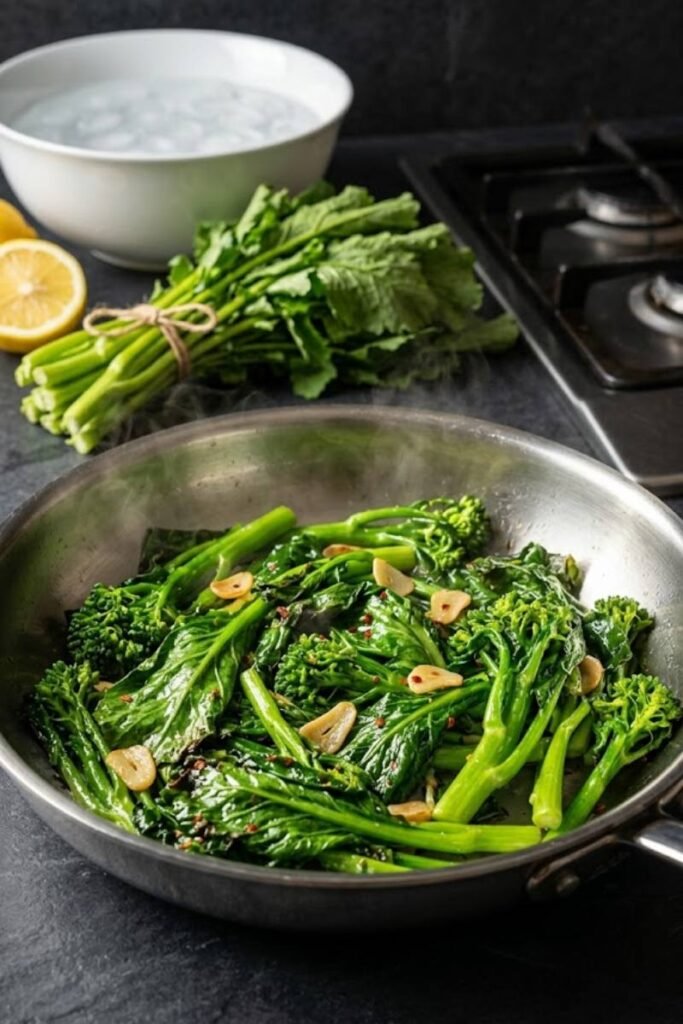
When I trim a fresh bunch of leafy greens on my wooden prep station, understanding exactly what is broccoli rabe is the ultimate baseline step required to balance pungent Italian flavors without overwhelming your palate. Over my years of managing high-volume kitchen lines and monitoring vegetable blanching windows, I have treated enzyme deactivation, sulfur release curves, and salt-fat boundaries as strict chemical formulas.
Whenever I see amateur home cooks dump raw, un-blanched rapini stalks straight into a dry sauté pan and wonder why their final greens taste like an unpalatably harsh, medicinal medicine, it hurts the plate. Watching your guests push these tough, fibrous stalks to the rim of their bowls shows how improper thermal prep ruins the meal.
For me, delivering an elite restaurant-quality Italian side dish simply requires pulling out harsh glucosinolate bitter compounds through a fast water shock before tossing the greens in warm lipids.
This continuous chemical defense ensures the sturdy stalks soften into a nutty, peppery bite, a structural vegetable rule I balance carefully when isolating aggressive chlorophyl traits inside my guide on Flat-Leaf Italian Parsley vs. Curly Parsley.
The Mustard Family Lineage of a Spiky Roman Staple
To understand why this dark green vegetable carries such an intense, aggressive bite across your tongue, you have to look closely at agricultural taxonomy. Despite its common commercial name, broccoli rabe is not a subspecies of standard sweet broccoli at all; it is actually a direct genetic cousin of turnip greens and mustard seeds.
This specific genetic lineage means the leafy sheets and small, dark green florets are saturated with glucosinolates, natural organic sulfur compounds that act as a bitter defense network to deter insects. When you bite into a raw stalk, your teeth crush these cellular walls, instantly releasing a sharp, mustard-like heat and a heavy, tongue-drying bitterness.
Authentic Italian kitchens embrace this deep, peppery punch because it acts as a perfect contrast to rich, fatty pork dishes like roasted porchetta or grilled fennel sausages.
However, unlocking that pleasant, nutty background flavor requires you to execute a multi-stage cooking strategy that tames the wild sulfur gasses without turning your delicate florets into a soggy mush.
The Serious Eats Two-Minute Thermal Blanching Blueprint
The single greatest operational error separating an elite, vibrant side dish from a bitter mess comes down to neglecting your hot water station. I follow the strict trimming profiles, boiling durations, and ice-bath submersion scales documented inside the official Serious Eats Braised Brassica and Greens Directory to keep my vegetable cell walls pristine.
Bring a large pot of water to a rolling boil over a high flame and drop in a generous two tablespoons of coarse sea salt, transforming the liquid into a high-density saline solution.
Drop your trimmed greens into the boiling water, using a wooden spoon to submerge the thickest parts of the bottom stems completely. Let the pot bubble rapidly for exactly two minutes; this brief thermal blast rapidly dissolves the highly water-soluble glucosinolate compounds, drawing the harsh bitterness out into the water.
This rapid osmotic draw works effectively because the intense heat breaks down the outer cell membranes, forcing the sharp organic sulfur compounds to leach away into the surrounding hot currents rather than anchoring inside the plant tissue.
Use tongs to lift the bright green stalks out of the heat and plunge them immediately into a massive bowl of ice-cold water to halt the internal cooking progression instantly.
This rapid temperature drop locks the bright chlorophyll colors firmly into the leaves, preventing the delicate green heads from turning a dull, muddy brown color inside your sauté pan.
This precise cold shock stops structural enzyme decay instantly, preserving a crisp cellular integrity that handles skillet heat smoothly without breaking apart into an unappealing green paste.
Driving Deep Umami into the Softened Green Stalks
The final law for successfully finishing your rapini assets requires building a high-lipid, high-aromatic frying pan environment that coats every single leaf evenly. Once your blanched greens are drained, grab a clean kitchen towel and wring the bunches out aggressively to expel any trapped water pockets from the florets.
If you drop wet greens into a pool of hot fat, the water will instantly steam-boil the oil, preventing the vegetable from searing and washing away your seasoning. Pour a heavy quarter-cup of extra virgin olive oil into a skillet over medium heat, dropping in four thinly sliced garlic cloves and a half-spoon of red pepper flakes.
Let the aromatics toast slowly until the garlic turns a pale golden color, then tumble your dry, blanched greens directly into the hot, infused oil. Use your tongs to toss the greens continuously for three minutes, forcing the seasoned oil to coat every single spiky edge and open floret cluster uniformly.
I know my skillet execution is completely successful when the edges of the green leaves develop tiny, crisp seared boundaries while the garlic slices stay tender. Splash a drop of fresh lemon juice across the top right before sliding the hot greens onto your dinner table to provide a bright acid finish.
Taking the extra five minutes to execute a salty blanch and manage your pan oil is the ultimate kitchen secret to keeping your Italian greens elite.