
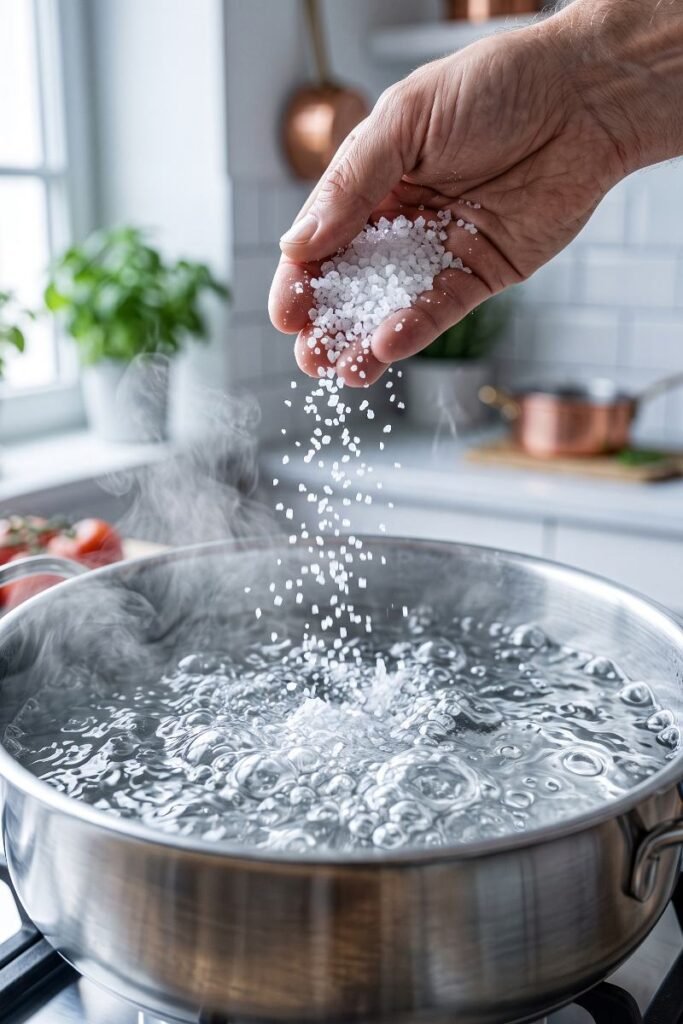
When comparing how much salt for pasta water is required for an authentic Italian dinner, you have likely noticed a massive variation in recipes. Seasoning your boiling pot is the single most critical step of the entire meal because it acts as your only opportunity to flavor the dry noodle dough from the inside out.
For home cooks trying to elevate their Italian cooking, guessing the volume of seasoning can feel like a frustrating game of trial and error. Striking the perfect balance between an under-seasoned, flavorless dough and a harsh, metallic salinity requires understanding a foundational mathematical ratio used across Italy.
How Salt Chemically Changes the Pasta as it Boils
To understand why seasoning is essential, you have to look at what happens to dry flour networks under heat. Dried pasta is composed almost entirely of tightly bound starch granules and gluten proteins. When dropped into a boiling pot, these starch molecules absorb liquid, swell up, and begin to expand.
If your cooking liquid contains zero sodium, the pasta absorbs plain, flavorless water, locking that bland profile permanently inside the center of the cooked noodle. No matter how heavily you season your sauce later, it can only coat the outermost surface of the pasta shape.
When you add the correct ratio of salinity, sodium ions ride the water molecules deep into the expanding starches. This chemically amplifies the natural, nutty aroma of the durum wheat flour, giving the starch a rich, savory backbone that perfectly complements your final plating.
The Famous Italian 1-10-100 Rule
In authentic Italian kitchens, seasoning is never done by guesswork or “palmfuls.” Instead, chefs rely on a memorable metric formula designed to ensure perfect baseline salinity every single time you turn on the stove:
- 1 Liter of Water: The minimum volume required to cook 100 grams of starch smoothly without crowding the pot.
- 10 Grams of Salt: The precise weight required to achieve a clean 1% salinity environment.
- 100 Grams of Pasta: The standard individual portion size for a traditional Italian multi-course meal.
If you are cooking a standard one-pound box of long noodles (approx. 450 grams) for a family dinner, you simply scale this rule up. You will need roughly 4.5 liters of water mixed with 45 grams of salt.
Coarse Sea Salt vs. Kosher Salt Densities
The type of crystal sitting in your pantry drastically changes how much sodium fits into a single measuring spoon. Traditional Italian recipes strictly use coarse Mediterranean sea salt (sale grosso). However, if you are cooking in an American kitchen, you are likely reaching for a box of coarse kosher salt.
Never swap these varieties one-to-one by volume. As detailed in the Serious Eats Cooking Salt Salinity Guide, different crystal structures pack tightly or loosely inside a spoon. Fine table salt consists of tiny, compact cubes, making it twice as salty by volume as light, hollow flakes of kosher salt. If a recipe calls for 1 tablespoon of dense sea salt and you use fine table salt, you will completely ruin your dinner. When in doubt, always measure your seasonings using a digital kitchen scale rather than cups or spoons.
Adjusting for Your Sauce Selection
While the 1% ratio is the golden standard, you must learn to adjust your baseline salinity depending on the specific profile of the meal you are creating.
Lighter, Butter-Based Pastas
If your dish features delicate, quick coatings, keep your water at full strength. This guarantees the noodles carry enough internal pop to blend with simple fats, which is the exact technical method required to carry the clean profile of our traditional Spaghetti Aglio e Olio e Peperoncino.
Heavy, Cured Meat Sauces
If your dinner features naturally salty, intense ingredients like Pecorino Romano cheese, capers, pancetta, or aged hard cheeses, dial your pot seasoning down to 5–7 grams per liter. This prevents the final tossed dish from crossing over into overwhelming sharpness, which is a vital balance to maintain when executing our creamy Cacio e Pepe Recipe.
The Ultimate Rule: Never Add Olive Oil
A stubborn kitchen myth suggests adding a splash of olive oil to the boiling pot to keep noodles from sticking together. Never do this. Oil is hydrophobic and floats directly to the top of the water. When you pour the pot through a colander, that surface oil clings to the pasta, creating a slick, water-resistant barrier. This completely blocks your marinara or ragu from adhering to the starches, leaving your beautiful sauce to slide straight off the noodles and pool uselessly at the bottom of your bowl.