
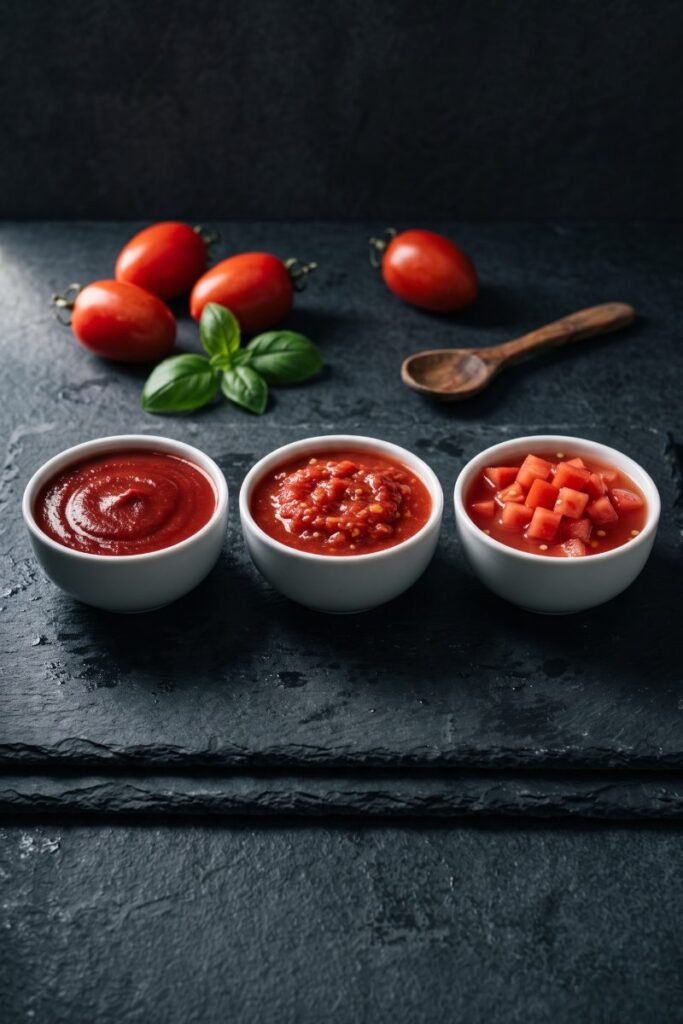
When mastering the technical nuances of passata vs crushed vs diced tomatoes for your home cooking, it is easy to assume that all canned variants behave identically on the stovetop. After all, every can contains the exact same base ingredient harvested from the vine. In traditional Italian kitchens, however, these distinct preparations are treated as entirely separate building blocks with unique chemical and physical properties.
For home cooks striving to unlock professional-quality results, picking the wrong can at the grocery store can entirely alter the structural success of a dish. Replicating the authentic mouthfeel of a true regional sauce requires understanding how these unique solids break down under heat and how their water content impacts your pan reduction.
How Thickness and Chunkiness Affect Your Cooking
To understand why these options cannot be swapped interchangeably, you have to look at how each variety is processed. The thickness and structural integrity of a canned tomato dictate how it transfers heat and coats a piece of pasta. When a tomato is chopped, crushed, or strained, it releases an enzyme called pectinase, which naturally begins to break down the firm pectins holding the fruit’s cell walls together.
Industrial processing plants control this breakdown using varying degrees of heat. Passata receives immediate high-heat flashing to lock in natural sugars before straining. Conversely, diced tomatoes are treated with a chemical firming agent called calcium chloride.
According to official food safety and composition standards tracked by the USDA FoodData Central Agricultural Registry, this specific mineral treatment permanently alters the structural integrity of the vegetable tissue.
This chemical bond forces the diced cubes to maintain their rigid shape even after hours of intense simmering, whereas crushed tomatoes retain a loose, pulp-heavy profile that absorbs fats effortlessly.
Mastering Tomato Passata
Because passata is completely smooth and entirely free of watery seed liquid, it possesses a deep, uniform consistency straight out of the bottle. It functions as a clean canvas because it cooks down incredibly fast without separating into water and oil phases. You should strictly reach for passata when creating silky, minimalist bases where chunks of skin or seeds would ruin the velvety presentation.
This uniform profile is the exact technical reason strained purée serves as the foundational core for our smooth, aromatic Classic Italian Tomato Sauce. Because it lacks heavy solids, it coats long, thin pasta strands evenly, ensuring no thick weight strips down delicate noodles while heating. It emulsifies quickly with premium olive oil, transforming into a uniform coat within ten minutes.
When Crushed Tomatoes Are Mandatory
Crushed tomatoes offer the ultimate sweet spot between a smooth liquid and a heavy, rustic paste. When you open a high-quality can of crushed tomatoes, you are looking at tiny, soft pieces of tomato flesh suspended in a thick, concentrated purée layer. This multi-textured composition makes crushed tomatoes the ideal choice for any slow-cooked meal featuring braised meats, ground proteins, or layered casseroles.
The soft pulp particles melt directly into your cooking fats over a 30 to 45-minute simmer, thickening your gravy naturally without requiring artificial starch binders or heavy flour additions. Use this variety whenever you are building rich, savory structures for meat toppings or deep skillet reductions that need a substantial, fork-clinging presence rather than a smooth glaze.
The Specific Role of Diced Tomatoes
Many home cooks mistakenly buy canned diced tomatoes expecting them to break down into a smooth marinara sauce. This is a fatal technical mistake. Because of the added firming calcium salts, those distinct tomato cubes will remain completely intact even if you simmer them for three hours on your stove.
If you attempt to make a smooth pasta coating with diced tomatoes, you will end up with a watery pool of liquid at the bottom of your plate scattered with hard, rubbery fruit chunks.
However, this rigid firmness is highly valuable in other culinary applications. You want to utilize diced tomatoes exclusively when you explicitly require visible, structural pockets of bright acidity that can withstand the extreme dry heat of an oven without turning to soup.
This intense heat resistance is precisely why firm, cubed pieces excel inside our robust Oven Baked Rigatoni with Meatballs, as the cubes maintain their juicy identity alongside heavy cheeses without dissolving into a loose puddle.