
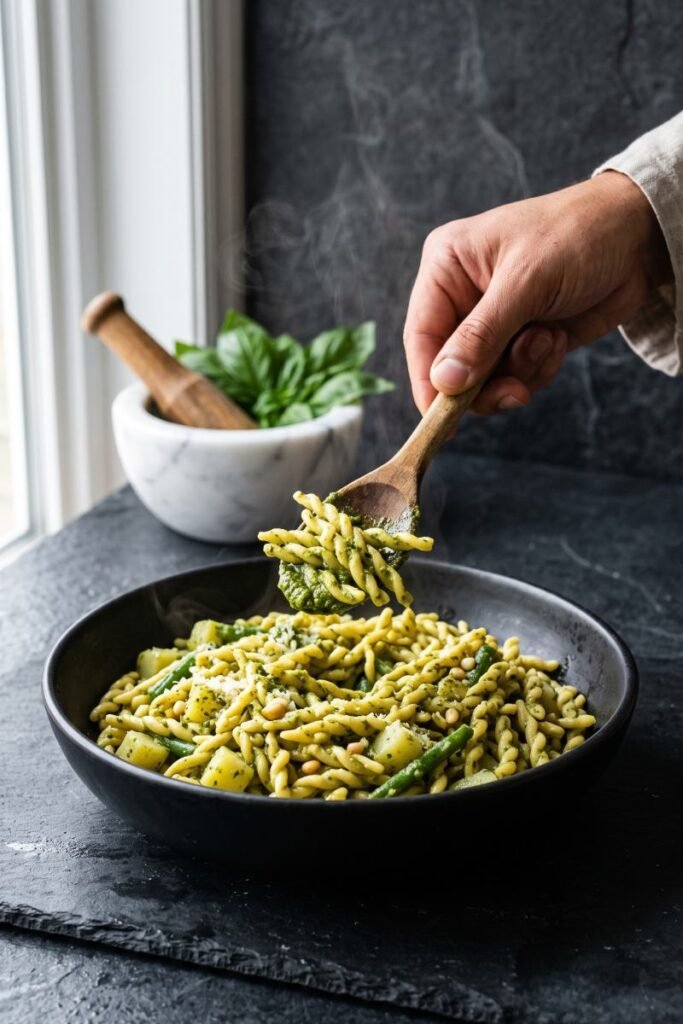
When I travel up the rugged coast of northern Italy and sit down at a seaside trattoria in Genoa, studying my Trofie Pasta Guide notes reminds me how fiercely Italians guard their regional food boundaries. Over my years of mastering traditional sauces, I have learned that pairing a fresh basil emulsion with standard boxed spaghetti or penne is considered a severe cultural offense by local purists.
Whenever I see international kitchens smothering heavy, hot fettuccine strands in a jar of cooked green paste, I notice how it entirely destroys the intended structural balance of the meal. For me, replicating an authentic plate of Trofie al Pesto requires respecting the physical mechanics of hand-rolled dough and learning why this specific shape was engineered for cold herb dressings.
How Traditional Hand-Rolling Gives the Dough Its Unique Twist
To understand why this noodle holds such an elite status along the Italian Riviera, I always analyze the manual physical gestures required to build its unique shape. The very name trofie stems directly from the ancient Ligurian dialect verb strufuggiâ, which translates literally to “rub” or “roll.”
When I watch traditional Italian home cooks shape this eggless dough, their hands move with a rhythmic, multi-generational confidence. They pinch off a piece of semolina dough the size of a single hazelnut and rub it briskly against a wooden cutting board using the heel of their palm.
This single, sweeping downward stroke elongates the core into a small spindle while simultaneously spinning the ends around a finger to form a tight, central twist. I have observed that this artisanal friction creates a deeply scratched, uneven surface landscape that commercial factory extrusions can never replicate.
Why Cold Raw Pesto Damaged by Hot Skillets Needs This Shape
The primary technical reason I save my hand-rolled twists exclusively for pesto is driven entirely by how this specific shape handles temperature adjustments. True Pesto alla Genovese is strictly an unheated raw emulsion of basil, garlic, pine nuts, and aged cheeses.
If I toss a delicate raw dressing like that into a pan of steaming hot, flat noodles, the intense friction and heat will instantly cook the basil leaves, turning the vibrant emerald green into an unappetizing muddy brown. Because trofie spirals are dense, short, and thick in the center, they retain their firm structure while cooling down rapidly in the serving bowl.
The twisted grooves scoop up the dense olive oil paste without melting the raw garlic profiles or breaking the cheese fats. This temperature harmony is completely different from the bubbling, high-heat pan extractions I manage when baking a savory Homemade Pizza with Sausage.
Boiling Your Pasta and Fresh Vegetables Together in One Pot
When I set out to boil a traditional batch of trofie in my kitchen, my workflow follows a unique regional technique known locally as Trofie Avvantaggiate. According to historical agricultural and cultural registries maintained by the official Regione Liguria Government Portal, the authentic baseline for coastal peasant dishes relies heavily on pairing localized starches to stretch simple ingredients.
Following this ancient maritime method, I never boil my pasta alone; I drop diced yellow potatoes and trimmed fresh green beans into the exact same salted water pot. As the vegetables and the fresh dough cook together over the flame, the boiling potatoes shed massive amounts of loose starches into the boiling water.
I have watched this starchy water transform into a thick, milky liquid that serves as a powerful binding agent for my sauce. This single-pot technique is a beautiful reflection of northern maritime history, a coastal approach to combining starches and fresh components that I also lean on when crisping up my traditional Fritto Misto di Mare.
How to Mix the Starchy Potato Water with Cold Pesto Smoothly
Once my trofie, potatoes, and beans reach a perfect state of uniform doneness, my final step requires removing the entire pot away from any active heating element. I drop my drained, un-rinsed components directly into a cold ceramic serving bowl containing my fresh marble-mortar pesto.
I immediately introduce a small, reserved splash of that starchy potato water and begin aggressively folding the mixture together using a wooden spoon. I watch the starchy water and the cold olive oil fuse instantly, creating a smooth, vibrant green coat that locks cleanly into the spiral twists.
The dense pasta twists deliver a robust, bouncy bite that perfectly balances the crunch of the pine nuts and the creaminess of the grated cheese. For me, pulling a forkful of perfectly coated spirals from the bowl without seeing a single drop of separated oil at the bottom is the ultimate proof of success.