
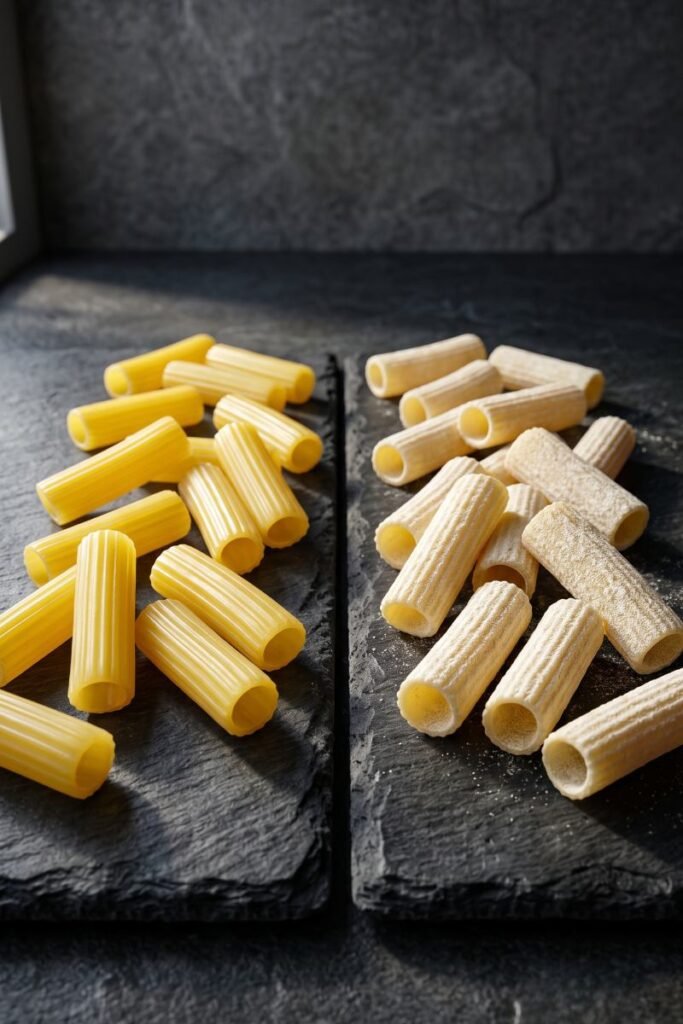
When I stand in the supermarket aisle reviewing rows of cardboard boxes and cellophane bags, identifying true high quality dried pasta is a skill that dictates the success of my entire dinner. Over my years of boiling durum wheat shapes, I have treated the physical texture of dry noodles as a critical design element rather than a standard commodity.
Whenever I watch casual home cooks grab the cheapest, smoothest yellow box off the discount shelf, I notice how it creates a slippery surface that ruins their final sauce cohesion. For me, executing an authentic Italian meal requires inspecting the raw surface of the grain to ensure it possesses the micro-ridges needed to lock onto my pan reductions.
How the Metal Molds Shape the Texture of Your Pasta
To understand why I examine the exterior of my raw noodles so closely, I always analyze the mechanical processing methods used by commercial factories. The type of metal mold used to shape the warm semolina dough completely changes how the finished product interacts with heat and liquid fats.
Mass-market commercial manufacturers rely heavily on high-speed Teflon extrusion inserts because the non-stick surface allows them to pump out thousands of pounds of slick, smooth yellow strands every single hour. While this shortcut cuts down production costs, it leaves the noodle with an impermeable, glassy outer jacket that completely rejects sauce adhesion.
When I hunt for artisanal brands, I look exclusively for dough that has been packed slowly through traditional, heavy bronze extrusion dies. The rough abrasive character of the bronze metal tears open the microscopic surface layers of the wheat, creating a deeply scratched, porous landscape that acts like fine sandpaper.
Looking for the Pale Chalky Finish of True Artisanal Brands
My absolute baseline rule when evaluating a new pasta brand is to look past the branding and study the natural hue and transparency of the dry wheat. I have learned that a vibrant, translucent yellow color is a clear indicator that the factory flash-dried the dough at extreme temperatures to save processing time.
This hyper-speed heating window effectively bakes the starches prematurely, locking the exterior into a rigid, non-absorbent plastic shield that degrades the ultimate al dente chew. Premium bronze-die pasta will always look noticeably pale, matte, and covered in a fine layer of chalky white flour dust straight out of the package.
I rely heavily on this powdery, rough flour coating to thicken my liquid reductions, a texturing trick I use when heavy semolina shapes absorb boiling liquids inside my comforting Italian Lentil and Pasta Soup. This low-and-slow dehydration method preserves the biological integrity of the durum wheat, yielding a superior nutritional structure and a deeper, nuttier grain flavor on the palate.
Checking Your Boiling Water for a Cloudy Milky Look
When I test a new artisanal box on my stovetop, my verification process continues directly into the boiling phase of the meal. I watch the color and cloudiness of my water change, as this fluid composition provides undeniable visual proof of premium structural quality.
According to manufacturing parameters tracked by the Italian Trade Agency English Portal, authentic premium pasta must release an abundant layer of pure amylose starch molecules into the liquid during a steady simmer. I make sure to use a wide, accessible vessel to monitor this transformation easily, relying on the high-walled structural features highlighted inside my Best Pasta Pot for Arthritis.
If my boiling water remains completely clear and watery after ten minutes, I know I am dealing with an inferior, teflon-slick noodle that is retaining its starches. A premium bronze-die strand will turn the water heavily cloudy and milky, yielding a rich, starchy binder that I can ladle straight back into my skillet to emulsify my pan oils perfectly.
Testing the Center of the Cooked Strand for a Springy Chew
Once my boiling test finishes, my final quality assessment happens the exact moment I bite into the center of the cooked strand. I am looking for a dense, highly elastic, and toothsome core that provides a clean structural snap rather than a mushy, waterlogged break.
Because premium semolina retains its high-protein gluten matrix during low-temperature air drying, the noodle maintains its rigid structural bounce even when exposed to aggressive boiling water. Cheaper variants tend to absorb water unevenly, transforming into a slippery outer paste while leaving the very center raw, brittle, and chalky.
When I toss my un-rinsed, rough bronze-die noodles directly into a warm sauce skillet, those microscopic surface scratches act as physical anchors that hold the fat molecules perfectly. Watching the sauce fuse into a uniform, glossy glaze that clings tightly to every single ridge is my ultimate proof that I invested in a truly magnificent product.