
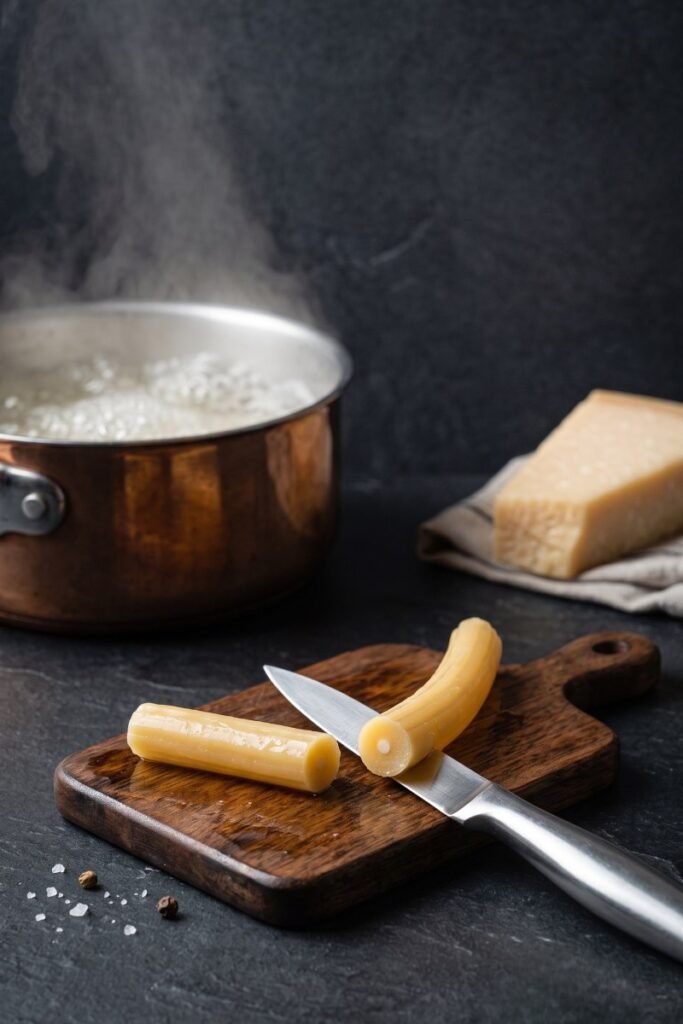
When I pull a steaming strand of wheat out of my boiling pot to check its doneness, understanding exactly what does al dente actually mean is the single most critical factor separating a sloppy dinner from a restaurant-quality masterpiece. Over my years of mastering traditional regional Italian cooking, I have treated the structural firmness of my noodles as a non-negotiable culinary law rather than a loose texture preference.
Whenever I watch casual home cooks blindly follow the generic time windows printed on commercial cardboard boxes, I notice how they almost universally end up with soft, waterlogged dough that ruins their final dish. For me, achieving an authentic regional mouthfeel requires ignoring the kitchen timer completely and learning how to read the physical, hidden structural lines running straight through the center of the grain.
What Al Dente Actually Means
To understand why I guard this firm internal core so fiercely, I always look closely at the chemical changes happening to durum wheat semolina under intense heat. Pasta dough is structurally composed of a dense, interlocking matrix of gluten proteins that trap tiny starch granules tightly inside their cellular walls.
When I drop dry noodles into boiling water, the moisture slowly penetrates from the outside inward, causing the tightly wound starch molecules to hydrate, swell, and soften gradually. If I let the boiling process continue until that moisture hits the absolute center of the noodle, the gluten sheets completely collapse and lose their elasticity.
I have watched overcooked noodles absorb too much water, causing them to turn into a heavy, flaccid paste that rejects sauce adhesion entirely. Keeping the pasta firm preserves the structural resilience of the gluten, which delivers a springy, satisfying bounce on the palate that defines true Italian craftsmanship.
How to Tell When Pasta Is Al Dente
My absolute baseline method for verifying the structural state of my boiling wheat is a technique I call the cross-section slice. Instead of trusting a clock, I stand by my stove with a small paring knife and fish a single strand of pasta out of the boiling water roughly two minutes before the package directions suggest.
I place the hot strand onto a cutting board and slice it cleanly in half to inspect the interior landscape of the cut edge. If the noodle is overcooked, the cross-section will look completely uniform, translucent, and solid yellow from edge to edge.
A technically perfect al dente strand will reveal a distinct, tiny white dot or a thin, pale ring sitting precisely at the very center of the core, which Italians call the anima or the “soul” of the pasta. This visible white speck is the physical proof that a small fraction of un-hydrated raw starch remains, providing the exact structural resistance I need to finish my meal properly.
Why You Should Finish Cooking Pasta in the Sauce
The primary reason I explicitly pull my pasta out of the water while that white starch core is still visible is that my cooking process never finishes inside the boiling pot. I follow the strict culinary guidelines and grain hydration baselines detailed in The Science of Al Dente Guide by Pasta Regina to ensure my starch structures stay completely firm.
I ensure my under-cooked, firm strands are transferred directly into my separate sauce skillet using long tongs, bringing a healthy splash of starchy cooking water along with them. Over the next two minutes, the under-cooked noodle acts like a sponge, drawing in the seasoned fats and pan reductions to finish hydrating that raw white core.
This pan-tossing phase allows the exterior starches to fuse flawlessly with my liquid fats, a technical requirement I rely on to build a glossy, uniform coat on my savory Pasta with Broccoli and Sausage. By letting the wheat finish its cooking cycle directly inside the sauce, the noodles drink in the flavor profiles completely without getting mushy.
How to Keep Pasta Perfect in Seafood Dishes
Once I have mastered reading the inner white ring of thick tubular pastas, applying this visual test to delicate, fine strands requires a significantly higher level of attention. Thin noodles possess an incredibly narrow hydration window, meaning they can shift from a perfect firm bite to an overcooked mess in a matter of thirty seconds.
When I prepare delicate shapes, I start performing my visual slice test early and pull the pasta off the burner the exact second the central white line starts to thin out. I handle these fragile profiles with extreme care, ensuring my seafood reductions are fully reduced and ready to receive the hot wheat immediately.
This hyper-focused timing is exactly how I preserve a clean, resilient bite when tossing light strands into my vibrant Shrimp Linguine with Tomato. For me, respecting these precise physical transformations inside the grain is the ultimate secret to elevating my family table.