
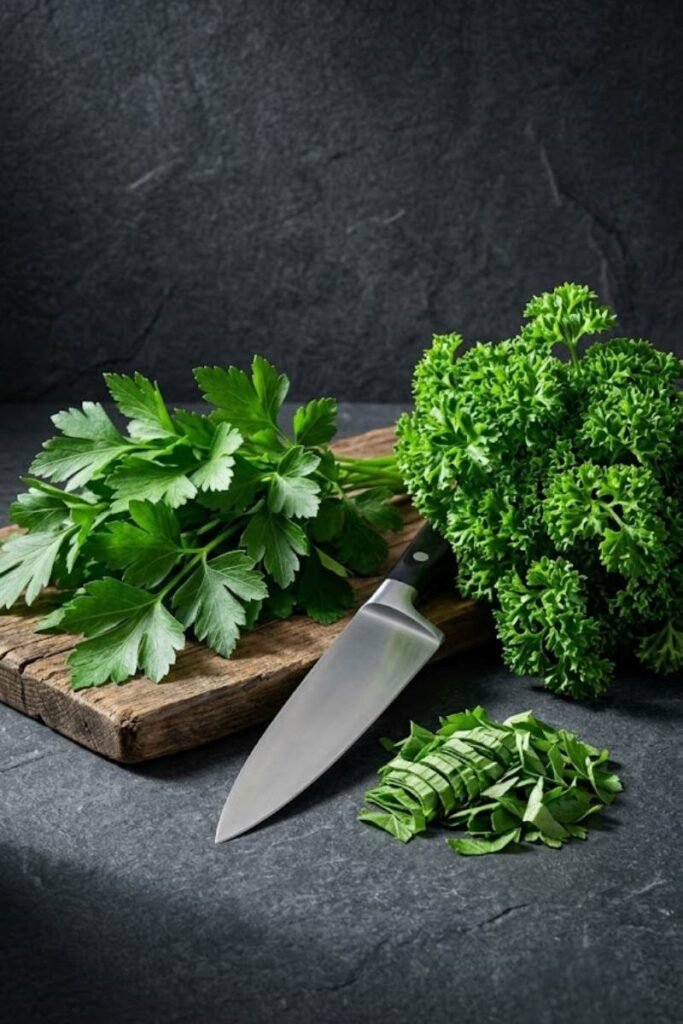
When I run a heavy chef’s knife through a fresh bundle of greens to finish a slow-simmered seafood sauce, balancing the aromatic profiles of Flat-Leaf Italian Parsley vs. Curly Parsley is the absolute core step required to protect your pan bases from tasting like grass clippings.
Over my years of executing traditional regional recipes, I have treated volatile essential oil yields, leaf textures, and structural browning boundaries as strict material variables rather than simple garnishing decisions.
Whenever I see casual home cooks reach for whatever green bundle is nearest in the produce display case, it hurts the dish. Chopping coarse, ruffly leaves into a delicate garlic butter emulsion and wondering why their guests struggle with a tough, scratchy texture shows how bad ingredient pairings limit the plate.
For me, delivering a true restaurant-quality finish requires saving ruffly, water-retaining leaves for external decorations. Instead, depend exclusively on flat, oil-rich stalks to melt cleanly into hot pan juices.
How Essential Oil Yields Alter Your Aromatic Foundation
To understand why professional culinary enthusiasts avoid ruffly green clumps inside cooked pan sauces, you have to look closely at the underlying plant physiology and botanical oil profiles. The smooth, flat-leaf cultivar, known scientifically as Petroselinum crispum neapolitanum, features high natural concentrations of volatile aromatic compounds like apiol and myristicin woven directly into its broad leaf cells.
This high essential oil yield generates a clean, distinctly peppery taste carryover that cuts through heavy cooking lipids smoothly without breaking down over heat. The common curly variation, Petroselinum crispum, prioritizes moisture storage inside its heavily ruffled, fibrous structural frames.
This altered cellular layout yields a noticeably weaker, grassy, and slightly bitter flavor footprint when introduced to warm pan elements. Shaving these weak, water-heavy ruffles into a hot garlic base yields a dull, vegetal finish that washes away your secondary herbal seasonings, a flavor dilution trap I track closely across my entire ingredient station.
I monitor these precise fluid-to-oil variations whenever I choose fresh garden components for my stove, a structural balance focus I maintain when separating fresh volatile leaf fats inside my guide on Can You Freeze Homemade Pesto Sauce? (The Olive Oil Layer Trick).
The Thermodynamic Failure of Ruffly Leaves in Hot Sauces
The next major variable that establishes a deep dividing line between these two common herb variations comes down to leaf surface area and physical breakdown capabilities under direct skillet heat. I follow the strict texture testing data, sensory panel results, and structural herb profiles documented inside the official America’s Test Kitchen Ingredient Evaluation Index to regulate my finishing steps safely.
The rigid, highly convoluted contours of curly parsley are physically engineered to stand tall, a crisp structure that repels water droplets and resists wilting on display platters. When you chop those springy, crinkled leaves and drop them into a hot pan, those dense cellulose skeletons refuse to dissolve or collapse uniformly into the liquid phase.
Instead of melting into a smooth, glossy coat, the micro-planed curly fragments stay floating as stiff, sponge-like particles that actively absorb your sauce’s emulsified fats. When the plate hits the table, this structural resistance translates into an unpleasantly gritty, abrasive texture that mimics the mouthfeel of fine sand trapped inside your velvet reduction.
Flat leaves lack these rigid structural ribs, allowing the chopped tissue to soften completely inside warm steam within seconds, wrapping around your noodles like a smooth jacket without changing the underlying density.
Handling the Wash and Chop Without Bruising Delicate Cells
The final law for successfully working with fresh herbal additions requires executing your cleaning and cutting routines perfectly so you never smash the delicate cellular walls before they hit the skillet. Never run your knife back and forth across a damp bundle of flat leaves in rapid, sawing paths, as this brute pressure breaks down the delicate cell walls against your cutting board.
This crushing movement forces the dark green chlorophyll juices to bleed outward onto the wood, turning your bright, peppery flakes into a dark, bruised paste that oxidizes and tastes unpleasantly metallic inside your pan wells. To execute a flawless artisan chop, ensure your leaves are 100% dry after running them through a salad spinner.
Gather the smooth stalks into a tight, dense cylinder with your non-dominant hand, and pass a razor-sharp chef’s knife through the bundle in a single, clean rocking motion. This clean slicing step preserves the essential aroma oils safely inside the cut rings until the absolute millisecond they hit the hot pan currents.
I know my herb prep is completely successful when the chopped green ribbons tumble away from the blade in fluffy, separate flakes that hold their bright color on the plate. Taking the extra two minutes to select pure flat-leaf bundles and manage your knife friction is the ultimate secret to keeping your Italian cooking elite.