
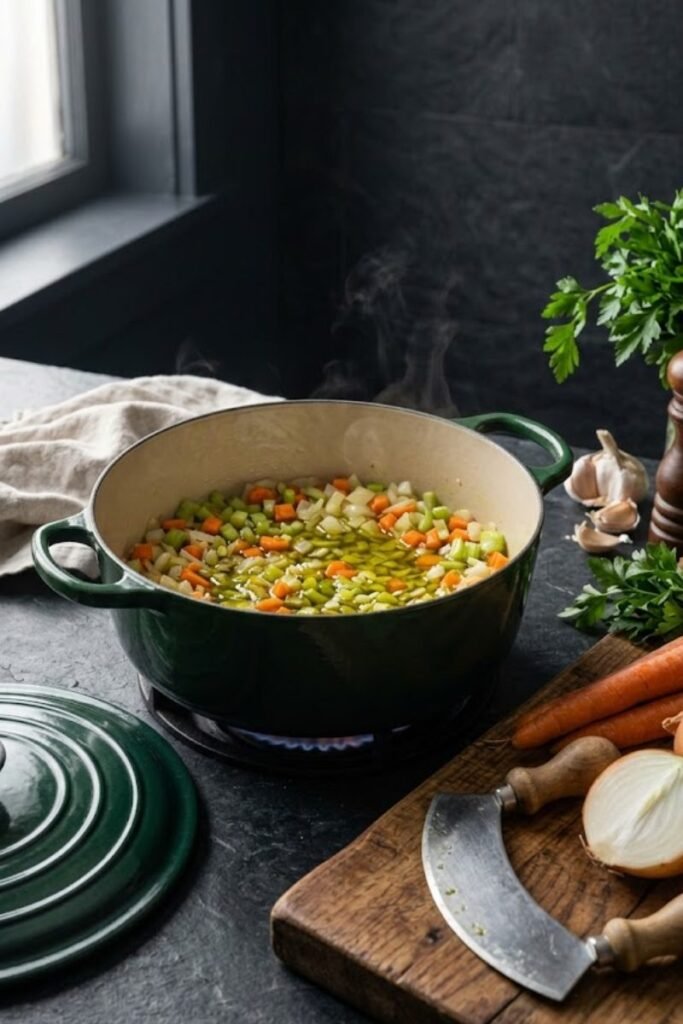
When I set a heavy enameled Dutch oven over a low flame, understanding exactly what is a soffritto is the ultimate structural step required to build an authentic Northern Italian soup or ragù foundation. Over my years of dicing garden aromatics, I have treated vegetable water-release curves, lipid extractions, and enzyme transformations as exact flavor-engineering metrics.
Whenever I see amateur home cooks blast their stove heat to high, frying their minced vegetables until they turn brown and crispy within five minutes, it hurts the base. Watching your pot contents develop a bitter, singed edge before you even pour in your broth shows how poor thermal management completely ruins the foundation.
For me, delivering an elite restaurant-quality dinner simply requires sweating your minced aromatics slowly inside a premium fat pool. This continuous temperature defense ensures the cell walls dissolve into a sweet, melting paste, an essential flavor balancing rule I track constantly when establishing deep, unheated vegetable profiles inside my master guide on the Essential Pantry Ingredients That Define Puttanesca.
The Mathematical Ratio of the Aromatic Holy Trinity
To understand why this simple combination of root crops yields such immense savory depth, you have to examine the chemical structure of the holy trinity of Italian cuisine. While many home cooks throw whatever scrap vegetables they have left in their crisper drawer into the pot, traditional regional cooking dictates a strict volume balance.
The official, chef-vetted foundation relies on a clean 2:1:1 geometric ratio by volume. You must measure out two full parts of finely minced yellow onion to one part minced carrot and one part minced celery stalk.
The massive onion portion provides an abundance of natural sugars and sulfur compounds that soften into a sweet, savory glaze under gentle heat. The carrots contribute a bright carotene sweetness that balances the sulfur, while the celery introduces a woodsy, high-sodium herbal element that deepens the overall complexity.
Technically speaking, this vegetable mixture is referred to as a battuto while it sits raw and cold on your wooden cutting board. The exact second those cold raw fibers hit a warm pool of premium fat, the battuto officially transforms into a cooking soffritto.
Without adhering to these precise volume weights, the flavor profile shifts drastically; too much celery introduces a bitter, aggressive green sharpness, while an overload of carrot turns the entire soup base cloyingly sweet, masking your primary herbs.
The Serious Eats Low-Heat Lipid Sweating Principle
The single greatest operational error separating an authentic, slow-cooked masterpiece from a bitter soup base comes down to pan thermodynamics. I follow the strict dicing profiles, slow-sweating durations, and lipid extraction guidelines documented inside the official Serious Eats Aromatic Base Technical Manual to keep my foundation layers flawless.
When you drop your minced vegetables into a frying pan, your primary goal is to encourage complete cellular breakdown without triggering the Maillard browning reaction. Pour a generous quarter-cup of high-quality extra-virgin olive oil across your pan floor, keeping the flame locked at a low, gentle simmer.
The gentle thermal energy coaxes the vegetable cells to slowly dump their internal water content, allowing the aromatics to cook thoroughly inside their own steam vapors. At the same time, the surrounding olive oil fat acts as an organic solvent, absorbing the oil-soluble flavor compounds from the dissolving vegetable fibers.
This slow mechanical process requires roughly 15 to 20 minutes of patient, attentive stirring. You know your sweating run is fully successful when the onions turn completely translucent, the carrots soften into a matte paste, and the sharp crunch of the celery completely dissolves.
Allowing the pan heat to spike even slightly past this gentle threshold seals the outer vegetable skins, locking the raw, bitter internal fluids inside the cells instead of drawing them out into the cooking oil.
Refining Your Base for Clear Broths vs. Rich Ragùs
The final law for successfully managing your soup assets requires tailoring your knife work to complement the physical density of your final broth. For light, clear vegetable broths or classic Tuscan bean soups, use your chef’s knife to slice the raw aromatics into a uniform, quarter-inch small dice.
This larger cut allows the independent vegetable cubes to retain their clean physical geometry through a long boiling cycle, providing a satisfying pop of color and texture on the spoon. When your menu transitions to rich, velvety pan reductions like a classic Ragù alla Bolognese, completely abandon large, blocky vegetable cuts.
Instead, use a traditional half-moon mezzaluna knife or a food processor to grind the raw aromatics down into a microscopic, grain-sized mince. This extra-fine dice ensures that as the beef fat simmers over several hours, the vegetable structure dissolves away completely into the liquid.
The fibers disappear into the background, leaving behind a smooth, umami-packed glaze that thickens your sauce naturally without introducing chunkiness. This thorough breakdown allows the natural starches to disperse evenly across your braising liquids, preventing any grittiness and binding your pan fats into a beautiful, professional emulsion that coats every noodle.
Taking the extra twenty minutes to respect the mathematical ratios and regulate your pan heat is the ultimate kitchen secret to keeping your Italian soup base elite.