
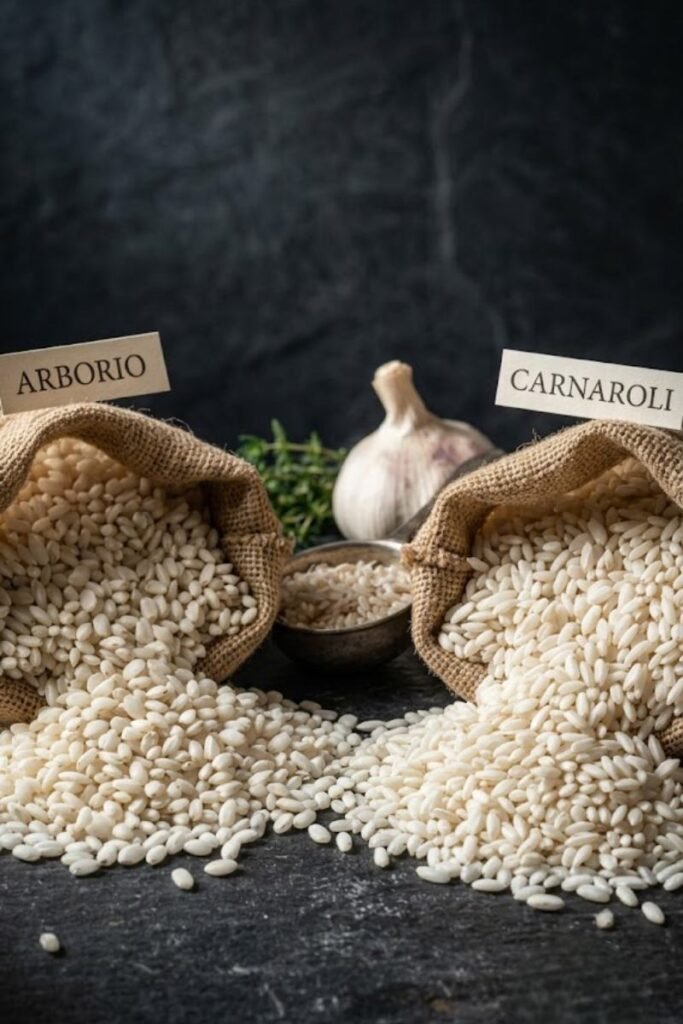
When I weigh out grains for a dinner service, selecting the absolute best rice for perfect risotto is the ultimate structural choice that determines whether your plate finishes as a fluid masterpiece or a heavy mush. Over my years of managing busy kitchen line expansions, I have treated starch density matrices and core kernel thresholds as strict chemical blueprints rather than casual grocery purchases.
Whenever I default to basic, low-protein grain boxes from the supermarket shelf without checking the exact cultivar stamp on the back panel, it completely compromises the meal. Watching your labor-intensive reductions break apart into a wet slurry or an over-extracted porridge shows how matching the wrong grain anatomy to your pan heat instantly limits your cooking.
For me, delivering a true restaurant-quality plate simply requires aligning your cooking time with a grain that features a high amylose concentration to yield an effortless fluid wave. This strict botanical selection process ensures your starches emulsify cleanly across the skillet floor, guaranteeing a smooth and glossy table presentation.
The Amylose Matrix of the Superfino Rice Family
To understand why two white grains sitting inside identical burlap sacks behave so differently inside a hot skillet, you must examine the internal grain structure of Italian Superfino rice. Authentic regional cooking completely rejects standard long-grain options like Jasmine or Basmati because they lack the specific starch structures required to build a natural sauce emulsion.
Italian rice classification relies on grain size, with the elite tier known as Superfino characterized by large, plump kernels featuring a high-density starch core called the perla. Inside this white pearl sits a precise chemical ratio of water-soluble amylose molecules and sticky amylopectin walls.
When these grains are stirred inside a hot broth well, they shed their outer starch cells smoothly to thicken the cooking fat. Choosing a grain variant with a weak starch matrix means the cell walls collapse prematurely, flooding your pan wells with sticky amylopectin before the core can soften.
This structural starch extraction requires a delicate botanical environment where the external cell linings can hydrate without fracturing the internal kernel frame. I balance this grain rule carefully when separating moisture boundaries to prevent standard mechanical breakdown, a cell-trapping protocol I track closely inside my troubleshooting guide on Why Your Risotto is Gummy Instead of Creamy (The Stirring Science).
Without a dense perimeter layer to control the water translation across the endosperm, the cooking liquid drives deep into the grain core far too quickly. This un-regulated moisture fluid translation turns individual kernels into soft, split fragments that fail to hold their geometry.
Arborio: The High-Yield Supermarket Workhorse
Arborio is undeniably the global ambassador of Italian short-grain rice, named after the town in Piedmont where it was first cultivated in the 1940s. It features an exceptionally wide, fat kernel with a large, visible white pearl core that draws up warm liquids incredibly fast.
This high absorption rate makes it highly accessible for home cooks because it swells into a visibly plump, thick porridge within twenty minutes of cooking. However, Arborio carries a relatively low amylose starch percentage compared to its high-end architectural siblings.
Because its outer starch layers dissolve so quickly, the grain structure becomes highly fragile as it approaches a soft state. If your wooden paddle spoon agitates the pan even slightly too forcefully during the final reduction steps, the tender kernels fracture along their midlines, turning a smooth cream into a gummy mass.
This breakdown point occurs because the structural perimeter lacks the necessary density to withstand prolonged mechanical friction over an open gas flame. Home cooks often run into this textural collapse because they expect the grain to handle heavy manual stirring, unaware that Arborio’s thin starch shell will completely disintegrate under aggressive handling.
Carnaroli: The King of Professional Risotto Grains
The single most reliable operational secret hanging inside upscale restaurant kitchens is a complete reliance on Carnaroli, a grain widely hailed across northern Italy as the Il Re dei Risi (The King of Rice). I follow the strict grain selection matrices, kernel density curves, and regional pairing parameters documented inside the official Serious Eats Guide to Italian Rice Cultivars to keep my station setups pristine.
First, Carnaroli possesses the highest internal amylose starch concentration of any grain inside the Superfino family tree. This means it can absorb a massive volume of hot broth, wine, and butter without losing its structural perimeter or blowing out its cell boundaries.
As you execute your gentle manual stirring intervals, Carnaroli sheds a rich, velvety coat of amylose starch that builds a flawless, glossy jacket around the grain columns. This high starch density creates a stable emulsion that handles pan tossing effortlessly, allowing your final dairy additions to lock together into a smooth pourable ribbon.
Second, the structural core of a Carnaroli kernel is remarkably tough, rigid, and resistant to over-extraction over a live stove flame. It offers a much wider margin of safety than fragile Arborio boxes, maintaining a firm, distinct al dente snap even if left sitting inside a hot pan reduction for an extra few minutes during plating.
The rigid interior pearl keeps its firm density intact throughout the cooking process, providing that essential contrast between a creamy sauce layer and a toothsome bite.
I know my grain selection strategy is fully successful when the cooked mass rolls across the plate in a fluid, moving wave that displays zero grain cracking or watery separation lines. Taking the extra minute to track down an authentic blue box of imported Carnaroli is the ultimate kitchen secret to keeping your cooking elite.