
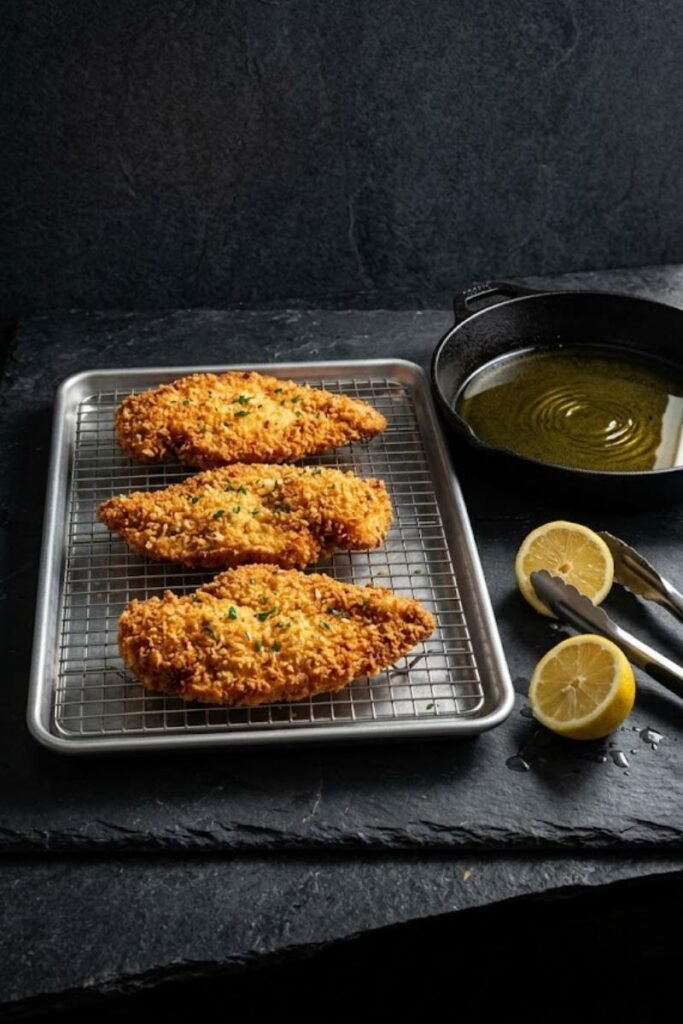
If you are wondering how to keep breaded chicken cutlets crispy, mastering this simple frying method is the absolute ultimate step required to preserve that shattering tableside crunch. Over my years of managing busy kitchen lines, I have treated moisture translation curves and egg wash coagulation as serious thermodynamic variables.
Whenever I see amateur home cooks stack their hot poultry directly on a flat porcelain dinner plate, it completely ruins the texture. Watching the trapped steam pools form between the sizzling layers instantly turns a beautiful crunchy shell into a wet, leathery skin.
For me, delivering a true restaurant-quality bite simply requires breaking your enclosed moisture traps the exact second the meat clears the oil line. This continuous temperature defense ensures the breadcrumb boundary remains completely rigid, guaranteeing a flawless, golden crunch that holds its shape through dinner.
The Invisible Capillary Leak of Trapped Internal Chicken Moisture
To understand why a perfectly fried crust collapses into a soft sponge so quickly, you have to look closely at fluid dynamics and cellular heat translation. When a thin sheet of poultry cooks inside a pool of hot fat, the high frying temperature drives the internal meat juices toward the core, building an internal reservoir of hot water vapor.
The exact second you lift the meat out of the skillet, that trapped internal moisture begins migrating slowly outward toward the dry, porous breadcrumb boundary. If you place the hot bird flat against the non-porous surface of a ceramic plate, you block the escaping water vapor completely.
The rising steam pools inside the narrow space between the plate floor and the bottom breading layer, re-hydrating the crispy starch matrix instantly. This moisture pooling transforms your hard, crunchy egg and flour shield into a soggy, peeling slurry before the platter even clears your kitchen counter.
This deep fluid translation requires a strict moisture containment shield to protect the fragile exterior breading network from inside the meat cell walls. I manage these exact oil-to-meat boundaries constantly when setting up my shallow pan shallow fry lines, a crisp seasoning standard I map out closely inside my master Italian-Style Breaded Chicken Cutlets Recipe.
The Serious Eats Elevated Wire Rack Ventilation Rule
The operational secret to ensuring your breading boundaries remain completely rigid through a long family dinner relies on selecting your post-frying resting stations carefully. I follow the strict protein resting scales, crumb insulation parameters, and skillet oil drainage guidelines documented inside the official Serious Eats Fried Chicken Maintenance Guide to keep my cutlet crusts pristine.
Banish paper towel puddles entirely. Do not let your hot cutlets sit directly on thick layers of absorbent paper towels for more than thirty seconds. While paper lifts away surface grease, it quickly traps the escaping steam underneath. This creates a high-humidity greenhouse environment that breaks down the breading.
Utilize elevated wire separation on your bench. Set a wire cooling rack directly inside a wide, rimmed metal baking sheet on your counter. Transfer the hot meat straight to the open metal mesh grid so that dry room air can circulate around every single side of the bird.
Maintain multi-zone airflow across the station. This vertical spacing allows the escaping internal water vapor to vent into the open kitchen space completely undisturbed. The surface lipids drop away into the baking sheet wells below, keeping the bottom breadcrumb matrix dry and crunchy.
If you need to fry several independent batches for a large dinner gathering, slide the entire wire rack and baking sheet setup into a warm oven set at 200°F. This gentle low-heat air environment keeps the internal starches gelatinized and moving. It lets you scale your inventory numbers safely without triggering structural skin breakdown.
The Starch Science Behind Double-Dredging Insulation
The final law for successfully locking a shattering crunch into your poultry assets requires adjusting your initial flour-and-egg station settings before cooking. Standard pre-packaged supermarket breadcrumbs are milled incredibly fine and flat, creating a dense, non-porous coating that struggles to form deep air cavities.
Switch your breading line exclusively to coarse Japanese Panko flakes or traditional homemade breadcrumbs pulsed into a rough, irregular texture. These large, angular bread fragments create thousands of microscopic air pockets across the skin of the meat as they hit the hot frying medium.
These jagged surface cavities act like physical steam vents, providing safe pathways for internal water vapors to escape outward without melting the underlying flour glue. Always dust your raw chicken cutlets in a thin layer of high-starch cornstarch right before dipping them into your beaten egg wash.
This starch skin forms an incredibly tough, waterproof biological seal that locks the natural meat juices firmly inside the muscle fibers through the frying process. I know my breading structure is fully successful when the drained cutlets feature an intensely matte, golden-brown armor that cracks loudly under a carving knife.
Taking the extra three minutes to set up an elevated wire rack and adjust your flour line is the ultimate kitchen secret to keeping your frying elite.