
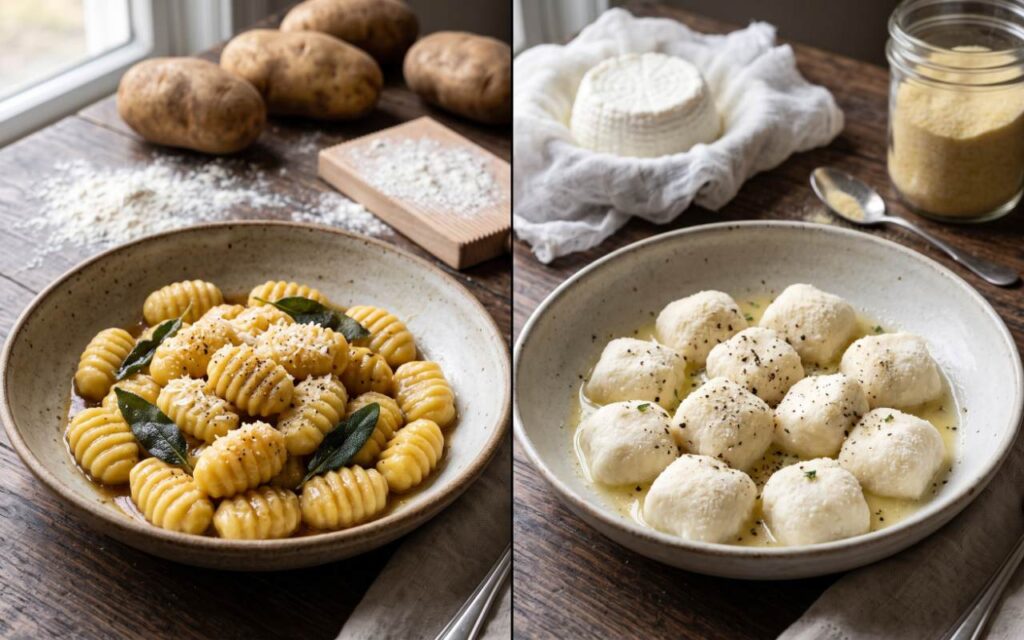
Mastering the culinary divide in gnocchi vs. gnudi comes down to balancing structural starch against delicate dairy proteins. While both deliver pillowy Italian dumplings, their physical mechanics, moisture handling, and threshold for kitchen disaster could not be more divergent.
Home cooks frequently ruin both preparations by treating them as interchangeable variations of the same base dough. Understanding how these ingredients interact under heat will prevent dense, leaden lumps and stop your delicate dumplings from dissolving into cloudy cooking water.
Starch Retrogradation and Potato Cultivars in Classic Gnocchi
The structural foundation of traditional potato gnocchi depends entirely on high amylose content and rapid moisture evacuation. Russet or Yukon Gold potatoes provide the optimal dry, floury starch matrix when baked rather than boiled. Boiling drives water deep into the potato cells; that excess moisture requires compensatory flour, which transforms tender dumplings into chewy, rubbery pellets.
Ricing the potatoes while they are steaming hot prevents starch granules from retrograding into a gummy paste. Steam must escape freely across a wide, flat work surface before any flour touches the potato flesh. Introducing flour to trapped steam activates gluten instantly, ruining the tender melt-in-the-mouth texture prized by Italian culinary tradition.
- High-starch Russet potatoes baked over a coarse rock salt bed to actively pull out exterior water.
- Immediate processing through a fine potato ricer to fracture cell walls cleanly without shearing starch molecules.
- Complete steam dissipation over an unvarnished wood board before the introduction of binders.
Experienced pasta makers often skip whole eggs entirely, relying solely on an egg yolk to provide richness and lecithin for light binding. Overworking this mixture initiates rapid gluten development, so the mass must be brought together with a bench scraper using a gentle folding motion.
Ricotta Moisture Extraction and the Semolina Curing Process in Gnudi
Gnudi shifts the structural burden away from cooked vegetable starches and places it entirely on coagulated dairy proteins. The authentic Tuscan preparation is essentially naked ravioli filling, discarding the pasta dough envelope in favor of an ephemeral dairy core.
Fresh supermarket ricotta contains far too much free whey for this technique, requiring a rigorous twenty-four-hour drainage through fine cheesecloth weighted down in the refrigerator.
| Characteristic | Traditional Potato Gnocchi | Tuscan Ricotta Gnudi |
|---|---|---|
| Primary Structural Base | High-amylose potato starch cells. | Strained whole-milk curd proteins. |
| Typical Binder Component | Low-protein Tipo 00 flour with optional yolk. | Egg yolk combined with aged grated hard cheeses. |
| Exterior Shell Creation | Formed manually via wooden ridging board friction. | Developed chemically through semolina moisture absorption. |
| Water Content Vulnerability | Excess interior steam creates dense, rubbery gluten. | Excess liquid whey causes total dumpling disintegration. |
| Ideal Water Agitation | Gentle rolling boil to float dense dough. | Bare simmer to prevent structural erosion. |
Instead of kneading flour directly into the cheese, authentic gnudi relies on a curing period inside a bed of coarse durum semolina. The hygroscopic semolina draws moisture out from the surface of the wet ricotta spheres through osmosis. This process builds a paper-thin, natural pasta skin around the liquid center without adding heavy interior starch.
A resting period between twenty-four and forty-eight hours in the refrigerator allows this delicate casing to fully set. Skipping this crucial drying window is the single most common reason home-cooked gnudi breaks apart instantly upon hitting hot water.
Flour Binder Ratios and Gluten Network Formation
Flour selection governs the textural elasticity of both dumplings, but the required volumes vary dramatically. Potato gnocchi typically demands an addition of roughly twenty to twenty-five percent flour by weight relative to the cooked potato. Exceeding this threshold pushes the mixture into heavy bread dough territory, while dropping below it risks structural collapse in the pot.
Gnudi requires almost zero internal flour when the ricotta has been properly dehydrated. Many Tuscan home cooks add only two tablespoons of flour per pound of curd, relying instead on grated Parmigiano-Reggiano and beaten egg yolks to set the protein network.
- Italian Tipo 00 soft wheat flour produces a delicate bite due to its low mechanical resistance.
- Coarse durum semolina serves primarily as an external desiccating bed rather than an internal binder.
- Unbleached all-purpose flour requires extremely light handling to avoid excessive gluten development.
Gluten networks provide tensile strength, but high levels of gluten ruin dumpling tenderness. When crafting gnocchi, the dough must be handled minimally, cutting and rolling each segment with light, swift cuts. Gnudi avoids internal gluten formation almost entirely, yielding an interior that melts instantly on the tongue.
Poaching Water Hydrodynamics and Dissolution Failures
The physical environment of your cooking vessel directly dictates whether your dumplings survive to reach the plate. Water density, salinity, and turbulence exert immense mechanical force on delicate dough structures. Vigorous, violent boiling will tear fragile gnudi apart before the exterior proteins can coagulate.
Gnocchi requires a steady, medium-high boil so that the dense starch mass is buoyed upward as steam pockets expand within the dumpling. The moment gnocchi surfaces, it has completed cooking and must be retrieved immediately with a perforated spider skimmer. Leaving potato dumplings in hot water for even sixty seconds too long allows water to breach the starch matrix, turning them soggy.
- Maintain an aggressive simmer for gnocchi to sustain upward water lift without tearing the edges.
- Drop water temperature to a bare, shuddering simmer when dropping cured gnudi dumplings.
- Always cook a single sacrificial test dumpling to evaluate structural integrity before dropping the entire batch.
If your test gnudi falls apart into milky streaks, the exterior casing has not cured sufficiently in the semolina. You can salvage the remaining batch by dusting them with a microscopic layer of Tipo 00 flour and chilling them uncovered for an additional two hours to set the exterior.
Fat Emulsification and Sauce Pairing Physics
The contrasting surface textures of these two preparations require fundamentally different sauce mechanics to achieve proper adhesion. Classic potato gnocchi is rolled across a grooved beechwood board (rigagnocchi) to create distinct ridges and a deep internal pocket. These micro-crevices mechanically scoop up viscous sauces like slow-braised ragu or rich Gorgonzola cream.
Gnudi possesses a soft, powdery exterior that cannot support heavy meat sauces or dense, chunky ingredients. The delicate skin demands low-viscosity, fat-forward coatings that lubricate the exterior without overwhelming its subtle dairy sweetness. Emulsified sauces based on high-fat butter protect the thin casing from mechanical tearing during plating.
- Nutty brown butter infused with whole fresh sage leaves to complement sweet dairy curds.
- Light, passed tomato coulis with minimal acidity that will not overpower milky sheep-milk ricotta.
- Emulsified pasta cooking water, high-grade butter, and finely grated Pecorino Romano for a clean glossy sheen.
Never dump cooked gnudi into a pan to toss aggressively over high heat. Instead, ladle warm, emulsified pan sauces directly over the plated dumplings, allowing the residual heat to carry the aromatics across the delicate surface.
Gnocchi & Gnudi Master Execution
Classic Potato Gnocchi
- 1 kg Russet or Yukon Gold potatoes
- 200g to 250g Italian Tipo 00 flour
- 1 large Egg yolk (for rich lecithin binding)
- For baking: Coarse rock salt bed
Tuscan Ricotta Gnudi
- 450g (1 lb) Whole-milk ricotta (strained 24h)
- 2 tbsp Tipo 00 flour (internal matrix)
- 50g Parmigiano-Reggiano, finely grated
- 1 large Egg yolk
- 500g Durum semolina flour (for exterior curing bed)
Chronological Preparation Steps
-
Dehydrate and Cure the Bases
For Gnudi: Suspend the fresh ricotta in cheesecloth under a weight in the refrigerator for 24 hours to expel excess whey.
For Gnocchi: Prick the potatoes and bake them whole over a generous bed of coarse rock salt at 400°F (200°C) until completely tender. -
Process and Dissipate Steam
Press the baked potatoes through a fine food ricer while they are steaming hot, spreading the fragments across an unvarnished wood work surface. Allow all moisture to dissipate entirely before proceeding. For the gnudi, gently fold the dry ricotta with the egg yolk, Parmigiano-Reggiano, and 2 tablespoons of Tipo 00 flour until just combined.
-
Shape and Roll
Gnocchi: Sift the flour over the cooled potatoes, add the yolk, and incorporate using a bench scraper. Roll into long ropes and cut cleanly into 1-inch segments. Roll across a ridged beechwood board.
Gnudi: Scoop the wet ricotta mixture into bite-sized rounds and drop them directly into a flat baking pan completely filled with durum semolina. Roll to coat thoroughly. -
The Osmotic Semolina Curing Window
Leave the semolina-coated gnudi completely buried in the semolina bed. Place the tray uncovered in the refrigerator for 24 to 48 hours. This allows the hygroscopic semolina to draw out outer moisture, building a delicate, natural pasta skin.
-
Hydrodynamic Poaching and Plating
Gnocchi: Poach in a steady, medium-high rolling boil. Skim them out immediately with a spider tool the exact second they float to the surface, tossing immediately into a structured sauce.
Gnudi: Lower the cooking water to a bare, shuddering simmer. Drop the cured dumplings gently. Remove after 3 minutes and ladle warm emulsified brown butter directly over the plated dumplings—never toss aggressively in a hot skillet.