
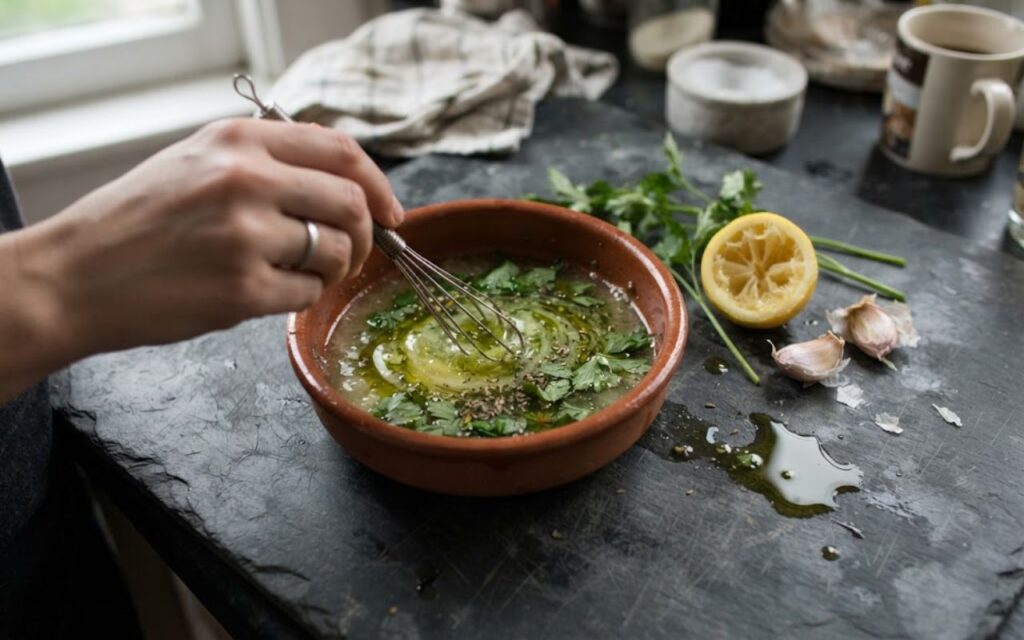
If you are wondering what is salmoriglio sauce, it is a Southern Italian finishing condiment used to transform grilled seafood. This ancient preparation relies on the harmonious interplay of unrefined olive oil, freshly squeezed citrus, and fragrant dried herbs. Whisking these raw components together creates a sharp brightness that instantly elevates simple proteins.
While many outside Italy mistake it for salad dressing, authentic coastal cooks treat it as a warm finishing emulsion. Its unique water-in-oil suspension prevents delicate fish from becoming heavy or waterlogged on the palate. Understanding the precise interplay between oil suspension, herb volatile release, and gentle heat unlocks its authentic Mediterranean character.
Quick-Glance Kitchen Summary
Salmoriglio sauce is a warm, whisked Southern Italian emulsion of olive oil, fresh lemon juice, dried wild oregano, garlic, and hot water used to dress grilled seafood. It relies on warm water to suspend citrus acids within fruity lipids while hydrating delicate dried herbs without scorching them.
- 120 ml robust extra virgin olive oil
- 60 ml freshly squeezed, strained lemon juice
- 30 ml hot water at approximately 60 degrees Celsius
- 1 tablespoon dried wild Sicilian oregano on the branch
- 2 tablespoons finely minced flat-leaf Italian parsley
- 2 medium garlic cloves, gently bruised or microplaned
- 1/2 teaspoon fine sea salt
- 1/4 teaspoon freshly cracked black peppercorns
Acid-Lipid Emulsification and Warm Water Hydrodynamics
The primary technical failure reported by home cooks in culinary forums is an unstable, greasy separation of citrus juice and oil. Standard vinaigrettes rely on mustard, honey, or egg yolks to bind polar water molecules to nonpolar lipids. Salmoriglio contains none of these commercial stabilizers, relying instead on mechanical agitation and the kinetic energy of warm water.
Whisking two tablespoons of hot water directly into the lemon juice before slowly incorporating the oil lowers the viscosity of the citrus base. This thermal shift allows the fat droplets from high-polyphenol olive oils, such as Sicilian Nocellara del Belice, to fracture into smaller, suspended globules. The result is an opaque, silky liquid that coats the surface of swordfish rather than running off into the grill grates.
A common pitfall is using boiling water, which degrades the delicate aromatic terpenes in the fresh lemon juice and cooks the fresh parsley prematurely. Keeping the water temperature around 60 degrees Celsius optimizes droplet dispersal while preserving volatile citrus esters.
- Maintain a strict 2 to 1 ratio of extra virgin olive oil to fresh lemon juice for proper palate balance.
- Whisk the salt directly into the citrus juice and warm water first, because sodium chloride dissolves poorly in pure oil.
- Stream the olive oil into the acidic base in a steady trickle while whisking vigorously in a stainless steel bowl.
Botanical Herb Volatiles: Dried Sicilian Oregano Versus Fresh Leaf Bitterness
Home cooks often assume fresh herbs outperform dried variants, but using fresh oregano is the fastest way to ruin a traditional salmoriglio. Fresh Mediterranean oregano (Origanum vulgare) contains high concentrations of moisture-bound chlorophyll that impart an astringent, soapy flavor when blended with raw acid. Sicilian culinary tradition mandates using wild flowering oregano dried on the branch (Origanum vulgare viridulum), which concentrates essential oils like carvacrol and thymol.
Crushing dried flowering clusters between your palms fractures the herb bracts, releasing aromatic oils into the warm liquid without introducing bitter plant juices. Flat-leaf parsley, conversely, must always be fresh, washed, dried thoroughly, and chopped with a sharp chef knife to prevent cellular bruising.
| Attribute | Dried Wild Sicilian Oregano | Fresh Italian Flat-Leaf Parsley |
|---|---|---|
| Primary Compound | Thymol and carvacrol aromatic oils | Apiol and fresh leaf chlorophyll |
| Mechanical Prep | Crushed by hand directly into warm oil | Finely minced with a sharp slicing motion |
| Flavor Contribution | Warm, pungent, earthy, and peppery | Clean, grassy, and crisp palate cleanser |
| Heat Vulnerability | Highly resilient to moderate residual heat | Rapidly wilts and browns if overheated |
| Moisture Content | Minimal moisture prevents emulsion breakdown | Must be spun completely dry before mincing |
This balance between shelf-cured and fresh botanicals creates the dual-tone flavor profile characteristic of southern coastal cooking.
- Procure wild oregano packaged on natural woody branches rather than pre-ground supermarket spice jars.
- Discard woody stems before crushing the dried florets between your hands directly over the mixing bowl.
- Incorporate fresh parsley only at the final assembly stage to maintain vibrant green flecks throughout the sauce.
Allium Allicin Control and Garlic Infusion Dynamics
Garlic management sparks heated debates on Italian cooking boards, primarily concerning acrid burn and overpowering pungency. When garlic cells rupture, the enzyme alliinase converts alliin into allicin, the volatile organosulfur compound responsible for intense garlic heat. Microplaning or pureeing raw garlic into cold citrus juice unleashes an aggressive allicin spike that obliterates delicate swordfish or branzino.
To achieve harmony, traditional Sicilian cooks bruise whole garlic cloves with the flat side of a knife and steep them in the warm emulsion. This technique allows oil-soluble garlic aromas to perfume the lipid phase while leaving sulfurous harshness trapped within the cell walls.
For cooks who prefer garlic distributed throughout every bite, macerating finely minced garlic in the lemon juice for five minutes before adding oil suppresses enzyme activity. The high acidity denatures alliinase enzymes, yielding a rounded, sweet garlic undertone that complements rather than dominates the plate.
- Bruise two garlic cloves gently to crack the skins while keeping the cloves largely intact for warm steeping.
- Remove bruised whole cloves after twenty minutes of infusion if serving alongside mild white fish like sea bass.
- Soak finely minced garlic in citrus juice first if you desire small, tender flecks dispersed evenly across the fish.
Grill Thermal Shock and Timing on Flaky Fish
Applying salmoriglio to fish during cooking requires precise thermal management to avoid incinerating aromatic compounds. Basting delicate herbs over direct, high-heat charcoal burns both the oregano and parsley into bitter carbon flakes within seconds. Furthermore, raw lemon juice splashed onto raw fish prematurely denatures surface proteins, creating a mushy, curdled exterior before proper Maillard browning occurs.
The professional method utilizes salmoriglio in two distinct, sequential phases: a light pre-grill brush and a generous resting bath. Brush your fish fillets with a thin film of the oil-heavy upper layer just moments before hitting the oiled, scorching grill grate. This lubricates the fish flesh and prevents sticking without dousing the glowing coals with excess flare-up liquids.
Reserve the bulk of the emulsified, herb-dense sauce in a warm ceramic bowl set near the grill edge. As soon as the fish hits an internal temperature of 52 to 55 degrees Celsius, transfer it directly into the warm sauce. The hot fish flesh absorbs the citrus brine through capillary action as muscle fibers relax off the heat.
- Reserve two-thirds of the fresh sauce strictly for post-grill dressing to keep herbs vibrant.
- Brush fish skin with plain high-smoke-point oil first, reserving salmoriglio for the flesh side near the end of cooking.
- Rest grilled seafood directly in a shallow pool of warm sauce for three minutes before serving to maximize moisture.
Acidity Buffering and Refrigeration Stability Limits
Salmoriglio is engineered as an immediate-use condiment, displaying peak organoleptic quality within two hours of assembly. In culinary forum experiments, cooks who prepare the sauce days in advance report that the bright yellow hue fades to an unappealing olive drab. This color degradation occurs as acidic lemon juice displaces the central magnesium atom in the parsley’s chlorophyll, producing dull pheophytin.
Refrigerating the sauce also causes high-grade extra virgin olive oil to solidify into a waxy, cloudy matrix beneath the acidic layer. If you must prepare elements ahead of time, store the strained lemon juice and olive oil separately at room temperature until service.
From a home food safety perspective, salmoriglio contains raw garlic immersed in an oil-and-citrus matrix. While the high volume of straight lemon juice lowers the overall product pH well below the 4.6 botulism threshold, ambient storage should never exceed four hours. If keeping leftovers, refrigerate them promptly in a sealed glass jar and consume them within twenty-four hours after warming the jar in lukewarm water.
- Whisk your ingredients thirty minutes prior to serving to allow dry herbs adequate hydration time.
- Avoid plastic storage containers, as acidic citrus oils readily leach odors and absorb volatile compounds from synthetic polymers.
- Discard any unrefrigerated sauce left at ambient room temperature beyond four hours to maintain stringent kitchen safety.