
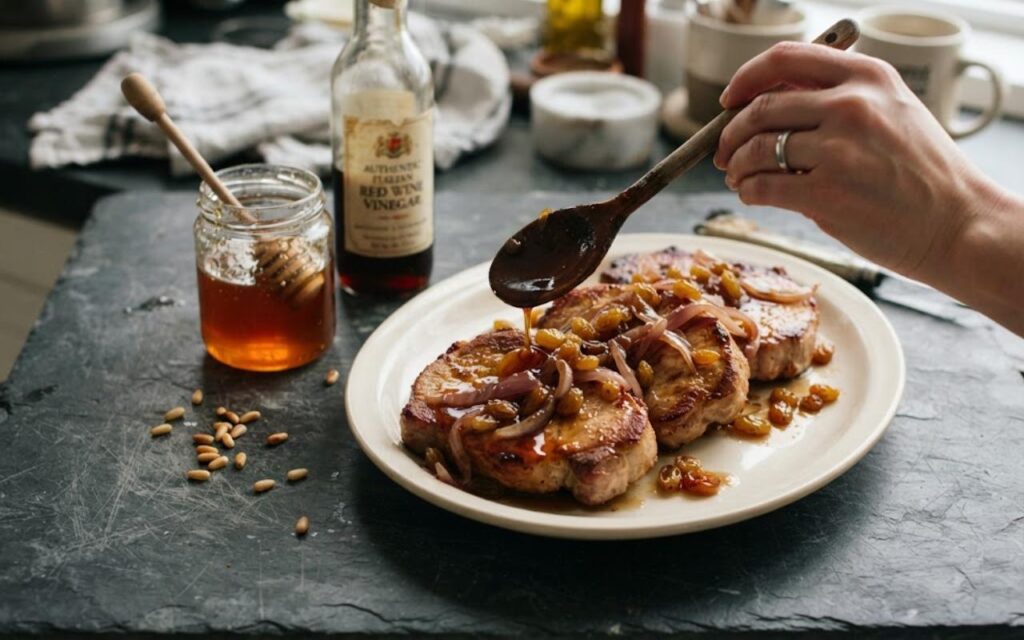
Mastering authentic agrodolce sauce transforms everyday roasted meats, bitter greens, and pan-seared fish through a vibrant equilibrium of intense sweetness and biting acidity. Originating in Sicily through historic Arab-Norman cultural exchange, this classic Italian condiment relies on accessible pantry staples that unlock sophisticated flavor chemistry.
Home cooks frequently encounter frustrating pitfalls, ranging from tear-inducing vinegar fumes during reduction to glazes seizing into jaw-breaking caramel. Conquering this sauce requires an understanding of thermal management, pan geometry, and acid preservation.
Quick-Glance Kitchen Summary
Agrodolce relies on dissolving sugar into vinegar and gently reducing the liquid until it coats the back of a spoon. Balancing the evaporation rate prevents the sauce from caramelizing into brittle candy while preserving enough sharp acidity to cut through fatty proteins.
- 1/2 cup red wine vinegar or white wine vinegar (standard 5% acetic acid)
- 1/3 cup granulated sugar, raw honey, or turbinado sugar
- 2 tablespoons golden raisins or currants, rehydrated in warm water
- 2 tablespoons toasted pine nuts (pinoli)
- 1 small shallot, minced fine (optional savory base)
- 1 pinch crushed red pepper flakes
- 2 tablespoons cold unsalted butter (optional, for gloss and emulsification)
- Heavy-gauge stainless steel saucier with a rounded bottom
Thermal Reduction Kinetics and Acetic Vapor Management
The most common kitchen mishap discussed across culinary forums is the suffocating cloud of acetic acid fumes created when vinegar hits a scorching skillet. Pure water boils at 212 degrees Fahrenheit, whereas pure acetic acid boils at roughly 244 degrees Fahrenheit. When you blast an agrodolce mixture over high heat, the water and volatile aromatic compounds vaporize instantly, launching concentrated acetic mist directly into your face.
To manage thermal reduction properly, combine your sugar source and vinegar off the heat or over low flame until the crystals fully dissolve. Once dissolved, raise the heat to a gentle simmer where small, lazy bubbles break across the surface rather than a violent rolling boil. This slower evaporation allows the sugars to soften the sharp bite of the vinegar without stripping away its delicate fruit aromatics.
- Maintain medium-low surface heat to promote steady moisture loss without burning the sugar.
- Keep exhaust fans running on high and avoid leaning directly over the reduction vessel.
- Stir with a heatproof silicone spatula to sweep the bottom perimeter continuously.
Never rush the reduction phase by cranking the burner to high. Intense heat accelerates scorching along the fluid line, creating bitter undertones that completely ruin the glaze.
Sugar Caramelization Profiles and Acid Ratios Across Regional Bases
The sweetness profile of your agrodolce dictates how the glaze behaves at lower temperatures. White granulated sugar yields a clean, neutral sweetness that lets high-acid wine vinegars take center stage, while honey introduces floral notes alongside hygroscopic properties that keep the glaze tacky and soft. Aceto Balsamico di Modena IGP provides deep wood-aged notes, but its high natural sugar content requires a shorter cooking time to prevent rapid burn.
| Regional Style | Acid and Sugar Core | Texture Target | Primary Pairing |
|---|---|---|---|
| Sicilian Classic | Red wine vinegar and granulated sugar | Syrupy nappe coat | Swordfish, eggplant caponata |
| Modenese Deep | Aceto Balsamico di Modena IGP and dark honey | Heavy gloss reduction | Roasted pork belly, aged cheeses |
| Venetian Marine | White wine vinegar and golden sultana paste | Light clinging lacquer | Pan-fried sardines, sea bass |
| Southern Peppered | Apple cider vinegar and turbinado sugar | Sticky glaze with heat | Charred sausages, bitter greens |
Balancing sweetness against sourness requires tasting the reduction in small increments. Remember that hot liquid tastes significantly less sweet and far more acidic than it does at room temperature. Allow tasting spoons to cool for twenty seconds before evaluating whether your batch demands an extra pinch of sugar or another splash of vinegar.
Saucier Geometry and Preventing Localized Scorching
Pan geometry determines your success when reducing high-sugar, high-acid liquids. Standard straight-sided saute pans feature a sharp ninety-degree corner between the flat floor and the vertical wall where syrupy fluids pool undisturbed. Whisks and traditional wooden spoons cannot sweep this sharp seam effectively, leading to localized burnt rings that taint the entire batch.
A curved-bottom saucier forged from multi-clad stainless steel provides the ideal thermal environment for delicate glazes. The continuous arc of a saucier allows a flexible spatula or flat-bottomed wooden spoon to glide along every millimeter of the pan surface. Aluminum cores ensure uniform heat dispersion across the entire curve, preventing hot spots directly over gas burner flames.
- Choose multi-ply stainless steel or enameled cast iron cookware to avoid metallic off-flavors caused by high acidity.
- Avoid unlined copper or bare carbon steel pans, as raw acids strip the seasoning and leach metallic taints into the sauce.
- Match burner size directly to the flat contact base of the vessel to eliminate flame roll up the exterior walls.
Stirring frequency should increase as moisture leaves the pan and bubble size expands. Once the bubbles become glassy and slow to pop, your glaze is within moments of finished reduction.
Viscosity Calibration and the Freezer Plate Test
Relying solely on how agrodolce looks in a hot pan is a recipe for disaster. At simmering temperatures, the sugars remain fully liquefied, making the reduction appear far thinner than its final resting texture. If you wait until the glaze looks thick and syrupy inside a simmering saucier, it will cool into hard, unpourable candy.
- Place two small ceramic saucers in your freezer before you begin cooking the reduction.
- Drizzle a few drops of hot glaze onto the chilled plate when bubbles turn slow and glassy.
- Nudge the drop with your fingertip after thirty seconds to verify whether it wrinkles and holds its shape.
If the droplet runs freely across the cold ceramic like water, return the pan to the heat for another two minutes of gentle simmering. If the droplet sets with a tacky, supple skin that slowly yields beneath your finger, remove the saucier from the burner immediately.
Traditional add-ins like toasted pine nuts and plump raisins should enter the pan right after passing this plate test. The dry dried fruit absorbs moisture from the hot syrup, stabilizing the final viscosity naturally as the sauce cools.
Preservative Acidity Metrics and Emulsion Finishing Techniques
Agrodolce doubles as an effective preservation medium due to its robust chemical profile. Standard retail vinegars maintain an acidity level of at least 5% acetic acid, which naturally drops the pH of an agrodolce glaze far below the critical 4.6 food-safety threshold. This hostile environment eliminates microbial risk and inhibits spoilage organisms, meaning pure reduced vinegar-sugar syrups can safely store in airtight glass jars inside the refrigerator for months.
- Use glass mason jars fitted with non-reactive plastic lids rather than raw metal bands to prevent acid corrosion.
- Reserve savory aromatic components like fresh garlic or shallots if your goal is long-term pantry storage.
- Reheat stored glazes with a tablespoon of hot water to dissolve crystallized sucrose chains before serving.
If you plan to serve the agrodolce immediately over pan-seared pork chops or roasted poultry, consider finishing with a culinary technique called monter au beurre. Take the saucier completely off the heat and vigorously swirl two tablespoons of chilled, cubed butter into the warm syrup. The cold milk fat forms a glossy, temporary emulsion that tames the sharp vinegar bite and imparts a velvety mouthfeel that clings tenaciously to meat.