
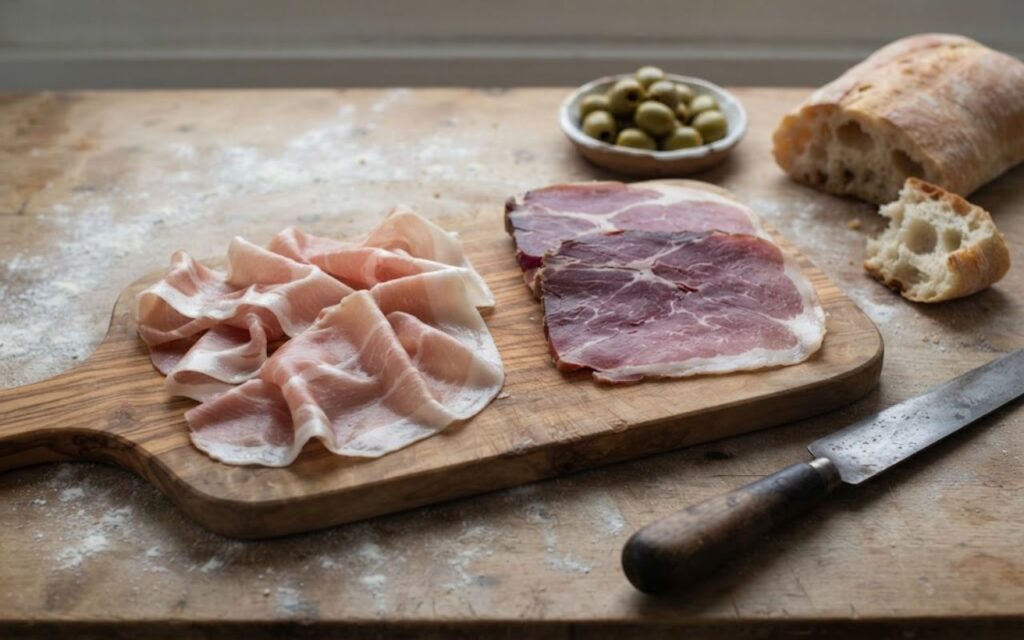
Navigating the culinary divide of prosciutto vs. jamón serrano requires understanding how distinct geography, pig genetics, and centuries-old preservation traditions yield fundamentally different dry-cured meats. While both hams trace their lineage to European mountain air and sea salt, their moisture levels, fat distribution, and aging timelines produce contrasting flavor profiles on the palate.
Home cooks and charcuterie enthusiasts frequently debate which ham suits a given application, often mistakenly treating them as interchangeable ingredients on a platter or in a skillet. Examining their physiological and biochemical shifts during curing reveals precisely why one melts luxuriously across the tongue while the other delivers a firm, intensely savory chew.
Quick-Glance Kitchen Summary
Prosciutto yields a sweet, delicate, high-moisture profile shaped by controlled cellar humidity and protective lard coatings, whereas Jamón Serrano undergoes deeper dehydration to create a concentrated, firm, and intensely savory bite. Use prosciutto raw at room temperature to preserve its velvety fat, and reserve jamón serrano for pairings that require assertive saltiness or gentle warmth.
- Raw Ham Base: Fresh pork hind leg rubbed strictly with sea salt
- Prosciutto Moisture Target: Regulated between 59.0 and 63.5 percent final water content
- Jamón Serrano Moisture Target: Typically ages down to approximately 50 to 55 percent residual water content
- Optimal Serving Temperature: 65 to 72 degrees Fahrenheit for lipid softening
- Home Slicing Gear: Long, flexible granton-edge slicing knife or commercial gravity-feed meat slicer
Swine Breed Genetics and Sugnatura Fat Applications
The foundational difference between these cured legs begins on the farm with distinct livestock genetics and dietary regimens. Authentic Prosciutto di Parma and Prosciutto di San Daniele rely on heavy Italian pigs, typically Large White, Landrace, or Duroc breeds, raised to a mature slaughter weight of 160 kilograms (±10%).
Jamón Serrano typically utilizes white pig breeds like Landrace, Large White, and Pietrain, which are processed at lower weights, yielding leaner hind legs with denser muscular striations.
Salt application also diverges significantly during the initial curing phase. Italian prosciuttai use a measured dual-salting protocol, dusting the skin with wet sea salt and the exposed lean muscle with dry salt, keeping sodium levels notably restrained.
Spanish curers historically immerse the entire leg in mounds of coarse sea salt based on weight, calculating approximately one day per kilogram, which initiates deep early sodium penetration.
To prevent the exposed meat of prosciutto from desiccating too rapidly during its lengthy maturation, artisans apply a thick paste known as sugnatura. This paste combines rendered lard, rice flour, pepper, and occasionally salt to coat the unskinned muscle tissue.
This breathable fat barrier slows ambient moisture loss, ensuring a soft interior, whereas traditional Jamón Serrano cures open to dry mountain drafts without an applied lard shield.
Technical Variable Comparison Matrix
| Technical Variable | Prosciutto (Parma / San Daniele DOP) | Jamón Serrano (Consorcio / ETG) |
|---|---|---|
| Primary Pig Breed | Italian Large White, Landrace, or Duroc | Landrace, Large White, or Duroc crosses |
| Protective Muscle Seal | Sugnatura (lard and rice flour paste) applied mid-cure | Open-air curing without a lard barrier |
| Aging Environment | Temperature-controlled cantine with valley airflow | Dry secaderos and high-elevation bodegas |
| Average Moisture Loss | Typically 25 to 30 percent total weight reduction | A minimum regulatory 34 percent weight loss |
| Texture on Palate | Silky, pliable, and melts across the tongue | Firm, dense, fibrous, and pleasantly chewy |
| Dominant Flavor Tone | Sweet, nutty, buttery, and low salinity | Earthy, intensely savory, rustic, and forward salt |
Curing Microclimates and Dehydration Dynamics
Environmental humidity drives the stark textural divergence between these Mediterranean dry-cured staples. In the foothills around Parma, humid breezes off the Tyrrhenian Sea pass through Apennine mountain valleys, creating a gentle curing climate that favors slow enzymatic evolution.
Jamón Serrano undergoes aging in the Continental extremes of Spanish plateaus, enduring harsh winter freezes followed by blistering dry summers known locally as the sudao or sweating period.
| Technical Variable | Prosciutto (Parma / San Daniele DOP) | Jamón Serrano (Consorcio / ETG) |
|---|---|---|
| Primary Pig Breed | Italian Large White, Landrace, or Duroc | Landrace, Large White, or Duroc crosses |
| Protective Muscle Seal | Sugnatura (lard and rice flour paste) applied mid-cure | Open-air curing without a lard barrier |
| Aging Environment | Temperature-controlled cantine with valley airflow | Dry secaderos and high-elevation bodegas |
| Average Moisture Loss | 28 to 32 percent weight reduction | 34 to 38 percent weight reduction |
| Texture on Palate | Silky, pliable, and melts across the tongue | Firm, dense, fibrous, and pleasantly chewy |
| Dominant Flavor Tone | Sweet, nutty, buttery, and low salinity | Earthy, intensely savory, gamey, and high salt |
The Spanish sweating period forces intramuscular fats to liquefy and redistribute through the lean muscle, creating deeper flavor concentration. Prosciutto skips this intense heat exposure, resting in cool, dark cantine where high ambient humidity prevents severe crusting.
These divergent environmental pathways dictate whether the finished leg retains a tender, flexible structure or transitions into a robust, chewy charcuterie staple.
Enzymatic Proteolysis and Tyrosine Crystal Formation
As moisture leaves both types of cured ham, long-chain muscle proteins begin breaking down through endogenous enzymes called calpains and cathepsins. This chemical transformation, known as proteolysis, snips tough actomyosin fibers into free amino acids, primarily glutamate, which produces an intense umami punch.
In both meats, this cellular degradation essentially pre-digests the muscle, generating remarkable tenderness without the application of heat. Home charcuterie buyers often notice small, crunchy white flecks nestled inside the red muscle fibers of long-cured hams.
Online forum members frequently mistake these flecks for salt deposits or parasitic cysts, but they are actually harmless tyrosine crystals. Tyrosine precipitation occurs naturally when free amino acids achieve super-saturation during extensive curing periods exceeding twelve months.
- Tyrosine development signals proper enzymatic breakdown and extended cellar aging.
- Prosciutto reveals fewer, softer crystals due to higher residual water retention.
- Jamón Serrano develops hard, distinct crystals throughout its firm meat matrix.
Because Jamón Serrano loses significantly more water over its maturation cycle, tyrosine crystals appear far more frequently and offer an audible crunch. Prosciutto di Parma undergoes a more controlled, humid protein breakdown, keeping tyrosine largely solubilized within the ham’s interstitial moisture.
When tasting Jamón Serrano, these mineral-like pops act as small reservoirs of concentrated, savory flavor that contrast sharply with the ham’s leathery grain.
Lipid Oxidation and Palate Salinity Thresholds
Fat composition fundamentally separates how human tastebuds register these two cured specialties. Prosciutto features a thick, snow-white exterior fat cap along with delicate ribbons of intramuscular marbling that maintain low oxidation rates. Jamón Serrano carries a firmer, yellow-tinted fat edge resulting from accelerated lipolysis and lipid oxidation during the warm summer secadero phase.
This lipid oxidation creates aldehydes and ketones that produce a characteristic rustic, cured funk reminiscent of aged cheese and game. Prosciutto stays largely protected from aggressive oxidation by its sugnatura layer, allowing the sweet, milky notes of the pork fat to remain intact. Enthusiasts often refer to this sweetness as dolcezza, a defining characteristic protected by Italian consortium regulations.
Salinity levels dramatically shift sensory perception between the two hams. Prosciutto regulations enforce strict baseline limits, with finished hams registering an average of 5.3 percent sodium chloride (legally capped at a maximum of 6.0 percent).
Conversely, high-quality Consorcio Serrano regularly showcases a deeper, rustic salt profile balancing around 4.5 to 5.5 percent salinity in certified selections, though uncertified commercial white pig iterations routinely test higher to accelerate commercial moisture evaporation.
Blade Friction and Serving Temperature Mechanics
The physical mechanics of cutting dry-cured ham directly dictate its mouthfeel and aromatic expression. In community culinary forums, users frequently complain that their store-bought prosciutto tears into stringy clumps or feels unpleasantly gummy. This issue stems almost entirely from dull blades, thermal friction, or serving the meat straight out of a cold refrigerator.
Cold temperatures cause pork lipids to congeal, muting volatile aromatic compounds and turning the fat cap waxy. Serving cured ham at room temperature allows unsaturated oleic fatty acids to soften and liquify immediately upon contact with the warmth of the tongue. Jamón Serrano requires slightly more jaw work due to lower moisture, so pairing it with crusty bread and olive oil helps lubricate the palate.
- Keep slicing knives razor-sharp to prevent pulling or shredding delicate muscle fibers.
- Slice prosciutto paper-thin on an electric deli slicer or with a flexible blade so it drapes effortlessly.
- Carve Jamón Serrano into bite-sized, slightly thicker shavings across the grain to highlight its dense chew.
- Allow packaged slices to rest on the counter for twenty minutes before plating to release trapped aromas.
When applied to cooking, high ambient heat behaves differently across these two cured products. Cooking prosciutto drives off its precious moisture, causing the delicate slices to turn tough, stringy, and aggressively salty. Jamón Serrano handles culinary heat far better; its lower hydration and firm muscle structure hold up when tossed into hot sautés, simmered into white bean stews, or crisped alongside eggs.