
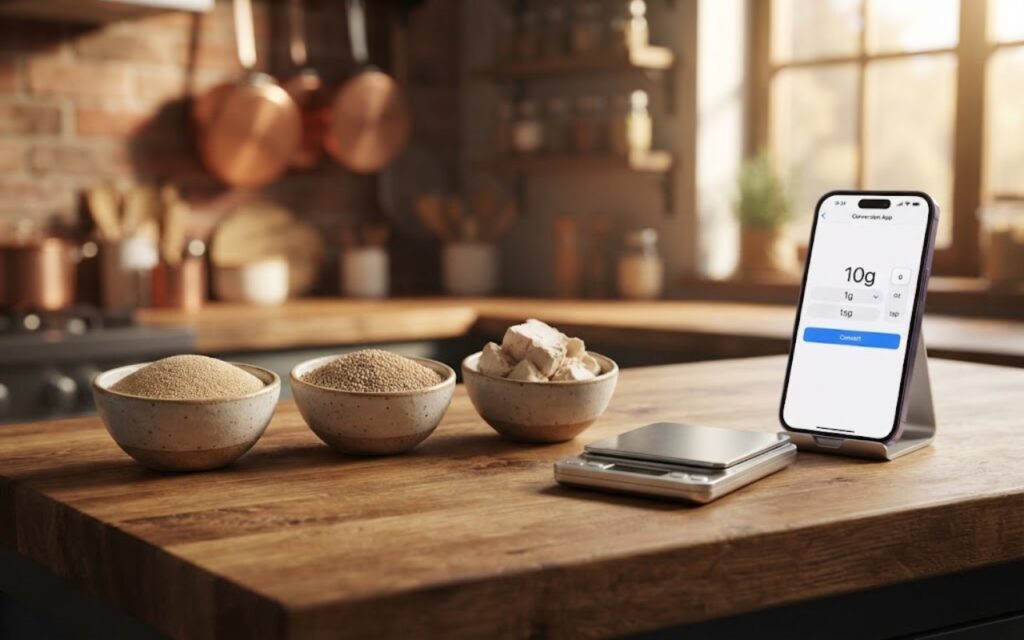
Swapping one type of leavening agent for another without adjusting your recipe weight will quickly result in an over-proofed dough blowout or a flat, dense brick. To maintain total control over your fermentation timeline, you must understand how different manufacturing processes alter yeast potency. This complete pizza yeast conversion guide provides the precise mathematical ratios needed to swap between formulations flawlessly.
Commercial baking relies on three primary yeast strains: Instant Dry Yeast (IDY), Active Dry Yeast (ADY), and Fresh Cake Yeast. Because each type contains varying moisture levels and cellular concentrations, they cannot be substituted on a one-to-one basis.
Using an interactive pizza yeast conversion guide calculator allows you to input your exact recipe weights and translate them across all three classifications instantly. Below, we break down the molecular differences between these cell strains and how to execute precise math conversions in your home kitchen.
🧫 Yeast Conversion Matrix
Interactive Formulation Equivalence Engine
Calculated Equivalent Weights
Understanding the Three Core Yeast Formulations
To execute a flawless substitution, you must understand the underlying structural characteristics of your leavening ingredients:
- Instant Dry Yeast (IDY): This is the most potent and highly concentrated dry strain available. During manufacturing, the cells are aggressively dehydrated and milled into microscopic porous rods. This unique structural format allows IDY to absorb water instantly, meaning it can be mixed directly into your dry flour without any prior liquid activation step.
- Active Dry Yeast (ADY): This formulation features larger, rounded pellets. The manufacturing drying process leaves a protective layer of dead yeast cells encapsulating a living core. Because of this outer barrier, ADY must be dissolved in warm water (around 105°F / 40°C) prior to mixing. This dissolves the shell and wakes up the dormant cells.
- Fresh Cake Yeast: Also known as compressed yeast, this is a soft, moist block containing roughly 70% water weight. It is highly favored by traditional pizzerias for its smooth, steady gas production. However, because it remains completely hydrated, it has a short shelf life and must be stored constantly under refrigeration.
If you are looking to integrate these custom conversion profiles directly into a full baker's percentage calculation recipe sheet, head over to our master pizza dough calculator.
The Mathematical Equivalence Formula
The core mathematical ratio governing professional yeast substitution relies on a fixed constant rule: 1 part IDY is equal to 1.25 parts ADY, which is equal to 3 parts Fresh Yeast. While commercial baking specifications from manufacturers like Lesaffre sometimes optimize for a tighter 1:1.20:3 ratio baseline, using the standard 1.25 multiplier ensures reliable gas production in home environments without under-proofing.
When using your interactive pizza yeast conversion guide tool, the engine uses these specific multiplier variables to bridge the gap between potency levels seamlessly:
- Converting from Instant Dry Yeast (IDY):
- To find ADY: Multiply your IDY weight by 1.25
- To find Fresh Yeast: Multiply your IDY weight by 3.0
- Converting from Active Dry Yeast (ADY):
- To find IDY: Divide your ADY weight by 1.25
- To find Fresh Yeast: Multiply your ADY weight by 2.4 (since 3.0 divided by 1.25 equals 2.4)
- Converting from Fresh Cake Yeast:
- To find IDY: Divide your fresh weight by 3.0
- To find ADY: Divide your fresh weight by 2.4
For example, if an artisan recipe demands 2.0 grams of high-potency IDY, but your pantry only contains standard ADY pellets, multiplying 2.0g by 1.25 tells you to scale out exactly 2.50 grams of active dry yeast. If you wish to use fresh compressed cake blocks instead, multiplying 2.0g by 3.0 dictates a final scale weight of 6.00 grams.
Step-by-Step Activation Profiles
1. Handling Direct Instant Mixes
Because Instant Dry Yeast lacks a protective skin barrier, you can dump it straight into your dry flour bins along with your salt and sugar. Ensure your water temperatures sit between 65°F and 72°F (18°C to 22°C) to prevent thermal shock, and begin your standard mechanical mixing sequence immediately.
2. Proofing Active Dry Pellets
Never dump raw ADY directly into dry flour. The dead outer shell requires liquid submersion to clear the path for the live inner cells. Pull your calculated recipe water, heat it gently until it reaches a lukewarm 100°F (38°C), and stir your ADY directly into the fluid. Let it sit undisturbed for 10 minutes. When a thick, frothy layer of tan foam covers the water surface, your cells are active and ready to pour into your mixer.
3. Dissolving Fresh Compressed Blocks
Fresh yeast should be crumbled directly into your recipe water using your fingers. Whisk the mixture until the block breaks down into a uniform, milky fluid with no solid chunks remaining, then proceed with adding your flour and salt additions according to your standard workflow.
Aligning Your Yeast Ratios with Cooking Temperatures
Once you have converted your leavening weights to match your pantry supply, you must ensure your baking environment can handle the fermentation gas expansion.
Low-yeast formulas designed for extended 72-hour cold proofing cycles are highly optimized for high-heat outdoor environments. The explosive thermal energy inside a commercial-grade deck expands the tiny gas pockets instantly, yielding a beautifully blistered rim.
🔥 Ready to maximize your dough's oven spring? Even a perfectly executed conversion recipe requires an intense blast of heat to expand those fragile carbon dioxide pockets before the structure sets. Check out my extensive, hands-on review of the Best Pizza Ovens for Home Use to see which portable outdoor and countertop electric models manage precision floor deck temperatures to char artisan bakes flawlessly.