
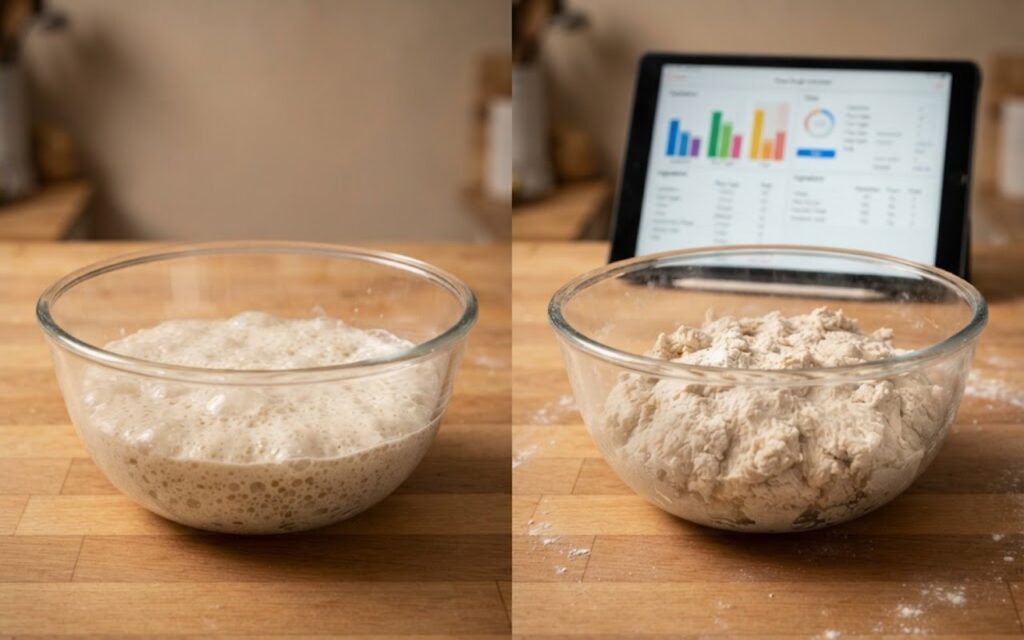
Baking an exceptional crust requires mastering the science of indirect fermentation. To move away from quick, single-day mixes, using a professional how to calculate poolish and biga for pizza dough matrix eliminates all guesswork before you touch a mixing bowl. These classic Italian starters re-engineer your flour’s biochemical properties but require completely different hydration math equations to succeed.
While a liquid Poolish uses a matching one-to-one ratio of flour and water, a Biga is a stiff preferment dough ball mixed at a low moisture threshold. Balancing these split-phase weights manually while keeping your final recipe percentages stable is incredibly easy to get wrong. Our advanced translator tool handles this multi-stage algebra instantly.
🧪 Preferment Split Matrix Engine
Advanced Poolish & Biga Calculator
Phase 1: Overnight Poolish Starter
Phase 2: Final Main Dough Mixing Additions
This advanced split formula partitions commercial yeast variants dynamically between phases to secure controlled enzymatic progression and prevent overnight starter failures.
Liquid vs. Stiff Starters: Poolish and Biga Profiles
To implement an indirect baking workflow successfully, you must understand how water content influences starter fermentation biology:
- The Poolish Profile: Mixed at an exact 100% hydration ratio (equal weights flour and water). Because this environment is highly liquid, yeast cells move and feed quickly, accelerating enzymatic activity. Protease enzymes break down flour proteins, creating an incredibly extensible, relaxed dough structure. This is the optimal configuration for hand-stretching a soft, bubbly Neapolitan or New York style rim.
- The Biga Profile: Codified heavily by Italian baking masters like Piergiorgio Giorilli, an authentic classic biga is mixed at a stiff 44% to 45% hydration. Because water availability is limited, enzymatic pathways adapt. The primary drivers for acetic acid flavor generation are low hydration and cool resting temperatures (60°F / 15°C). Acetic acid development strengthens the gluten boundaries, creating structural gas-holding elasticity. This allows high-rising structures like Detroit pan crusts to achieve a tall, airy honeycomb interior crumb. Modern home bakers sometimes increase this baseline to 50% to make the shaggy mass slightly easier to incorporate by hand.
If you wish to run basic, single-stage direct formulas without an isolated pre-ferment phase split, return to our complete unrestricted master pizza dough calculator.
The Mathematical Splitting Laws
The single biggest failure point when learning how to calculate poolish and biga for pizza dough is accidentally shifting your recipe's master baker's percentages. Beginners often mix a random volume of starter and add it to a standard recipe, which throws off their final hydration and salinity balance.
To execute a split formula correctly, your starter inputs must be subtracted directly from your calculated master ingredient limits. Let's look at the exact arithmetic progression for a 1,000-gram batch at 65% total hydration utilizing a 50% flour split:
The Liquid Poolish Split Check
- Master Total Profile: Flour: 611.58g, Water: 397.52g.
- Phase 1 Poolish Box: Take exactly 50% of your flour (305.79g) and mix it with an equal weight of water (305.79g).
- Phase 2 Main Mix Box: To keep your percentages balanced, your mixer bowl receives the remaining flour (305.79g) and only the remaining water mass: 397.52g total minus 305.79g starter equals 91.74 grams left.
The Stiff Biga Split Check
- Master Total Profile: Flour: 611.58g, Water: 397.52g.
- Phase 1 Biga Box: Take exactly 50% of your flour (305.79g). Multiplying 305.79g by the authentic 0.45 hydration constant dictates a starter water mass of exactly 137.61 grams.
- Phase 2 Main Mix Box: Your remaining flour stays stable at 305.79g. Because your dry starter held back less moisture, your final mixing bowl water addition increases to cleanly offset the recipe balance: 397.52g total minus 137.61g starter equals exactly 259.92 grams left.
Step-by-Step Mixing & Production Workflows
1. Fermenting an Overnight Liquid Poolish
Combine your phase 1 poolish flour, matching water weight, and all your recipe yeast in a glass vessel. Stir into a smooth, loose paste, cover loosely, and allow it to ferment at room temperature for 14 to 16 hours. When the mixture has doubled in volume and is completely covered in popping surface micro-bubbles, proceed with your phase 2 water, remaining flour, and salt additions.
2. Crafting a Stiff Biga Ball
Combine your phase 1 biga flour, your 45% water allotment, and your yeast. Do not knead this mixture into a smooth ball. A Biga should look rough, dry, and shaggy, resembling a loose clump of wet clay particles with raw patches of flour still visible.
Ferment at a cool 60°F (15°C) for 16 hours to allow slow organic acid progression. To blend it into your phase 2 final mix the next day, cut the tough biga ball into small fragments using a bench scraper and let them dissolve in your remaining water before adding your flour and salt.
Thermal Stability and Your Final Crust Spring
Once your split preferment has fully re-engineered your grain proteins, executing that recipe on baking night requires a rapid shock of thermal conductivity. If your oven cannot conduct massive energy into the base of your pan or dough skin instantly, those delicate, acid-relaxed gas chambers will collapse before they can set.
Pairing your multi-stage poolish or biga recipes with an intense, high-heat deck ensures your crust achieves maximum volume and structural integrity.
🔥 Ready to maximize your dough's oven spring? Even a perfectly calculated preferment recipe requires a powerful heat engine to pop those carbon dioxide chambers before the dough structure sets. Check out my extensive, real-world field review of the Best Pizza Ovens for Home Use to see how modern portable outdoor and countertop electric models manage precision floor deck temperatures to char artisan bakes flawlessly.