
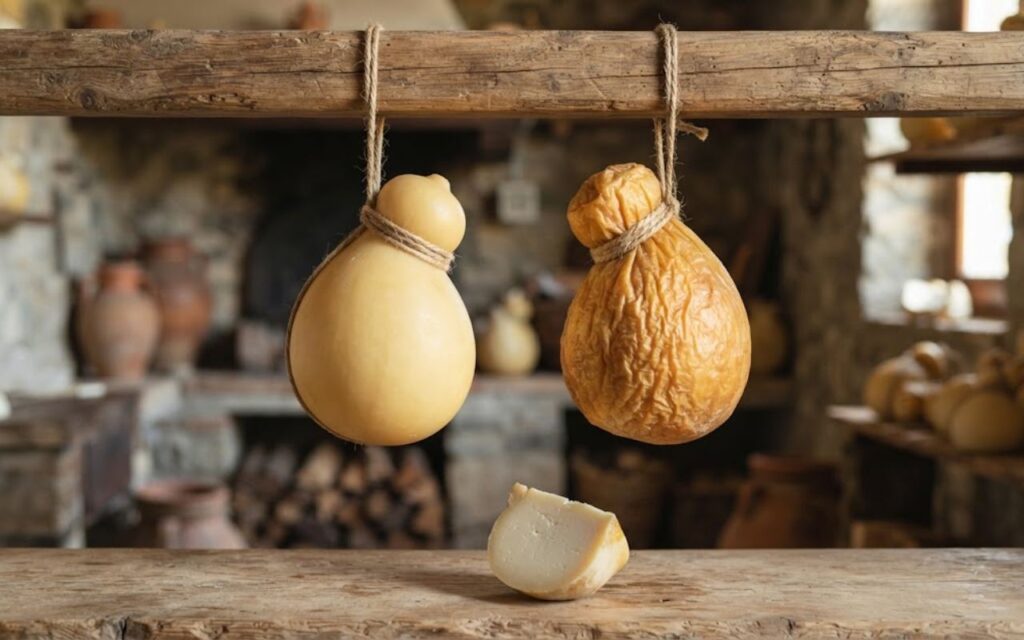
Hanging in pairs tied with rough hemp twine over cellar beams, caciocavallo cheese is one of the oldest stretched-curd cheeses in southern Italy. You can spot its iconic teardrop or gourd shape across deli counters from Campania down through Calabria and Sicily.
Learning what is caciocavallo cheese comes down to knowing how age changes its melting point, how it handles direct heat, and how to slice it for hot pans.
Quick-Glance Kitchen Summary
Caciocavallo is an Italian pasta filata cheese made by pulling and shaping curd in hot water before aging it tied in suspended pairs. Young wheels melt smoothly over dry heat, while firm wheels aged over six months grate cleanly over baked pasta without turning greasy.
- Milk Base: Whole cow milk, traditionally from pasture-fed Podolica cattle or mixed dairy herds.
- Curd Stretching Temperature: 80°C to 85°C (176°F to 185°F) hot water bath at a target curd pH of 5.2.
- Young Aging Profile: 30 to 60 days; mild, milky, elastic, melts at approximately 55°C (131°F).
- Mature Aging Profile: 6 to 12 months; sharp, flaky, piquant, ideal for shaving or hard grating.
- Best Cooking Pan: Heavy-bottomed cast iron or carbon steel skillet for searing thick cut slabs.
How Italian Cheesemakers Shape and Hang Caciocavallo
Cheesemakers produce caciocavallo using the pasta filata technique, the exact family of cheese stretching that yields mozzarella and provolone. Raw or pasteurized milk curdles with calf or kid rennet before resting in whey to acidify. Once the curd hits a specific pH around 5.2, the protein bonds loosen and permit manual stretching in near-boiling water.
Artisans manually stretch, pull, and compress the curd into a smooth, shiny mass to expel air pockets and excess whey. The cheese worker pinches off the top into a small bulbous head, loops a string around the bottleneck, and binds two cheeses together.
The name translates literally to cheese on horseback. This label comes from the practice of slinging two tied bulbs over a horizontal wooden beam or pole to dry in curing cellars. Gravity pulls the paste downward while it cures, cementing the classic teardrop silhouette.
Caciocavallo Silano PDO vs. Podolico: Flavor and Aging Profiles
Selecting the best wedge depends on whether your dinner plan calls for gooey melting or a hard, salty finish. Young wheels provide a gentle chew, whereas long-aged wheels develop sharp tyrosine crunch crystals similar to Parmigiano-Reggiano.
| Cheese Variety | Milk Source | Primary Texture | Best Kitchen Application |
|---|---|---|---|
| Young Caciocavallo (30-60 Days) | Cow milk | Springy, supple, smooth | Pan-frying, table snacking, melting inside toasted sandwiches |
| Caciocavallo Silano PDO | Cow milk | Semi-hard, dense, aromatic | Cubed into pasta al forno, melting over polenta |
| Caciocavallo Podolico (12+ Months) | Podolica cow milk | Hard, flaky, crystalline | Dry grating over ragu, shaving over bitter greens |
| Provolone Piccante (Industrial) | Cow milk | Semi-hard, oily, biting | Direct substitution for melting, though sharper on the tongue |
| Low-Moisture Mozzarella | Cow milk | Soft, elastic, high-moisture | Standard pizza topping, lacks the deep savory funk of caciocavallo |
Age shifts the moisture content drastically. Young versions hold around 40 percent moisture, which yields a buttery stretch when heated gently.
Wheels aged past eight months lose water, concentrating salt and free fatty acids. These mature wheels hold up against grating teeth, showering pasta sauces with sharp, nutty ribbons that do not clump up.
How to Cook and Melt Caciocavallo Without It Separating
Heating caciocavallo requires attention to heat control. Stretched-curd cheeses will split into a rubbery clump swimming in clear yellow butterfat if the pan surface runs too hot.
A famous preparation from Palermo is caciocavallo all’argentiera. Cooks sear thick slabs in a heavy pan with olive oil, garlic, a splash of white wine vinegar, and dry oregano.
- Slice the cheese into slabs at least one-half inch thick to keep the interior core soft while the outside browns.
- Set a heavy carbon steel or cast iron skillet over medium-low heat to ensure even heat spread across the metal.
- Lightly coat the cold cheese with olive oil rather than flooding the hot pan directly.
- Sear each side for roughly 90 seconds until a deep, blistered crust forms, then immediately deglaze with vinegar.
The acetic acid in the vinegar cuts directly through the fat, creating a glossy pan emulsion rather than an oily puddle. Serve this dish immediately, as pasta filata stiffens rapidly once the internal temperature drops below 40°C.
The Best Substitutes When You Cannot Find Authentic Caciocavallo
Imported southern Italian cheeses can be difficult to track down outside specialty Italian grocers. Knowing which substitute fits your recipe saves a weeknight dinner from falling flat.
If your recipe calls for young, melting caciocavallo, look for authentic Italian caciotta or young provolone dolce. Provolone shares the identical pasta filata curd framework, meaning it behaves predictably under a broiler without breaking into water. Avoid pre-shredded industrial pizza mozzarella, which carries potato starch anti-caking agents that ruin smooth sauces.
For recipes requiring aged, dry caciocavallo for grating, bypass standard parmesan and seek out aged Pecorino Crotonese or mature Provolone Piccante. These cheeses mirror the salty, animal musk and firm grating resistance of cellar-cured caciocavallo.
If you substitute aged sheep cheese, drop your recipe’s added table salt by a quarter. Sheep milk yields higher sodium perception on the palate than cow milk curd.
Storing Cut Wedges to Stop Rind Mold and Sweat
Plastic cling wrap is the enemy of artisan caciocavallo. Trapping high-fat cheese inside airtight non-porous plastic forces trapped moisture to condense on the surface, which accelerates slime and green surface mold.
Wrap your wedge first in breathable parchment or professional cheese paper, then place it inside a loose zip-top plastic bag. This two-layer barrier allows the cheese to breathe while stopping the low humidity of modern home refrigerators from drying the cut paste into leather.
Keep the wrapped cheese in the vegetable crisper drawer, which naturally maintains a stable 4°C to 7°C environment. Stored this way, an aged wedge stays fresh for up to six weeks without spoilage.
If white or gray surface mold appears on a hard aged wedge, do not throw it out. Cut away one-half inch around and below the mold spot with a clean knife, keeping the blade away from touching clean portions of the paste.