
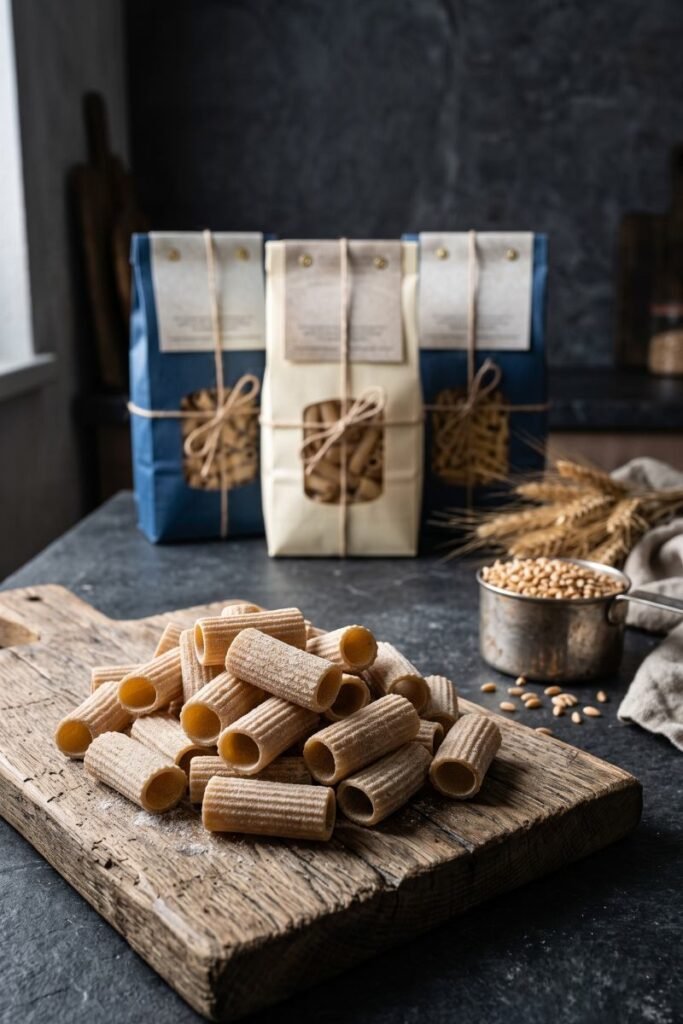
When I drop a handful of wheat strands into a roaring pot of salted water, selecting premium store-bought dried pasta brands is the ultimate baseline step required to keep your reductions clinging uniformly to the grain. Over my years of managing high-volume kitchen lines and monitoring starch extractions, I have treated die configurations, heat-drying speeds, and protein percentages as serious material variables rather than simple grocery runs.
Whenever I see amateur home cooks reach for the cheapest, smoothest industrial box on the supermarket shelf, it completely ruins the dinner. Watching your carefully emulsified sauce slide straight off slick, Teflon-extruded noodles into a greasy puddle on the plate shows how low-quality box selection instantly limits your cooking.
For me, delivering an elite restaurant-quality table experience simply requires targeting coarse, high-protein matrices that release clear starches to bind your pan liquids. This continuous quality control ensures your wheat strands absorb maximum flavor, a structural standard I maintain across my entire kitchen layout when choosing cooking mediums inside my guide on Red Wine vs. White Wine: How to Choose Cooking Wine.
Why Slick Teflon Extruders Create Sauce Friction
To understand why common industrial grocery boxes fail so aggressively inside a sauté pan, you have to examine factory tooling and cellular starch dynamics. High-volume commercial manufacturers run their wet semolina dough through high-speed Teflon-coated dies to churn out millions of uniform units per hour.
This slick plastic coating polishes the outer skin of the dough completely smooth, creating a non-porous, glossy finish that lacks any physical micro-grooves. When you toss these slick noodles with your oil-and-butter emulsions, the fats cannot find a physical surface grip, causing the sauce to run off the wheat instantly.
True chef-favored premium brands utilize heavy, traditional bronze metal dies to stamp out their custom shapes. The coarse bronze metal cuts through the dough roughly, leaving behind a matte, chalky exterior that looks like fine sandpaper.
This micro-rough skin acts like an open network of thousands of tiny hands, physically locking in your hot pan lipids while bleeding clean starch back into your pan water. This continuous starch dispersion stabilizes your cooking juices, transforming a loose layer of rendered butter into a thick, uniform glaze that wraps around the noodles.
Without this rough surface layer to arrest the flow of hot fats, cooking liquids fall right into the bottom of your dinner bowls, collecting as a thin grease puddle. Using premium shapes stops this separation entirely, keeping your rich emulsions perfectly bound to the grain until the plate is empty.
The Top 3 Chef-Recommended Boxes to Stock in Your Pantry
My absolute baseline technical rule for evaluating your grocery store grain options relies on monitoring physical surface friction and internal protein metrics. I follow the strict ingredient testing scales, drying curve analyses, and starch retention studies documented inside the official Serious Eats Premium Pantry Ingredient Guide to keep my inventory pristine.
- Pastificio Mancini Rigatoni: This is the ultra-premium farm-to-table standard grown and harvested directly on their agricultural estate in Le Marche. The raw semolina dries over 40 slow hours at extremely low temperatures, maintaining perfect wheat aromatics and a rough surface.
- Rummo Lenta Lavorazione Pasta: This box delivers unparalleled structural durability through their patented slow-processing layout. It maintains a rock-solid, high-bite core that resists over-cooking even if left sitting in a hot pan reduction.
- De Cecco Durum Wheat Pasta: This is the ultimate, universally accessible supermarket workhorse found on almost every professional station globally. It consistently delivers a reliable bronze-cut texture and a high 13% protein framework that holds a perfect structural bite.
Stocking these precise brands guarantees your pan lipids absorb into the core cell networks easily, preventing flavor fatigue and ensuring each noodle retains an exceptional chew.
Decoding Protein Weight Percentages to Guarantee High Bite
The final law for successfully identifying a stable, non-mushy dried product requires ignoring marketing labels and reading the structural nutrition panel on the back of the cardboard. High-quality artisan factories look for elite durum wheat crops that yield an internal protein concentration hovering between 13% and 14.5%.
This dense concentration of natural gluten proteins builds an incredibly tough, resilient internal matrix that locks the starch granules tightly inside the cooked core. When you boil cheap, low-protein boxes, the loose starch grids dissolve away completely into the boiling water, leaving behind a limp noodle.
Always scan the ingredient label to ensure the brand uses 100% pure durum wheat semolina, avoiding any added enrichments or vegetable flours. I know my dried asset sourcing is fully successful when the drained columns tumble into my skillet wells as separate, elastic ribbons.
The rough, chalky skins absorb the seasoned pan fats smoothly, transforming loose liquids into a uniform, glossy jacket that clings perfectly to the plate. Taking the extra minute to check for bronze-cut labels and trace your protein percentages is the ultimate secret to keeping your cooking elite.
This careful attention to detail protects your finished starch plates from turning gummy or collapsing under heavy sauce weights during assembly. By keeping a sharp eye on these back-panel protein declarations, you preserve an authentic, toothsome structure that handles pan-tossing easily and elevates your home kitchen work.