
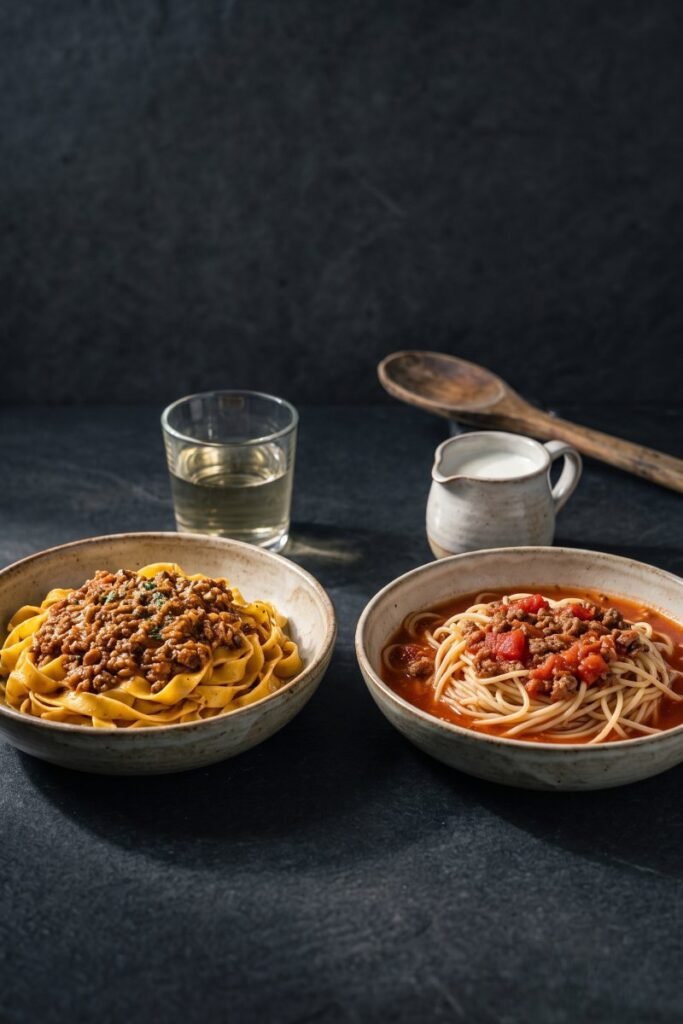
When I brown minced beef inside a deep pan on a quiet Sunday morning, distinguishing the physical mechanics of Bolognese Ragu vs. Standard Meat Sauce is the ultimate key to mastering true northern Italian comfort. Over my years of slow-simmering regional reductions, I have treated meat-to-tomato fluid ratios and dairy fat integration as strict structural rules rather than flexible cooking steps.
Whenever I see casual cooks drown ground beef in a giant pool of loose marinara and label it an authentic ragù alla bolognese, I notice how a lack of historical technique washes away the culinary heritage of the dish. For me, executing an authentic masterpiece requires stepping away from watery commercial purees to let slow, low-heat meat extractions build a thick, velvety glaze that clings tightly to wide noodles.
Why Traditional Ragù Focuses on Meat Fluid Extractions
To understand why an authentic ragù behaves so differently on your tongue compared to a standard commercial pour, you have to look closely at its core ingredient ratios. An authentic northern Italian reduction is not a tomato sauce with added meat; instead, it is a dedicated meat assembly that uses a microscopic layer of tomato paste strictly to bind the fats together.
When I build a traditional base, I cook a finely diced soffritto of sweet carrots, celery, and onions over a low flame until translucent before searing a combination of minced beef and fatty pork. This prolonged, dry frying phase forces the natural moisture inside the muscle cells to escape as steam, causing the remaining proteins to caramelize cleanly against the hot bottom of the pan.
Standard meat sauces bypass this dry rendering step entirely, drowning the raw beef inside a wet pool of processed tomato liquid before the meat fibers can develop a rich crust. I avoid these high-moisture drowning blunders completely, a moisture-management rule I follow when treating extra moisture blocks inside my guide on handling Homemade Tomato Sauce Too Watery.
The Chemical Power of Adding Whole Milk to the Simmer
The single most unique marker of a true ragù alla bolognese is the introduction of fresh whole milk directly into the hot, seared meat layer. I follow the historical ingredient guidelines and structural dairy testing parameters detailed inside the official Serious Eats Bolognese Food Science Guide to safely regulate my liquid phases.
When I pour milk into the pan, the natural lactic acid coats the tough muscle fibers, breaking down the rigid protein chains and tenderizing the beef down to a velvety softness. As the dairy liquid simmers lazily for three hours over medium-low heat, the milk fats emulsify with the rendering pork fats and dry white wine.
This chemical bonding creates a rich, creamy matrix that locks out any harsh fruit tartness without needing white table sugar crystals. Standard meat sauces completely lack this velvety dairy insulation, relying instead on high volumes of acidic marinara that can leave your palate tasting sharp and unbalanced.
Selecting Wide Porous Shapes Over Thin Spaghetti Strands
The final law for serving an authentic Sunday meal requires matching your meat reduction to a pasta shape that can physically carry its heavy weight. My absolute kitchen baseline rule is to completely ban long, thin spaghetti strands from ever crossing paths with a rich, slow-simmered northern ragù.
Because minced beef and pork are heavy and chunky, they cannot grip onto the sleek, rounded outer walls of a thin spaghetti strand, causing the meat to slide down to the bottom of your bowl. Instead, true Italian cooks pair this velvety glaze exclusively with wide, porous egg pasta ribbons like fresh tagliatelle or thick, hollow durum tubes.
These wide surfaces provide the ideal mechanical grip to lock the savory meat bits straight onto the dough, ensuring every forkful delivers a cohesive texture balance.
Managing the Extended Cooking Window for Peak Density
Once your white wine, milk, and hint of tomato paste are safely resting inside a heavy Dutch oven, your workflow transitions into a passive evaporation window. I let my open pot bubble lazily on the lowest stove setting for at least three full hours, watching the color slowly deepen into a rich, dark mahogany red.
This patient approach allows the natural animal gelatins to meld with the cooking oils, creating a thick, uniform glaze that coats a wooden spoon seamlessly. If you rush this timeline and cut the burner after twenty minutes, the fats will separate into a greasy top layer, completely ruining the mouthfeel of the dinner.
I know my pot is successful when I can run a spoon through the center of the pan and the reduction holds its lane without weeping separate watery streams. Taking the extra time to properly layer your fats, milk, and wine is the ultimate secret to delivering an elite meal to your family table.