
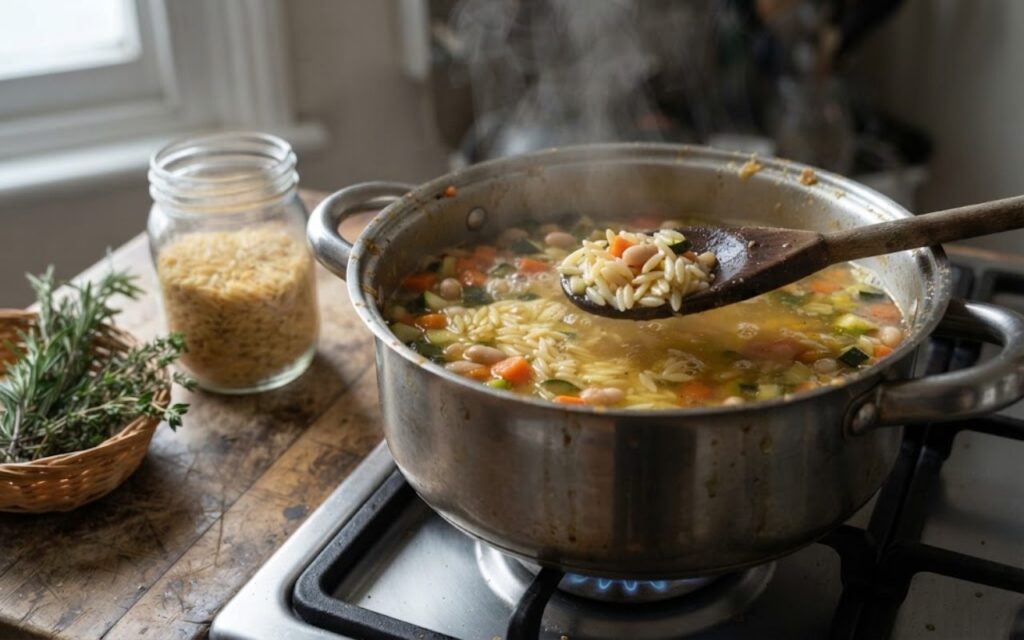
Understanding the functional battle of Orzo vs. Rice: Why Orzo Belongs in Your Italian Soup Pantry changes how home cooks build classic broths and hearty minestrone. While both look remarkably similar in dry form, their culinary behavior in hot liquid relies on fundamentally different food science principles.
Pasta is manufactured from milled durum wheat, whereas rice is an intact grain kernel with varying surface starch ratios. Choosing the wrong grain creates cloudy broth, bloated starches, and muddy textures that ruin an otherwise pristine soup.
Quick-Glance Kitchen Summary
Orzo provides a resilient gluten network that holds structural integrity in simmering broths without blowing out into mush like medium-grain rice. Par-cooking your starch separately preserves crystal-clear broth clarity while eliminating starch-driven liquid absorption during storage.
- Orzo: Bronze-die cut durum wheat semolina (such as De Cecco or Rummo)
- Rice alternative: High-amylose long grain (Carolina Gold or basmati) for holding shape, or superfino varieties (Carnaroli) strictly when intentional broth thickening is desired
- Cookware: 3-quart curved-wall saucier for uniform convection and preventing corner scorching
- Salinity target: 10 grams coarse sea salt per liter of par-cooking water
- Oil finish: 1 teaspoon extra virgin olive oil tossed into drained grains to halt clump formation
Starch Gelatinization Dynamics: Amylose Release Versus Durum Gluten Trapping
The fundamental difference between these two staples lies in their molecular construction. Rice releases free surface starch granules directly into your broth as the water heats past 150 degrees Fahrenheit. Without an outer protein casing to trap the amylose and amylopectin molecules, the grain sheds starch layers that cloud your soup and turn thin broths into viscous sludge.
Orzo, by contrast, relies on a dense matrix of glutenin and gliadin proteins formed during semolina extrusion. Commercial pasta dies, particularly traditional bronze dies, compress durum wheat under immense mechanical pressure. This dense protein web physically encapsulates the internal starch granules, preventing them from bleeding unchecked into the surrounding liquid during simmering.
Because the gluten matrix expands uniformly, orzo retains an al dente bite far longer than standard white rice. Long-simmered soups like classic Italian wedding soup demand this mechanical durability. When cooked directly in vegetable or chicken broths, orzo maintains clean edges, while medium-grain rice sloughs off its exterior and compromises broth clarity.
| Starch Type | Core Material Matrix | Broth Performance Profile | Leftover Storage Stability |
|---|---|---|---|
| Orzo (Risoni) | Hard durum wheat semolina pastina dough rolled into grain shapes. | Elite; locks in a firm al dente texture without releasing loose starches. | Excellent; remains firm and distinct inside cold liquids overnight. |
| Long-Grain Rice | Natural, unprocessed seed grains from the Oryza sativa grass plant. | Soft; releases surface amylose that muddies and thickens clear stocks. | Poor; continues absorbing moisture until it splits into a soft slurry. |
Structural Breakdown and Performance Profiles in Broth
Home cooks frequently encounter frustrating texture failures when swapping grains without adjusting their approach. The physical characteristics of each ingredient dictate exactly how they interact with boiling broth, aromatics, and fats over extended cook times.
| Starch Type | Primary Starch Compound | Broth Impact | Texture Retention | Best Soup Application |
|---|---|---|---|---|
| Durum Orzo | Encapsulated Amylose and Amylopectin | Minimal starch shed; leaves broth clear | High; stays al dente for 30 minutes | Minestrone, Italian wedding, brodo |
| Long-Grain Rice | High Amylose (approx. 22 percent) | Low-to-moderate starch shed if washed | Moderate; softens rapidly after heat stops | Chicken and wild rice, lemon-herb broth |
| Short/Medium Rice | High Amylopectin | Heavy starch wash; turns broth cloudy | Low; breaks down into thick porridge | Rice puddings, thick winter pottages |
| Parboiled Rice | Chemically Gelatinized Surface | Very low starch shed; maintains broth clarity | Firm; lacks traditional toothsome bite | High-volume food service, shelf-stable soups |
The mechanical resilience of extruded pasta makes it far more forgiving during casual weeknight cooking. If your soup boils slightly longer than intended, orzo swells gently without falling apart. Rice kernels quickly reach their gelatinization threshold, split open along natural fissures, and dissolve into the soup base.
Thermal Shock and Retrogradation: Preventing Leftover Mush
The true test of soup ingredients happens in the refrigerator overnight. Cooked rice undergoes rapid starch retrogradation, a process where gelatinized amylose molecules cool, realign, and form rigid crystalline structures. While this firming effect works well for fried rice, it causes refrigerated rice in soup to absorb all available liquid, transforming your soup into a solid block of starch.
Orzo behaves with much greater stability during cooling and subsequent reheating. Although the pasta absorbs some surrounding liquid via capillary action, the dense gluten web halts runaway liquid intake. The pasta swells marginally but avoids the chalky, gritty disintegration common to cold, soaked rice.
To achieve superior leftover quality, cooks must manage the cooling process carefully. A high volume of hot soup trapped in a deep container retains heat too long, overcooking delicate grains through residual thermal mass. Spreading cooked grains across a rimmed sheet pan halts cooking instantly, preserving texture for days.
Saucier Geometry and Par-Cooking Strategies for Clear Broths
Cooking starches directly inside soup broth is the most common home kitchen mistake reported across culinary communities. The floating starch creates a murky, dull appearance and steals delicate aromatic compounds from your mirepoix or sofrito. Professional kitchens avoid this completely by par-cooking small pasta shapes like orzo in dedicated salted water.
Using a curved saucier rather than a sharp-cornered straight stockpot provides noticeable hydrodynamic advantages during prep. The rounded bottom perimeter promotes natural convection currents, keeping the grains continuously suspended in the boiling water. This constant motion prevents heavy pasta grains from settling into cold dead zones where they can burn or stick.
- Bring 3 quarts of well-salted water to a vigorous rolling boil.
- Add your measured orzo and cook for precisely two minutes less than the package directs.
- Drain the pasta thoroughly in a fine-mesh sieve; do not rinse under tap water.
- Toss the drained orzo with a half-teaspoon of neutral oil or olive oil.
- Spread the pasta onto a stainless steel sheet pan to cool quickly at room temperature.
- Portion the cooled orzo directly into serving bowls and ladle hot soup over the top.
This split-cooking workflow ensures the soup broth stays sparkling and translucent. It also prevents the pasta from continuously drinking up expensive, hours-simmered homemade stock while sitting in the pot.
Food Safety Benchmarks: Bacillus Cereus Risks and Reheating Protocols
Beyond culinary texture and flavor, storing grain-based soups involves critical biological considerations. Uncooked rice frequently carries dormant spores of Bacillus cereus, a heat-resistant bacterium capable of surviving normal cooking temperatures. If cooked rice soup sits in the culinary temperature danger zone between 40 and 140 degrees Fahrenheit, these spores germinate and produce emetic toxins that standard reheating cannot destroy.
While wheat pasta can also support microbial growth when handled improperly, it presents a significantly lower statistical hazard for Bacillus cereus proliferation compared to wet rice. Regardless of which base you choose, food safety protocols require strict time and temperature management. Never leave grain-loaded soups to cool slowly on a turned-off stovetop for hours.
- Cool hot broth-based soups from 135 degrees to 70 degrees Fahrenheit within two hours.
- Continue chilling down to 41 degrees Fahrenheit or below within an additional four hours.
- Store cooked orzo and seasoned broth in separate, shallow, airtight glass containers.
- Reheat stored broth to a rolling boil of at least 165 degrees Fahrenheit before serving.
- Drop cold par-cooked orzo into the boiling soup during the final 60 seconds of heating.
Mastering these physical, chemical, and safety boundaries ensures your soup pantry stays dependable. Orzo provides the perfect balance of structural endurance, culinary versatility, and textural resilience that delicate homemade soups deserve.