
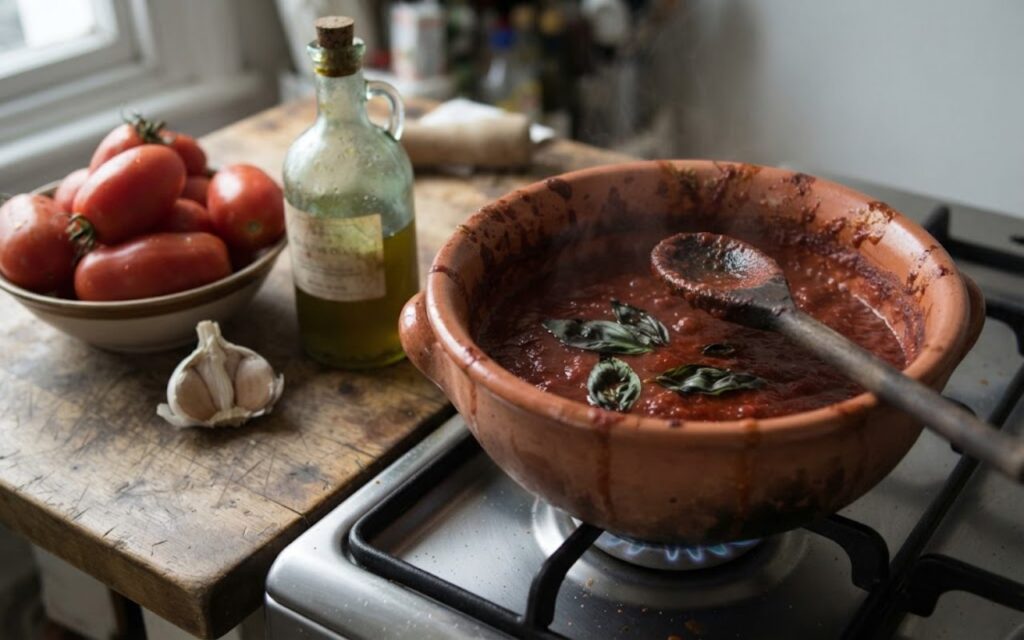
Have you ever wondered what is salsa madre? It is the foundational, slow-simmered mother tomato sauce reduction that anchors classic Southern Italian cooking. This traditional base relies on gently extracting moisture from ripe plum tomatoes, garlic, and fresh basil leaves to create a thick, intensely concentrated purée.
In traditional Mediterranean kitchens, this master reduction serves as a clean canvas before any regional finishing fats or proteins are introduced. Mastering this initial concentration technique prevents watery layer separation and guarantees restaurant-caliber flavor binding across every single pasta dish you plate.
Quick-Glance Kitchen Summary
A Salsa Madre is a gently simmered, seed-strained master tomato sauce designed to serve as the structural blank canvas for classic regional derivations.
Simmer whole peeled San Marzano or plum tomatoes slowly with minimal aromatics, pass them through a food mill to remove bitter seeds, and store or can the concentrate for rapid weeknight sauce building.
- Core Ingredients: Whole peeled plum tomatoes (DOP San Marzano or quality canned pelati), extra virgin olive oil, whole crushed garlic cloves, fresh basil sprigs, fine sea salt.
- Primary Hardware: Heavy-bottomed enameled cast iron Dutch oven or multi-clad stainless steel saucier, rotary food mill with a medium disc, heat-resistant silicone spatula.
- Thermal Constraints: Gentle simmer maintained between 85 to 90 degrees Celsius for 45 to 60 minutes; avoid rapid rolling boils that scorch natural sugars.
- Food Safety Benchmark: Shelf-stable preservation requires an equilibrium pH strictly below 4.6 achieved with verified acidification.
| Tomato State | Structural Profile | Stovetop Emulsion Performance | Traditional Culinary Purpose |
|---|---|---|---|
| Salsa Madre | Thick, glossy, and fully homogenized pure tomato reduction with no added fats. | Elite; binds beautifully with starches and olive oils without separating. | The master base for ragùs, parmigiana, marinara, and long-simmered regional stews. |
| Passata | Raw, cold-strained tomato purée that remains uncooked and watery. | Moderate; requires aggressive stovetop reduction to burn off raw water. | Quick-cooking pizza sauces, seafood broths, and short pan-flashes. |
Thermal Mass and Evaporation Dynamics in the Tomato Base
The primary goal of the initial reduction is to evaporate volatile citric and malic acids without scorching the natural sugars present in the fruit pulp. Using reactive cookware like unlined aluminum or raw carbon steel causes acidic tomatoes to leach metallic flavors into the sauce.
Heavy-bottomed enameled cast iron or thick multi-clad stainless steel provides the uniform thermal mass necessary to prevent localized hot spots on standard residential stove burners.
A wide, shallow saucier accelerates the reduction process far more efficiently than a tall stockpot by maximizing the exposed liquid surface area. Maintain the heat at a low simmer where small bubbles gently break the surface, allowing water content to escape steadily.
Rapid boiling destroys delicate volatile aromatic compounds and degrades the natural pectin structures responsible for a glossy, clinging consistency.
- Set stove heat to medium-low to maintain a gentle bubbling frequency across the entire surface.
- Stir with a flat-edged wooden spatula every eight to ten minutes to clear the pan bottom corners.
- Simmer uncovered until the total volume reduces by approximately one-third, which typically requires 45 to 55 minutes.
Passaverdure Shearing Versus Blade Aeration and Seed Bitterness
Home cooks frequently ruin tomato sauces by running an immersion blender directly inside the pot. High-speed steel blades pulverize the tiny tomato seeds, releasing bitter polyphenols and astringent tannins directly into the sauce.
Furthermore, blade rotation whips ambient air into the mixture, oxidizing the delicate fats and turning a brilliant crimson sauce into a dull, pastel orange suspension.
The traditional Italian rotary food mill, known as a passaverdure, remains the gold standard tool for texture refinement. The manual sweeping blade presses the cooked tomato flesh through perforated metal holes while leaving the bitter seeds and fibrous skins trapped in the upper chamber.
This mechanical action yields a dense, velvety puree that maintains pure color and clean fruit sweetness.
| Processing Method | Blade Aeration Impact | Seed Polyphenol Extraction | Final Texture and Color |
|---|---|---|---|
| Rotary Food Mill (Passaverdure) | Zero micro-bubble incorporation preserves deep red lycopene pigment | Unbroken seeds remain trapped above the disc without releasing bitter oils | Silky, velvety sauce with intact natural tomato pulp fibers |
| High-Speed Immersion Blender | Heavy air shearing emulsifies lipids into a pale orange, foamy liquid | High-speed blades shatter seed coats, releasing astringent tannins | Watery yet foamy suspension that separates during pan tossing |
| Box Grater (Raw Method) | Minimal oxidation with moderate liquid release | Leaves tough outer skins behind while keeping seeds mostly intact | Coarse, watery pulp requiring extended stove reduction times |
Passing your tomatoes through the medium disc of a food mill yields the optimal balance between body and refinement. If you do not own a food mill, gently crush whole canned tomatoes by hand in a large bowl before simmering, completely skipping high-speed motorized blades.
Acidity Buffering, Natural Sugar Concentration, and Canning Safety Standards
Inferior canned tomatoes often carry an aggressive, sharp acidity from added citric acid preservatives. Rather than masking this harshness by dumping refined white sugar into the pan, skilled cooks rely on slow, low-temperature thermal breakdown to caramelize the fruit’s intrinsic fructose.
Adding a single whole carrot or a halved yellow onion during the simmer naturally buffers perceived acidity; discard these aromatics before final storage to keep the base neutral.
When preserving a large batch of mother sauce for ambient pantry storage, you must adhere strictly to established food safety protocols. Tomatoes hover dangerously close to the safety threshold for botulinum spore germination, meaning natural acidity alone cannot be assumed safe.
According to USDA and National Center for Home Food Preservation (NCHFP) standards, the equilibrium pH of tomato preserves must remain safely below 4.6.
- Mandate exactly 1 tablespoon of bottled lemon juice or 1/4 teaspoon of citric acid per pint jar before sealing.
- Mandate exactly 2 tablespoons of bottled lemon juice or 1/2 teaspoon of citric acid per quart jar before sealing.
- Process filled jars in a boiling water bath canner for the tested duration specified for your altitude.
Never rely on fresh-squeezed lemons for preservation, as their acid levels fluctuate wildly compared to standardized bottled juice. If you prefer not to alter the acidity profile chemically, store the reduced sauce in airtight containers in the freezer instead.
Emulsification Profiles and Derivation Into Regional Pasta Sauces
The true genius of the Salsa Madre lies in its neutrality, serving as the launching pad for dozens of classic Italian sauces in under ten minutes. Because the base contains only minimal olive oil, salt, and gentle aromatics, it adapts instantly to high-heat pan building.
You can transform this mother sauce into an Arrabbiata, an Amatriciana, or a Puttanesca simply by altering your finishing pan aromatics and fat sources.
- Arrabbiata Profile: Bloom sliced garlic and crushed dried peperoncino flakes in warm extra virgin olive oil, add two ladles of Salsa Madre, and simmer for five minutes before tossing with penne.
- Amatriciana Profile: Render diced guanciale until crispy, deglaze the pan with dry white wine, stir in Salsa Madre, and finish off-heat with finely grated Pecorino Romano.
- Puttanesca Profile: Sizzle salted capers, oil-cured black olives, garlic, and anchovy fillets in olive oil until dissolved, then incorporate the Salsa Madre and simmer briefly.
When finishing any derived pasta dish, transfer the boiled pasta directly into the sauce skillet along with a splash of starchy cooking water. Toss vigorously over medium-high heat to force the suspended tomato pectin, cooking water starches, and free olive oil lipids into a tight, glossy emulsion that clings to the pasta surface.
Lipid Partitioning and Storage Stability Across Freezing Cycles
Extra virgin olive oil behaves differently depending on when it enters the cooking process. Cooking raw olive oil for an hour degrades its delicate fruity top notes and can create a heavy, greasy mouthfeel in a mother sauce.
For maximum versatility, use only a minimal amount of neutral cooking fat or light olive oil during the initial simmer, finishing your derived dishes with premium raw extra virgin olive oil right before serving.
Freezing tomato sauce often causes syneresis, a structural breakdown where liquid water separates from the tomato solids upon thawing. This separation occurs because ice crystals puncture the delicate cellular walls of the tomato pulp during slow home freezing.
You can instantly restore a thawed, watery mother sauce by simmering it vigorously in a wide skillet for two minutes, using mechanical whisking to re-bind the pulp and free water into a smooth suspension.
- Cool the finished mother sauce completely to room temperature before portioning into freezer containers to prevent condensation ice crystals.
- Leave at least one inch of headspace in glass jars or plastic tubs to accommodate liquid expansion during the freezing phase.
- Reheat thawed batches over medium heat while whisking steadily to re-incorporate separated water phases before building your evening sauce.