
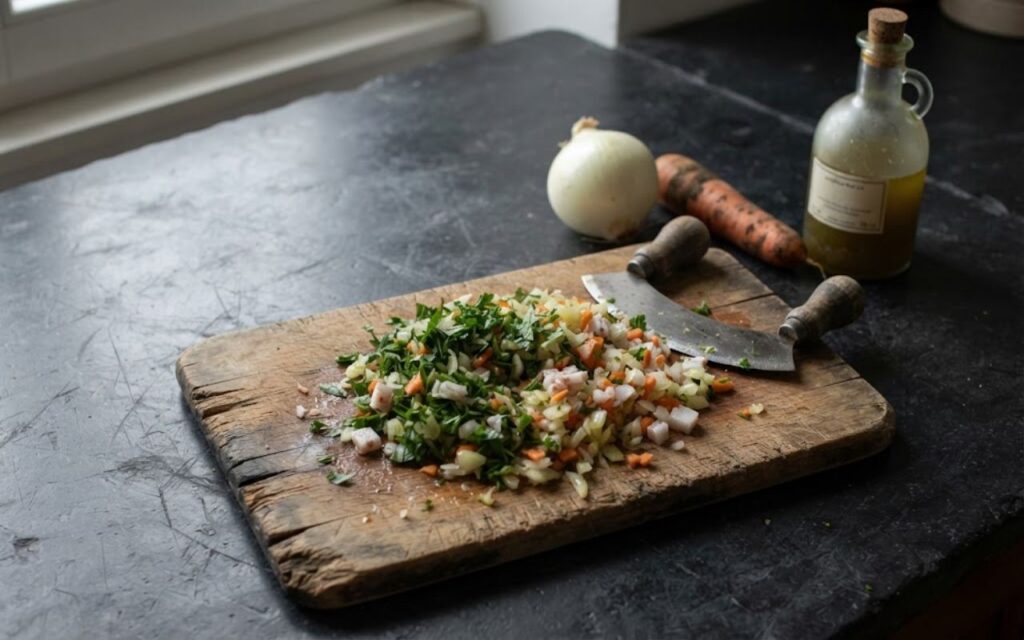
Mastering a traditional base separates flat sauces from restaurant-caliber regional Italian dishes. Learning how to make italian battuto relies strictly on a precise balance of knife technique, ingredient moisture control, and quality fat selection.
In traditional culinary terminology, this aromatic mix refers specifically to the raw, finely minced ingredients before heat is applied. Once these raw components sweat gently in a pan, they transform into a rich soffritto base that builds unmatched depth for ragùs and stews.
Quick-Glance Kitchen Summary
A traditional battuto is a raw, finely hand-minced aromatic base composed of vegetables, herbs, and cured fats tailored to specific regional recipes. Mincing ingredients with a sharp knife rather than pureeing prevents cellular bruising, ensuring clean flavor extraction without bitter water pooling.
- Yellow onion: 2 parts by weight, peeled and finely minced
- Celery stalk: 1 part by weight, stringed and finely minced
- Carrot: 1 part by weight, scrubbed and finely minced
- Fat medium: Unfiltered extra virgin olive oil, minced lardo, or guanciale
- Core gear: Heavy carbon steel chef’s knife (or mezzaluna) and large wooden cutting board
- Thermal vessel: Heavy-bottomed enameled cast iron or stainless steel skillet
Knife Geometry and Cellular Rupture: Hand Chopping Versus Food Processors
The primary failure point reported across home cooking forums is a watery, bitter base caused by using an electric food processor. Food processor blades spin at thousands of revolutions per minute, crushing plant cell walls through blunt force rather than slicing cleanly through them.
This violent cellular rupture releases excess intracellular water and activates sulfur-producing enzymatic reactions in alliums, turning your sweet onions acrid and watery.
Using a heavy carbon steel chef knife or a traditional double-handled mezzaluna provides precise physical control over cellular shearing. Slicing cleanly preserves cell walls, keeping moisture trapped inside the vegetable dice until it encounters hot fat in the pan.
- Keep the blade edge honed at a 15-to-20-degree angle to slice cleanly through fibrous celery strings without crushing.
- Work on a broad end-grain wooden board to absorb blade impact and prevent aromatic juices from running onto your counter.
- Dice all vegetables to an identical 2-to-3-millimeter mince to ensure uniform moisture evaporation during cooking.
When ingredients are uniformly hand-cut, moisture releases as gentle steam rather than pooling into a cold puddle. This mechanical precision ensures that your aromatics fry gently in fat rather than boiling in their own expelled juices.
Battuto Ingredient Variations and Regional Fat Matrices
A battuto is not a rigid formula; its composition shifts based on the target dish and geographical region. Northern Italian variations frequently incorporate cured pork fats like lardo or pancetta directly into the raw mince, while southern coastal regions lean exclusively on robust extra virgin olive oil and fresh parsley.
| Aromatic Base Style | Core Fat Carrier | Primary Herb/Allume Additions | Cut Geometry | Classic Application |
|---|---|---|---|---|
| Tuscan Classical | Minced lardo or cured pancetta | Rosemary, sage, yellow onion | 2 mm fine hand mince | Wild boar ragu, hearty bean stews |
| Roman Traditional | Rendered guanciale or olive oil | Celery-heavy ratio, garlic, parsley | 3 mm rustic dice | Pasta alla Gricia base, braised oxtail |
| Neapolitan Coastal | Cold-pressed extra virgin olive oil | Flat-leaf parsley, garlic, red pepper | Micro-mince | Seafood braises, quick marinara bases |
| French Mirepoix | Clarified butter or neutral oil | Thyme, bay leaf, leek additions | 5 mm to 10 mm cube | Stocks, veloutes, brown braises |
The choice of cooking fat alters the solubility of aromatic flavor compounds. Carotenoids in carrots and allicin derivatives in garlic dissolve far more efficiently in animal lipids and olive oil triglycerides than in water.
Selecting high-quality cured fats introduces natural glutamates and fat-soluble flavor carriers to the dish. If using cured pork fat, chop it together with the herbs on the board so the fat absorbs the botanical oils before meeting the heat.
Pan Thermal Mass and Moisture Evaporation Dynamics
The pan you select determines whether your raw aromatics sweat evenly or scorch into bitterness. Enameled cast iron and multi-ply stainless steel pans offer superior thermal mass, absorbing heat spikes and spreading energy across the base of the pan.
Thin non-stick pans or lightweight aluminum warp quickly, creating focal hot spots that burn tiny allium pieces before the carrots soften.
Controlling thermal distribution allows vegetable moisture to evaporate at a regulated, predictable pace. If the pan surface temperature exceeds the smoking point of your fat, delicate herb volatile oils vaporize immediately into the kitchen air instead of infusing the sauce.
- Heat your heavy skillet over medium-low heat for 3 minutes before introducing your cooking fat.
- Add the aromatic mixture in an even, single layer across the cooking surface to maximize surface contact.
- Maintain a gentle heat surface between 250 and 285 degrees Fahrenheit to sweat the vegetables without initiating heavy surface browning.
Stir the mixture with a flat-edged wooden spatula every 90 seconds to redistribute the aromatics. This scraping action keeps the smaller onion corners from sticking to the pan corners, where thermal energy builds up.
Fat-Soluble Flavor Extraction and Temperature Control
Transitioning the raw mixture into a sweet, unctuous foundation requires coaxing out sugars through low-temperature thermal breakdown. Sweating vegetables slowly breaks down pectin networks and converts complex carbohydrates into simple sugars without triggering rapid Maillard reactions.
Scorched onions develop harsh, burnt notes that permanently ruin the delicate profiles of slow-cooked ragus. Carrots contain hydrophobic carotenoid pigments that require lipid contact to break down and tint the cooking oil a deep amber. Celery provides natural sodium and umami precursors, which balance the intense sweetness of breaking-down alliums.
- Add a pinch of sea salt at the start of cooking to draw moisture out via osmosis, creating a protective steaming micro-barrier.
- Keep the pan uncovered so liberated moisture can exit freely as steam instead of condensing back onto the pan floor.
- Lower the flame immediately if you see edges browning before the 10-minute mark; the entire process requires 15 to 25 minutes.
Once the onions turn translucent and the fat matrix carries a golden hue, the aromatic compounds have successfully dissolved into the oil. At this stage, the raw mixture has officially evolved into a fragrant soffritto, primed to receive meat, legumes, or liquids.
From Battuto to Soffritto: Acid Deglazing and Safe Long-Term Storage
The final step in utilizing an aromatic base is deglazing the pan with an acidic liquid to lift concentrated vegetable drippings. Adding a dry white or red wine reduces the pan temperature, captures dissolved sugars, and balances the rich fat matrix with bright acidity. Allow the wine to reduce by at least three-quarters by volume before adding stocks, canned tomatoes, or braising liquids.
Many home cooks prepare large batches of raw aromatic mix ahead of time to streamline weeknight cooking. Freezing finely minced raw aromatics in ice cube trays or vacuum-sealed bags locks in volatile aromatic oils without significant flavor degradation.
- Freeze raw portioned aromatics in silicone molds with a light coating of olive oil to prevent ice crystallization.
- Drop frozen cubes directly into a warm, oiled skillet without thawing, as thawing at room temperature causes cell collapse and waterlogging.
- Store vacuum-sealed raw portions in the coldest part of your freezer for up to three months without aromatic loss.
If incorporating your aromatic base into home-canned tomato sauces or bottling projects, strict food safety parameters must be observed. The United States Department of Agriculture and the National Center for Home Food Preservation mandate that the equilibrium pH must remain strictly below 4.6 for safe water-bath canning.
You must add exactly 1 tablespoon of bottled lemon juice or 1/4 teaspoon of citric acid per pint jar, or exactly 2 tablespoons of bottled lemon juice or 1/2 teaspoon of citric acid per quart jar, ensuring microbial safety while locking in regional Italian flavor.