
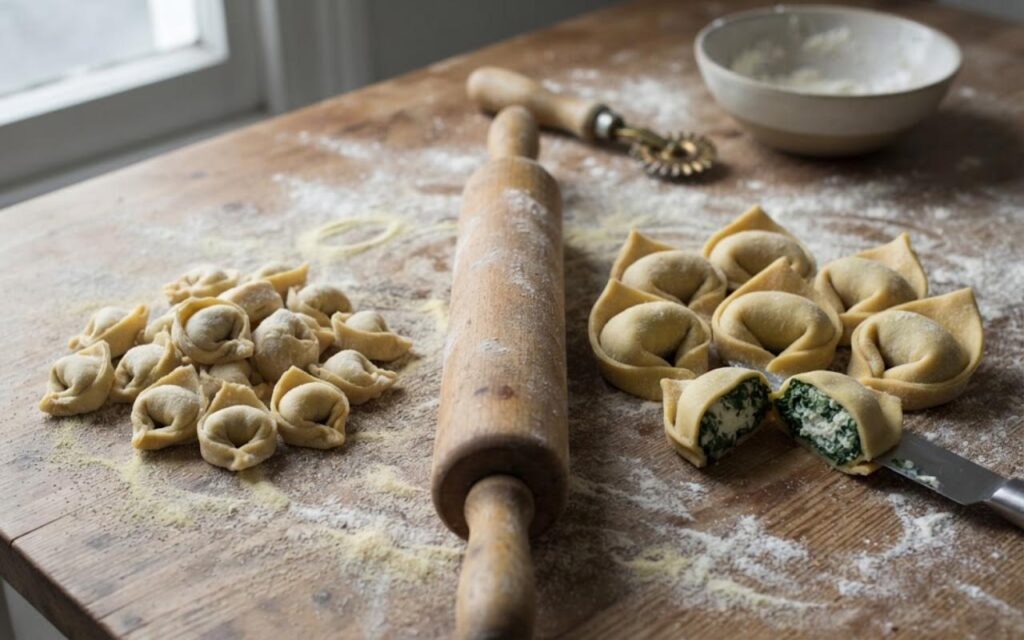
Navigating the classic debate of tortellini vs. tortelloni reveals a culinary division that extends far beyond a simple variation in pasta scale. While casual diners often mistake them for interchangeable sizes of the same stuffed parcel, Italian pasta makers treat them as fundamentally different culinary architectures.
Each shape answers to distinct regional origins across Emilia-Romagna, requiring customized dough thickness, contrasting filling textures, and separate cooking mediums to succeed on the plate. Misunderstanding these foundational parameters leads directly to undercooked dough seams, waterlogged fillings, and collapsed pasta parcels.
Quick-Glance Kitchen Summary
Tortellini are diminutive, dense meat parcels engineered specifically to cook and float in clear capon broth, whereas tortelloni are larger, soft-centered pockets designed to hold delicate vegetarian fillings dressed in butter emulsions or rich sauces. Mastering the divide requires matching the hydration and sheet thickness of your sfoglia to the moisture content of the chosen filling.
- Dough Hydration Baseline: 55 to 57 percent hydration using 100 grams of Tipo 00 flour to one large egg.
- Tortellini Pasta Sheet Thickness: 0.5 to 0.6 millimeters, corresponding to the final Setting 9 on standard hand-crank rollers.
- Tortelloni Pasta Sheet Thickness: 0.8 to 1.0 millimeters, corresponding to Setting 7 or 8 on standard hand-crank rollers.
- Core Tortellini Filling: Finely minced pork loin (browned in butter), mortadella, prosciutto di Parma, Parmigiano Reggiano, and nutmeg.
- Core Tortelloni Filling: Drained whole-milk ricotta, Parmigiano Reggiano, egg yolk, and leafy greens or winter squash.
- Primary Cooking Liquid: Rich capon or beef bone broth for tortellini; well-salted rolling water for tortelloni.
Dough Hydration Ratios and Sfoglia Thickness Benchmarks
Achieving the proper bite begins with mixing a traditional whole-egg sfoglia adjusted to the tension of the final fold. Tortellini require a remarkably thin sheet, rolled down to between 0.5 and 0.6 millimeters so the overlapping dough around your finger cooks through at the exact same rate as the single-layer belly. If rolled too thick, the navel knot remains tough and chalky even after simmering in hot broth.
Tortelloni demand a slightly thicker sheet, typically calibrated between 0.8 and 1.0 millimeters. Because the parcel carries a heavier, moisture-dense payload, an ultra-thin sheet will stretch thin across the filling, rupture in the water, and flood the interior.
Standard commercial pasta rollers like the Marcato Atlas 150 achieve this balance by taking tortellini dough down to its tightest threshold at Setting 9, while stopping at Setting 7 or 8 for tortelloni squares to safeguard the structural integrity of the wider pockets.
Maintaining an egg pasta hydration level of roughly 56 percent gives the dough the necessary elasticity to stretch without tearing. Working with a dry ambient kitchen humidity requires damp towels over the uncut sheets to prevent premature crusting. A dry edge will refuse to adhere to itself, ruining the hermetic seal needed during boiling.
- Flour Selection: 100 percent soft wheat Tipo 00 flour with high protein quality for stretch elasticity.
- Moisture Calibration: 55 to 57 grams of whole egg per 100 grams of flour, adjusting with egg white droplets if dry.
- Resting Time: Minimum 30 minutes sealed in plastic wrap to allow gluten relaxation and complete starch hydration.
Structural Geometry, Scale, and Filling Dynamics
The geometric scale of each pasta pocket dictates how thermal energy transfers through the parcel during cooking. Tortellini begin from tiny cut squares measuring between 2.5 and 3.5 centimeters per side, wrapping snugly around a hazelnut-sized ball of dense meat filling. Tortelloni start with expansive squares measuring between 6.5 and 8.0 centimeters, accommodating a generous tablespoon of soft, aerated cheese or vegetable purée.
| Structural Feature | Tortellini | Tortelloni |
|---|---|---|
| Cut Square Dimensions | 2.5 to 3.5 centimeters per side. | 6.5 to 8.0 centimeters per side. |
| Traditional Core Filling | Seared pork paste with mortadella and prosciutto. | Whipped cow or sheep ricotta with greens. |
| Target Sheet Thickness | 0.5 to 0.6 millimeters for even knot cooking. | 0.8 to 1.0 millimeters to prevent pocket rupture. |
| Traditional Serving Medium | Floating directly in hot capon or poultry brodo. | Tossed in emulsified sage butter or light ragù. |
| Sealing Geometry | Folded into a triangle, tips joined around a finger. | Folded into a triangle, corners overlapped flat. |
The Accademia Italiana della Cucina and the Dotta Confraternita del Tortellino strictly codified the authentic Bologna tortellino filling on December 7, 1974.
Deposited officially at the Bologna Chamber of Commerce, the notarized master recipe demands prosciutto di Parma, Mortadella di Bologna, 24-month Parmigiano Reggiano, egg, nutmeg, and pork loin that has been rested with aromatics and gently cooked in butter before grinding.
Using raw pork loin introduces excessive water activity inside a tiny parcel that cooks too quickly to render properly; a pre-cooked savory core prevents internal structural degradation. Tortelloni fillings instead celebrate dairy freshness, relying on high-protein ricotta, steamed Swiss chard or spinach, and lemon zest to create a luxurious, molten interior.
Filling Moisture Control and Ricotta Steam Blowouts
The most prevalent failure encountered when preparing homemade tortelloni is the explosive blowout during the cooking cycle. Supermarket tub ricotta contains excess whey, which expands violently into steam when submerged in boiling water. This internal steam pressure splits the delicate dough seams, washing the filling out into the pot and leaving behind hollow, gummy pasta skins.
Home cooks must drain commercial whole-milk ricotta overnight in cheesecloth over a bowl to eliminate free-floating whey. Alternatively, sourcing artisan basket-drained ricotta or dense impastata provides the firm, dry structure required for stable pasta filling. Binding the mixture with an egg yolk and aged cheese further stabilizes the emulsion by setting the protein network at lower temperatures.
- Overnight Draining: Suspend wet ricotta in fine cheesecloth over a colander for at least 8 hours under refrigeration.
- Binder Proportion: Use one egg yolk per 250 grams of drained ricotta to set the dairy proteins without adding excess liquid.
- Moisture Barrier: Incorporate finely microplaned Parmigiano Reggiano to absorb ambient moisture while seasoning the cheese.
Because tortellini fillings rely on ground cured meats rather than wet curds, steam expansion is minimal. The challenge there lies in achieving a silky, fine grind that will not puncture the fragile 0.5-millimeter dough skin. Running the meats through a fine grinder die twice or processing them in a chilled food processor blade creates the necessary spreadable paste.
Brodo Hydrodynamics Versus Emulsified Pan Sauces
In authentic Emilian tradition, pairing tortellini with heavy cream or thick meat sauce is considered a structural mismatch. The delicate meat filling and intricate folds get smothered and lost beneath viscous sauces. Tortellini belong exclusively in brodo di cappone or rich beef bone stock, where the piping-hot liquid seasons the dough externally while accentuating the savory cured pork interior.
Tortelloni present the opposite hydrodynamic challenge; their sheer mass and soft filling allow them to carry pan-emulsified fats effortlessly. The classic dressing pairs sweet butter, fresh sage leaves, and a ladle of starchy pasta water swirled in a curved saucier pan. The wide curvature of the saucier allows the butter-water emulsion to coat the large pockets gently without bruising the pasta edges.
- Heat Control: Simmer tortellini in broth below a violent rolling boil to prevent mechanical damage to the knots.
- Pan Geometry: Utilize a sloped saucier rather than a straight-sided skillet to swirl tortelloni without relying on utensils.
- Emulsion Mechanics: Swirl cold unsalted butter directly into starchy cooking water off the heat to create a glossy glaze.
Heavy meat ragù can also be paired with tortelloni, particularly versions stuffed with roasted pumpkin or squash. The robust acidity of a slow-cooked tomato base cuts cleanly through the sweet, dense vegetable core.
Sealing Mechanics and Freezing Preservation Protocols
Closing both pasta shapes requires precise air evacuation before finalizing the edge seal. Trapped air pockets expand during boiling, bloating the parcel and ripping the thinnest portion of the sfoglia. Home cooks should tamp the dough firmly around the filling core with their thumbs before pressing the outer edges together.
For long-term storage, stuffed egg pasta should never be refrigerated on a flat tray, as the dough absorbs moisture from the filling and turns sticky within hours. Flash freezing directly on a parchment-lined sheet pan keeps each parcel structurally sound. Once the pockets freeze solid after two hours, transfer them immediately into airtight freezer bags to eliminate freezer burn.
- Dusting Agent: Dust trays exclusively with coarse semola rimacinata rather than standard flour to prevent pasty sticking.
- Sheet Spacing: Ensure individual pieces do not touch during the initial blast-chill phase to prevent tearing during separation.
- Cooking Frozen Pasta: Drop frozen parcels directly into boiling broth or salted water without thawing to preserve structural elasticity.
When cooking directly from the freezer, extend the total simmer time by roughly 90 seconds. Monitor the pot temperature closely, as adding frozen pasta causes the water to drop below the boiling threshold. Bringing the liquid back to an active simmer swiftly ensures the pasta skin cooks through cleanly without soaking up excess water.