
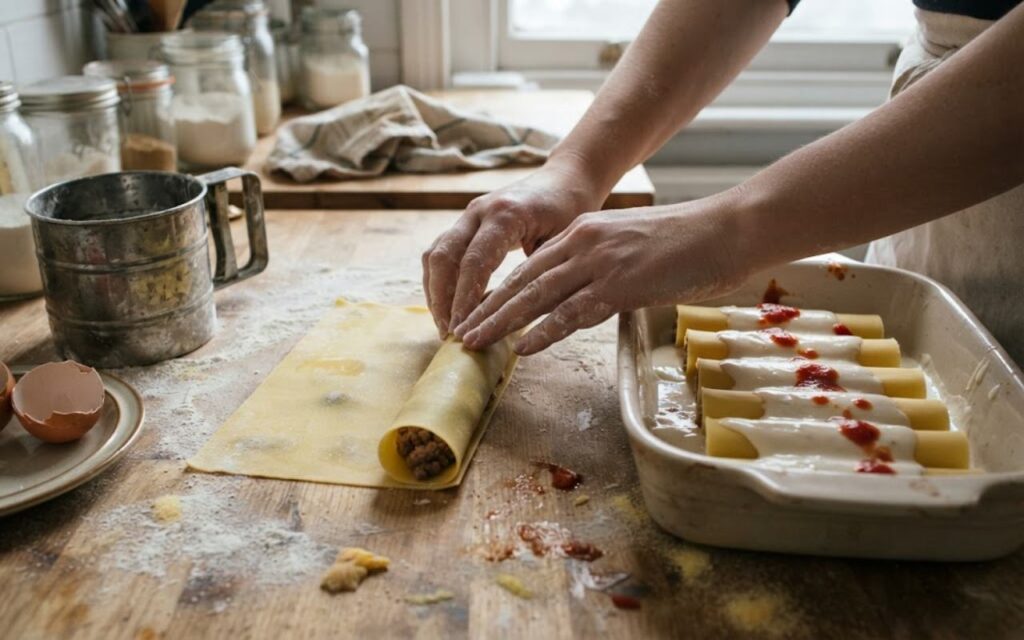
Understanding what is cannelloni requires stripping away decades of supermarket confusion between delicate rolled fresh pasta and thick factory tubes. Originating in Italian domestic cooking, authentic cannelloni consists of fresh egg dough rolled into hollow cylinders wrapped around savory fillings of braised meat or ricotta. In contrast, the American kitchen often conflates this handcrafted classic with factory-extruded manicotti tubes.
The difference between a soggy, torn casserole and a silky, blistered baked pasta lies in dough mechanics and moisture control. By exploring how traditional pasta construction differs from commercial dry pasta, you can master both technique and texture.
Quick-Glance Kitchen Summary
Authentic cannelloni relies on tender sheets of fresh egg pasta rolled around savory fillings, whereas commercial manicotti typically utilizes dried durum wheat tubes or southern-style crepes. Mastering this dish requires balancing high-moisture interior fillings with a dual blanket of silky besciamella and acidic tomato sauce to prevent the pasta from drying out during baking.
- Fresh egg pasta sheets: 55 to 57 percent hydration, rolled to roughly 1 millimeter thick
- Whole-milk besciamella: 1:1 flour-to-butter roux scaled at 50 grams each per 500 milliliters of whole milk
- Tomato reduction: Passata at 8 to 11 Brix, or standard puree fortified with double-concentrated paste (24 to 28 Brix) pincered in olive oil
- Core filling binder: Drained whole-milk ricotta mixed with 1 large egg yolk per 250 grams of cheese
- Baking gear: Heavy enameled cast iron or high-density ceramic baking dish for even thermal conductivity
- Assembly tool: 16-inch heavy-duty disposable piping bag cut to a 1-inch aperture
The Anatomy of Cannelloni: Egg Pasta Sheets Versus Preformed Extrusion Tubes
In traditional Italian gastronomy, cannelloni (meaning large reeds) are never extruded as solid, preformed cylinders. Cooks roll fresh egg pasta sheets (sfoglia) around a pre-cooked filling, creating a seamless overlap that melts into the sauce during baking. This construction allows the delicate egg dough to expand and absorb flavor without requiring excessive liquid to hydrate.
Factory-made manicotti, heavily popularized across North America, takes the opposite structural approach. Manufacturers push durum semolina and water through industrial bronze or teflon dies at high pressure, yielding rigid tubes with thick walls. These commercial shells lack the fat and elasticity provided by whole eggs, creating a noticeably dense bite.
When home cooks attempt to boil these commercial tubes before filling them, starch gelatinization weakens the cylinder walls. The result is almost inevitably a split tube that tears under the pressure of a spoon or piping nozzle.
| Pasta Variety | Structural Material Matrix | Wall Texture & Finishes | Traditional Filling Tradition |
|---|---|---|---|
| Authentic Cannelloni | Freshly rolled egg pasta dough sheets cut into squares and hand-rolled into tubes. | Completely smooth, ultra-thin, and delicate crepe-like consistency. | Savory braised meats (veal, beef, prosciutto) or fine ricotta and spinach pastes. |
| Manicotti (Italo-American) | Dry, factory-extruded durham wheat flour tubes with rigid, pre-formed shapes. | Thick, heavy walls featuring prominent, raised diagonal ridges (rigati). | Heavy, dense columns of pure ricotta, mozzarella, and blocks of melted cheese. |
Cannelloni Versus Manicotti: Comparing Dough Hydration and Extrusion Physics
| Parameter | Authentic Cannelloni | Commercial Manicotti |
|---|---|---|
| Base Materials | Soft wheat flour (Tipo 00) and fresh whole eggs. | Durum wheat semolina and water, occasionally formulated as thin egg-crepes (crespelle). |
| Dough Hydration | Typically 55% to 57% hydration derived from whole eggs. | Typically 30% to 32% hydration forced through industrial extrusion dies. |
| Texture | Silky, tender, and melds directly into the surrounding sauce. | Chewy, thick-walled, and structurally distinct from the filling. |
| Feeder Gear | Hand rolling pin or manual pasta rollers (sfogliatrice). | High-pressure commercial pasta extruders or nonstick crepe pans. |
The fundamental difference comes down to the presence of egg lipids and gluten development. Egg yolk fats lubricate the gluten matrix in cannelloni dough, ensuring the pasta remains supple even after double cooking.
Commercial manicotti relies purely on a tightly cross-linked gluten mesh formed by semolina and water under extreme extrusion pressure. This high density demands significant moisture from the pan to soften, often robbing your sauce of vital liquid.
The Piping Bag Dilemma: Overcoming Split Shells and Structural Blowouts
Home cooks routinely report catastrophic tearing when trying to spoon fillings into pre-boiled manicotti shells. Community culinary discussions consistently prove that boiled tubes develop fragile, swollen starch layers that rupture under the slightest mechanical friction.
If you use commercial dried shells, skip the boiling water entirely and fill them raw. Using a disposable piping bag with a wide tip allows you to load raw tubes cleanly in seconds.
- Fit a 16-inch heavy-duty pastry bag with a wide round tip or cut the plastic tip to a 25-millimeter opening.
- Transfer chilled filling into the bag to keep milk fats stable and prevent oily separation.
- Support the pasta cylinder horizontally in your palm rather than resting it upright on a cutting board.
- Pipe from the center outward toward each end to eliminate trapped air pockets that cause baking fractures.
For fresh cannelloni sheets, the process is even simpler. You pipe a horizontal bead of filling across a flat, blanched pasta square and roll it forward like a cigar. The natural overlap seals itself effortlessly as the proteins cook in the pan.
Sauce Viscosity Science: Balancing Besciamella Moisture and Tomato Brix Ratios
A frequent failure in baked pasta dishes is watery pooling beneath the pasta, paired with dry, rubbery exposed edges. This occurs when the moisture balance between the tomato base and the white sauce is miscalculated.
Authentic cannelloni relies on a classic two-sauce system: a rich besciamella on top and a vibrant tomato sauce beneath. The besciamella acts as a thermal blanket, trapping steam around the pasta while browning beautifully under direct oven heat.
To build a tomato base that clings without releasing water, monitor your solids concentration. Commercial passata typically sits at 8 to 11 Brix, which can thin out excessively as vegetables in the filling release water.
- Pincer your tomato paste: Fry double-concentrated tomato paste (safely verified at 28 to 30 Brix to align with authentic Italian Doppio Concentrato standards) in hot olive oil until it turns brick-red to eliminate raw metallic flavors.
- Deglaze and build body: Deglaze with dry wine or stock before incorporating sieved passata, such as Mutti or Cento, to build proper structural body.
- Prevent separation: Cook your besciamella until it cleanly coats the back of a wooden spoon to avoid sauce separation during baking.
- Hydrate the foundation: Spread a generous layer of tomato sauce on the dish base to keep the bottom pasta layer fully hydrated.
This deliberate balance prevents the pasta from absorbing all your sauce and turning into a dry, pasty casserole.
Thermal Pan Conductivity and Achieving the Gratin Crust
The material of your baking dish dictates how heat moves into the rolled pasta cylinders. High-density enameled cast iron or heavy stoneware distributes thermal energy evenly, preventing the bottom layer from scorching before the center reaches temperature.
Thin aluminum or glass pans often yield uneven results, causing sauce to boil aggressively around the perimeter while the core remains cool. A thick vessel ensures the pasta cooks gently in its trapped moisture.
- Preheat your oven to 190 degrees Celsius (375 degrees Fahrenheit) using standard conventional heat rather than convection.
- Cover the pan tightly with heavy aluminum foil for the initial 20 minutes to create an internal steam chamber.
- Remove the foil and finish under the broiler for 5 to 7 minutes to blister the Parmigiano Reggiano and besciamella crust.
- Rest the finished dish on a wooden board for 10 to 15 minutes before serving so the interior filling can firm up.
This resting step allows free starches to reabsorb ambient liquid, ensuring clean, elegant portions that do not collapse onto the plate.