
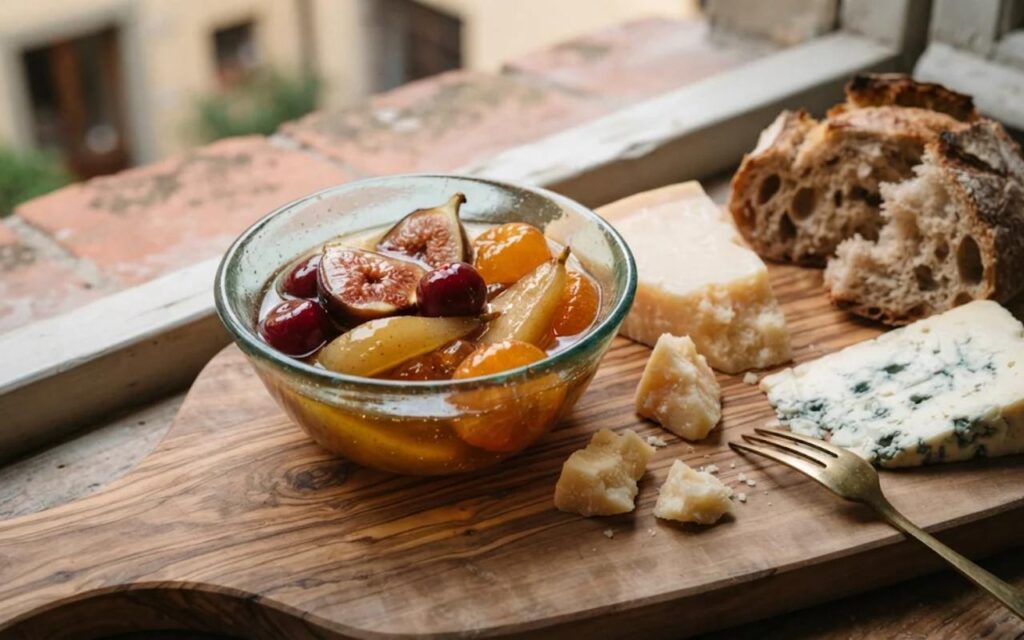
Mostarda is a traditional northern Italian condiment made from candied fruit preserved in a sweet syrup infused with pungent mustard oil or crushed mustard seeds. Unlike American yellow mustard or smooth fruit jam, Italian mostarda di frutta delivers an immediate two-stage flavor contrast: a lush, honeyed burst of glazed orchard fruit followed within seconds by a sharp, nasal, wasabi-like heat that clears the sinuses and vanishes cleanly.
Originating in the Po Valley across Lombardy, Veneto, and Piedmont, mostarda was developed centuries ago as a practical method for preserving late-autumn harvests through winter. Today, it is an indispensable fixture on northern Italian holiday tables, where it cuts through the richness of boiled meats (bollito misto), roasts, pumpkin-filled pasta (tortelli di zucca), and aged cheeses like Parmigiano-Reggiano and Gorgonzola.
Quick-Glance Summary: Italian Mostarda
- Core Ingredients: Whole, sliced, or puréed fruits (cherries, figs, pears, apricots, clementines, quince, or apples) cured in sugar syrup and spiked with mustard essential oil, mustard powder, or brown mustard seeds.
- Flavor Profile: Intensely sweet and fruity on first bite, followed by a brisk, sinus-clearing mustard kick that fades quickly without lingering chili burn.
- Etymology: Rooted in the Latin word mustum (unfermented grape must) and popularly linked to the 16th-century culinary phrase mustum ardens (“burning must”).
- Classic Pairings: Traditional bollito misto (mixed boiled meats), Mantuan tortelli di zucca (pumpkin ravioli), roasted pork or duck, aged Parmigiano-Reggiano, and Gorgonzola.
- Storage Life: Unopened commercial jars keep in a cool pantry for 1 to 2 years; once opened, high-sugar commercial jars last 3 to 6 months refrigerated, while lower-sugar homemade batches keep for up to 3 weeks.
History and Origins: From Roman Grape Must to Lombardy
The culinary roots of mostarda stretch back to ancient Rome and medieval monastic kitchens. Early Roman agronomists preserved autumn fruits by submerging them in mustum (freshly pressed grape juice reduced over low heat) mixed with ground mustard seeds.
Because mustard seeds release natural antimicrobial compounds in both liquid and vapor form, adding them prevented bacterial spoilage and fermentation over winter. By the 16th century, Italian writers popularized the romantic Latin nickname mustum ardens (“burning must”) to explain the condiment’s sweet-yet-fiery reputation.
During the Renaissance, the aristocratic courts of northern Italy transformed this rustic preservation technique into a prized delicacy. In the Lombard city of Cremona, apothecaries and confectioners refined the recipe by replacing grape must with imported cane sugar syrup and pure mustard essential oil (olio essenziale di senape), creating jewel-like jars of whole candied fruits that remain famous across Italy today.
Why Does Mostarda Have a Wasabi-Like Heat?
If you have never tasted authentic mostarda, its heat can catch you by surprise. Unlike chili peppers, which rely on fat-soluble capsaicin to create a slow, lingering burn on the tongue, mustard heat depends on the specific botanical species of seed used:
- Brown and Black Mustard (Brassica juncea and Brassica nigra): These seeds contain the glucosinolate sinigrin. When crushed and mixed with cool liquid, the natural enzyme myrosinase converts sinigrin into allyl isothiocyanate (AITC), a lightweight volatile vapor that rises straight into the nasal passages, creating a sharp, sparkling sensation nearly identical to fresh horseradish or real wasabi.
- White/Yellow Mustard (Sinapis alba): Milder yellow mustard seeds contain sinalbin, which breaks down into 4-hydroxybenzyl isothiocyanate, a heavier, non-volatile compound that creates a warm tingle on the tongue rather than a nasal vapor.
Traditional northern Italian producers rely on volatile allyl isothiocyanate precisely because it cleanses the palate between rich bites of fatty meat and aged cheese without numbing your taste buds.
(Culinary Rule: Because both the myrosinase enzyme and allyl isothiocyanate are highly heat-sensitive, authentic producers always stir mustard oil or cold-activated mustard paste into the syrup after removing the pot from the stove. Never boil jarred mostarda in a pan, or you will cook off its signature kick and release harsh, eye-watering fumes.)
The 4 Main Regional Types of Italian Mostarda
While most people outside Italy encounter the whole-fruit style from Cremona, several northern Italian provinces produce distinct regional variations that differ in fruit selection, texture, and pungency.
| Regional Variety | Primary Fruits Used | Texture & Appearance | Heat Level & Profile |
|---|---|---|---|
| Mostarda di Cremona | Whole cherries, figs, pears, apricots, clementines, quince | Whole or large glazed fruits in clear, glossy syrup | High, sharp, and bright wasabi-like punch |
| Mostarda di Mantova | Single fruit, traditionally tart mele campanine apples or quince | Thin, translucent, firm fruit slices in thick syrup | High, crisp, clean acidity with strong mustard bite |
| Mostarda Veneta (Vicentina) | Grated quince, apples, pears, and candied citrus peel | Thick, spreadable jam or coarse marmalade texture | Medium-high, aromatic with white wine notes |
| Mostarda Piemontese (Cugnà) | Red grape must, figs, pears, quince, and roasted hazelnuts | Dark, rich, rustic fruit butter or compote | Very mild, earthy, wine-like, minimal mustard heat |
1. Mostarda di Cremona (Lombardy)
The undisputed classic, Mostarda di Cremona features whole or halved fruits that undergo days of gradual sugar maceration until the syrup reaches a dense, jewel-like gloss (around 65° to 70° Brix) while the fruit stays plump and tender. Because commercial jars contain large whole fruits like pears, figs, and clementines, Italians typically spoon a piece onto a cutting board and slice it into bite-sized wedges before serving.
2. Mostarda di Mantova (Lombardy)
Roughly 40 miles east of Cremona, Mantua takes a minimalist single-fruit approach. Traditional Mostarda Mantovana uses small, firm, slightly tart local winter apples (mele campanine) sliced into delicate crescents. Because the fruit is sliced before candying, the mustard-infused syrup penetrates every piece evenly, making it ideal both for slicing over meats and for mincing directly into pasta fillings.
3. Mostarda Veneta / Vicentina (Veneto)
Produced around Vicenza and Padua, Mostarda Veneta looks and spreads much like a chunky fruit marmalade. Producers grate quince, apples, and pears, simmer them with white wine, sugar, and candied citron peel, and finish the mixture with mustard oil. Its spreadable consistency makes it the easiest style to spoon onto crostini or alongside soft cheeses.
4. Mostarda Piemontese / Cugnà (Piedmont)
Piedmont’s answer to mostarda stays closest to the ancient Roman mustum tradition. Known locally as cugnà, it is made by slowly simmering Barbera or Dolcetto grape must with autumn figs, Madernassa pears, quince, and toasted Piedmontese hazelnuts. It contains little or no added refined sugar and skips pure mustard essential oil, offering a deep, wine-dark sweetness tailored for aged mountain cheeses like Castelmagno.
How to Use and Pair Mostarda
A little mostarda goes a long way. Serve it at room temperature in a small glass or ceramic bowl with a dedicated fork or spoon so guests can portion small pieces onto their plates.
- Mantuan Tortelli di Zucca: In Mantua, finely chopped Mostarda di Mantova is an essential filling ingredient inside tortelli di zucca (pumpkin ravioli), where its sharp mustard bite balances sweet roasted squash, crushed amaretti biscuits, and Parmigiano-Reggiano.
- Traditional Bollito Misto: Across Lombardy and Emilia-Romagna, mostarda is the signature accompaniment to bollito misto, a celebratory winter platter of simmered beef brisket, veal, capon, tongue, and spiced cotechino sausage.
- Italian Cheese Boards: Pair sweet-hot mostarda with savory, crystalline aged cheeses such as 24- to 36-month Parmigiano-Reggiano, Grana Padano, Pecorino Stagionato, or Aged Asiago. It also creates an unforgettable contrast with creamy blue cheeses like Gorgonzola Dolce and Gorgonzola Piccante.
- Roasted Meats and Charcuterie: Spoon diced pear or fig mostarda alongside roasted pork tenderloin, pan-seared duck breast, Thanksgiving turkey, or thinly sliced prosciutto crudo and culatello.
- Elevated Sandwiches and Panini: Spread a thin layer of Mostarda Veneta or sliced Mostarda di Mantova inside a grilled fontina, prosciutto, and arugula panini for a gourmet sweet-heat kick.
How to Make Quick Homemade Mostarda (45-Minute Method)
Traditional artisanal mostarda requires up to a week of daily syrup boiling and cooling, plus pure food-grade mustard essential oil (which is highly concentrated and rarely sold in standard North American grocery stores). However, you can make 1 pint (about 16 ounces) of authentic-tasting small-batch mostarda at home in under an hour.
In this quick method, whole brown mustard seeds (Brassica juncea) are simmered in the syrup for visual appeal and a mild nutty pop, while cold-water-activated dry mustard powder added off-heat supplies all of the genuine nasal allyl isothiocyanate pungency.
Ingredients (Yield: 1 Pint / 16 oz)
- 1.5 pounds (680g) firm Bosc pears or Honeycrisp apples, peeled, cored, and sliced into 1/4-inch wedges
- 1 cup (200g) granulated sugar
- 3/4 cup dry white wine (such as Pinot Grigio) or water
- 2 tablespoons fresh lemon juice
- 1.5 tablespoons whole brown mustard seeds (Brassica juncea, for texture and visual garnish)
- 1 to 2 tablespoons dry English mustard powder (such as Colman’s, which blends brown and white mustard; adjust to taste)
- 1/4 teaspoon kosher salt
Step-by-Step Instructions
- Simmer the Syrup: Combine the sugar, white wine (or water), lemon juice, whole brown mustard seeds, and salt in a wide stainless-steel saucepan over medium heat. Stir until the sugar dissolves completely, then bring to a gentle simmer for 5 minutes. (Boiling the intact seeds deactivates their internal enzymes, turning them into mild, crunchy garnishes.)
- Poach the Fruit: Add the sliced pears or apples in an even layer. Simmer gently for 12 to 15 minutes until the fruit turns translucent and tender-firm without falling apart.
- Reduce the Glaze: Use a slotted spoon to transfer the fruit into a clean 1-pint glass jar. Boil the remaining liquid in the pan for 5 to 8 minutes until it thickens to a glossy, honey-like syrup that coats the back of a spoon. Remove from heat and let cool for 5 minutes (until below 140°F / 60°C).
- Activate and Stir in the Mustard: Whisk the dry mustard powder with 1 tablespoon of cool water to form a smooth paste (cool water activates the myrosinase enzyme that generates volatile allyl isothiocyanate, whereas boiling water destroys it). Stir the mustard paste into the warm syrup, then pour the syrup over the fruit in the jar.
- Cure Before Serving: Cool to room temperature, seal tightly, and refrigerate for at least 24 hours so the flavors meld. Because this quick recipe uses less sugar than commercial candied preserves, homemade mostarda keeps refrigerated for up to 3 weeks.
Buying Guide: How Heritage Italian Brands Compare
If you prefer to buy imported jars from specialty grocers, Eataly, or Whole Foods, pungency varies noticeably by producer:
- Lazzaris (Founded 1901, Conegliano): Known for balanced, approachable sweetness and medium-high mustard heat, making their Mostarda Veneta and single-fruit fig or pear jars ideal for first-time tasters.
- Vergani (Cremona): Produces classic, bold Mostarda di Cremona with large whole candied fruits and a brisk, pronounced nasal kick.
- Fieschi / Sperlari (Cremona): Delivers a traditional, assertive mustard punch tailored for heavy winter bollito misto platters.
Frequently Asked Questions
Is Italian mostarda the same as regular mustard?
No. Regular mustard is a savory paste made from ground mustard seeds, vinegar, water, and spices, whereas Italian mostarda is a sweet candied-fruit preserve infused with volatile mustard oil or brown mustard powder.
Where can I buy authentic Italian mostarda?
You can find imported jars of Mostarda di Cremona, Mostarda di Mantova, and Mostarda Veneta at Italian specialty markets, gourmet cheese counters, Whole Foods, Eataly, and online specialty food retailers.
Does mostarda need to be refrigerated after opening?
Yes. While unopened jars are shelf-stable in a cool, dark pantry for 1 to 2 years, you should always refrigerate mostarda after opening and keep the fruit submerged in its syrup. High-sugar commercial jars stay fresh and pungent for 3 to 6 months in the fridge, whereas lower-sugar homemade batches keep for up to 3 weeks.