
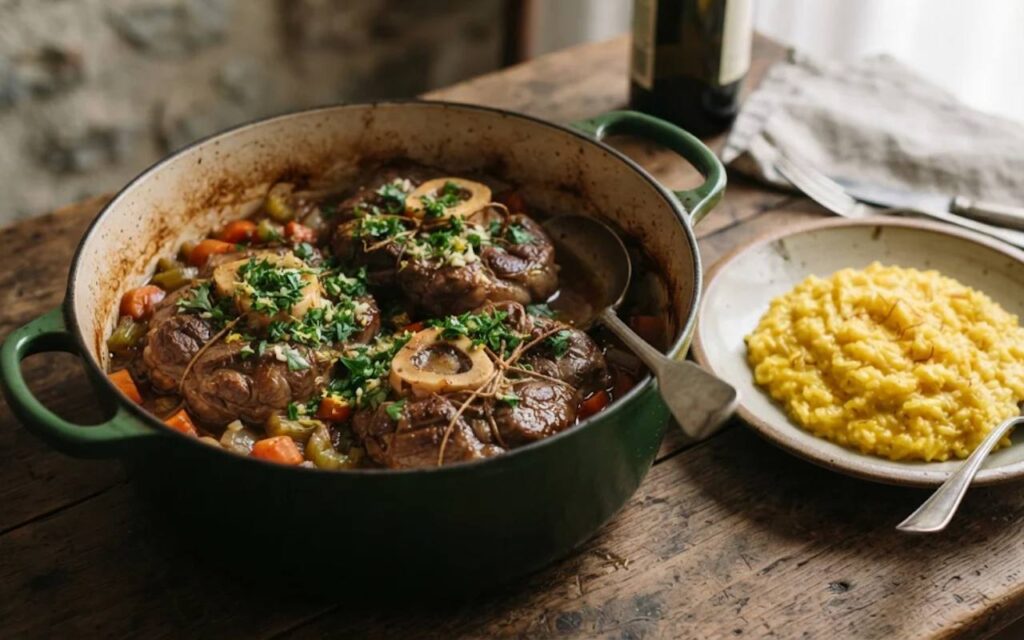
Osso buco (often spelled ossobuco in Italian) is a classic Milanese dish of cross-cut veal shanks braised slowly with aromatics, white wine, and stock until connective tissue melts into velvety gelatin and the center bone marrow turns custard-like. Translated from Lombard dialect (òss bus) as “bone with a hole” (osso meaning bone, buco meaning hole), the name refers directly to that marrow-filled shinbone cross-section.
At the butcher counter, restaurant-caliber results depend on shank anatomy. Choosing a meaty hind shank (geretto posteriore) over a sinewy foreshank (geretto anteriore), cutting cross-sections to 1.5- to 2-inch thickness, and finishing the braise with bright lemon-garlic gremolata transforms an inexpensive working muscle into a northern Italian classic.
Quick-Glance Summary: Italian Osso Buco
- Literal Translation: “Bone with a hole” (referencing the marrow-packed tibia or radius bone exposed by a cross-cut saw).
- Primary Cut: Cross-cut veal shanks (geretto di vitello), though beef shanks (ossobuco di manzo) and pork shanks are also braised using the same technique.
- Best Anatomical Cut: Hind shank (geretto posteriore), which features a single round bone surrounded by thick, uniform rings of tender muscle and generous marrow.
- Two Classic Styles: Osso Buco in Bianco (the traditional tomato-free Lombard version braised with white wine, warm spices, and broth) and Osso Buco alla Milanese (the modern tomato-enriched classic).
- Signature Garnish & Pairing: Finished with raw gremolata (minced lemon zest, garlic, and flat-leaf parsley) and served alongside saffron Risotto alla Milanese or creamy polenta.
The Butcher’s Anatomy: Hind Shank vs. Foreshank
Every veal carcass yields four shanks: two front shanks (foreshafts) and two rear shanks (hind shanks). Although butchers sell cross-cut slices from both under the label “osso buco,” their bone geometry and meat-to-connective-tissue ratios behave very differently in a Dutch oven.
| Anatomical Feature | Hind Shank (Geretto Posteriore) [Best] | Foreshank (Geretto Anteriore) |
|---|---|---|
| Bone Structure | Single large, round tibia bone with a wide marrow cavity | Two bones (radius and ulna) with narrower marrow channels |
| Meat-to-Bone Ratio | Thick, symmetrical ring of lean, tender muscle (up to 70% meat) | Higher proportion of heavy tendons, silver skin, and bone |
| Braising Behavior | Holds a neat, cohesive medallion shape when tied with twine | Separates into smaller muscle lobes as thick sinew dissolves |
| Ideal Kitchen Use | Classic plated restaurant-style osso buco | Rustic ragù, rich veal stock, or budget-friendly family braises |
How to Inspect Osso Buco Steaks at the Butcher Counter
When selecting shanks for braising, look for center-cut hind shanks measuring 1.5 to 2 inches (4 to 5 cm) thick. Cuts taken too close to the knee or ankle joint taper sharply and contain tough ligaments with almost no marrow.
Always verify that the marrow inside the center bone is intact and pale pink to creamy white, rather than scooped out by high-pressure band-saw rinsing.
Braising Science: How Tough Shin Muscle Turns Velvety
Because the lower leg supports the animal’s weight with every step, veal shanks are packed with dense type I collagen sheaths wrapping individual muscle bundles, plus a tough outer membrane (epimysium) around the perimeter. If you grill or pan-sear a veal shank quickly, those collagen fibers contract like rubber bands, squeezing out moisture and turning the meat chewy.
Low-and-slow moist heat unlocks three critical transformations:
- Collagen-to-Gelatin Conversion: Between 160°F and 180°F (71°C to 82°C) over 1.5 to 2.5 hours, triple-helix collagen strands unwind and dissolve into rich, silky gelatin. This melted gelatin coats the muscle fibers from the inside, giving fork-tender meat a succulent mouthfeel even after internal muscle temperatures pass 195°F (90°C).
- Marrow Emulsification: As the shank simmers gently in a covered pot, the lipid-rich bone marrow softens into a spreadable custard while releasing flavor compounds into the braising liquid. Avoid boiling rapidly, which melts the marrow completely out of the bone and leaves an empty hole.
- Why You Must Snip the Outer Membrane: The thin band of connective tissue encircling the outside of the shank shrinks faster than the interior meat when heated. Make 3 to 4 shallow vertical snips around the outer silver skin with kitchen shears, and tie a single loop of butcher’s twine horizontally around the middle of each steak, to keep the medallion flat and prevent the meat from curling off the bone.
Standard Braising Ratio & Temperature Blueprint
For home cooks preparing a classic four-shank batch in a heavy enameled Dutch oven, follow these baseline ratios for balanced reduction and intact marrow:
- Meat & Aromatics: 4 center-cut veal hind shanks (about 3.5 to 4 lbs total, 1.5 to 2 inches thick) over 2 cups finely diced soffritto (1 medium yellow onion, 1 carrot, and 1 celery rib).
- Braising Liquid Ratio: 1 cup dry white wine (such as Pinot Grigio or Soave) reduced by half, followed by 1.5 to 2 cups warm veal or chicken stock so the liquid reaches halfway up the sides of the shanks without submerging the marrow tops.
- Oven Temperature: Cover tightly and braise in a preheated 325°F (163°C) oven, maintaining a gentle sub-simmer at 180°F to 195°F (82°C to 90°C) inside the pot.
- Doneness Target: Braise 1.5 to 2 hours for veal shanks (or 2.5 to 3.5 hours for beef shanks) until a paring knife slides into the muscle with zero resistance while the marrow remains nestled inside the bone.
Historical Evolution: In Bianco vs. Alla Milanese
Osso buco originated in 19th-century Milanese osterie (neighborhood taverns) in Lombardy. One of the earliest known printed versions appeared in Giuseppe Sorbiatti’s 1879 cookbook Il Memoriale della Cuoca, which braised the shanks with white wine, cloves, and a spoonful of tomato sauce.
Twelve years later, Pellegrino Artusi codified the dish for Italian home cooks in Recipe #358 of his landmark 1891 manual La Scienza in Cucina e l’Arte di Mangiar Bene, stewing floured veal shanks with butter, aromatics, tomato juice or paste, and a finishing sprinkle of lemon peel and parsley. In 2007, the Municipality of Milan formally protected the traditional dish by awarding Ossobuco alla Milanese official De.Co. (Denominazione Comunale) heritage status.
- Osso Buco in Bianco (The Tomato-Free Lombard Style): Before tomatoes became universal across northern Italian winter cooking, traditional ossobuco in bianco braised flour-dredged veal shanks in butter, onion, celery, carrot, dry white wine, and veal broth scented subtly with bay leaf, cinnamon, and allspice.
- Osso Buco alla Milanese (The Modern Classic): Modern Milanese kitchens incorporate peeled plum tomatoes or tomato paste into the soffritto, creating a rich mahogany sauce whose bright acidity cuts cleanly through melted bone marrow and butter-enriched saffron risotto.
The Essential Finishing Touch: What Is Gremolata?
No authentic Milanese osso buco reaches the table without gremolata, a raw three-ingredient aromatic garnish sprinkled over the hot shanks during the final 30 seconds before serving.
Traditional gremolata consists strictly of:
- Fresh Lemon Zest: Finely grated yellow peel (avoiding the bitter white pith) for bright citrus oils.
- Raw Garlic: Very finely minced so its sharp pungency cuts through heavy gelatin and marrow fat.
- Flat-Leaf Italian Parsley: Finely chopped fresh leaves for clean herbal freshness.
Some Milanese variations add a single minced anchovy fillet for savory umami depth, though the pure trio of lemon zest, garlic, and parsley remains the gold standard.
Veal vs. Beef Osso Buco: Key Differences
While traditional Lombard recipes specify milk-fed or grain-fed veal shanks, many North American home cooks substitute beef shanks (ossobuco di manzo) because beef is more widely available and less expensive.
- Veal Shanks: Pale pink meat with delicate, sweet flavor, fine muscle grain, and tender collagen that braises to fork-tenderness in 1.5 to 2 hours.
- Beef Shanks: Deep crimson meat from an older, heavier animal with much thicker muscle fibers and denser connective tissue. Beef osso buco delivers a bold, beefy flavor, requires 2.5 to 3.5 hours of gentle braising, and benefits from dry red wine (such as Barolo, Barbera, or Chianti Classico) in place of white wine.
Classic Side Dishes to Serve with Osso Buco
- Risotto alla Milanese: The iconic Lombard pairing features creamy Carnaroli or Arborio rice infused with beef marrow, white wine, Parmigiano-Reggiano, and golden saffron threads, served right beside (or beneath) the braised shank so the rice absorbs the glossy braising sauce.
- Creamy Polenta: Stone-ground yellow cornmeal simmered slowly with butter and Parmigiano-Reggiano provides a velvety bed for winter beef or veal shanks.
- Garlic Mashed Potatoes or Roasted Root Vegetables: Simple mashed Yukon Gold potatoes or roasted fennel and carrots soak up the gelatin-rich pan juices cleanly.
Frequently Asked Questions
Do you eat the marrow inside the osso buco bone?
Yes. The creamy bone marrow inside the center tibia bone is considered the prized delicacy of the dish. Italian restaurants serve osso buco with a narrow, long-handled marrow spoon (nettamidollo) so diners can scoop the warm marrow onto crusty bread or stir it directly into their saffron risotto.
Why did my osso buco turn out tough?
Tough osso buco almost always means the shank was under-cooked rather than over-cooked. Connective collagen needs sustained moist heat above 160°F (71°C) for at least 1.5 to 2 hours (for veal) or 2.5 to 3 hours (for beef) to fully convert into soft gelatin.
Can you make osso buco ahead of time?
Yes, and it tastes even better the next day. Chilling braised osso buco overnight in its sauce allows the dissolved gelatin and aromatics to meld, while letting you easily lift off any solidified surface fat before reheating gently over low heat.