
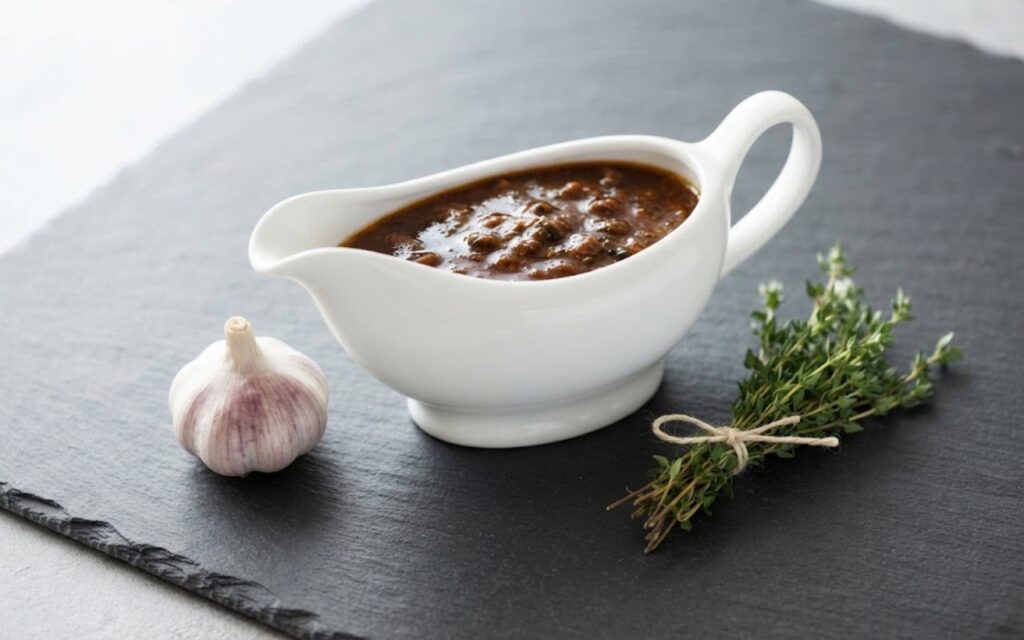
Master cooks know that authentic Sugo di Carne is not a generic ground-beef marinara, but an unctuous, slow-simmered Italian pan gravy forged from braised meats and pan drippings. Originating as a practical method to capture the caramelized goodness left behind after roasting or braising large cuts of meat, this sauce transforms foundational pan scrapings into an intensely rich, spoon-coating reduction.
Unlike fast-cooked pasta sauces that rely on the bright, acidic punch of fresh tomatoes, this preparation harnesses prolonged heat to melt animal collagen directly into a deeply savory emulsion. The result is a glossy, full-bodied gravy that clings tightly to wide pasta ribbons or polenta without shedding a pool of liquid on the plate.
Quick-Glance Kitchen Summary
Authentic pan gravy relies on extracting the caramelized meat fond, browning concentrated tomato paste directly in the rendered fat, and gently simmering collagen-rich cuts until liquid gelatin forms an unctuous emulsion. By controlling heat distribution and acid balance, you extract structural body directly from meat fibers rather than artificial thickeners.
- Base Protein: 2 to 3 pounds bone-in beef shank, chuck roast, or pork shoulder trimmed into large portions
- Pan Pinçage: 3 tablespoons double-concentrated tomato paste (24 to 28 Brix) such as Mutti or Cento
- Deglazing Liquid: 1 cup dry, un-oaked red or white wine (such as Chianti or dry Verdicchio)
- Extraction Simmer: 3 to 4 cups unsalted beef knuckle stock or low-sodium bone broth
- Cooking Vessel: Heavy-bottomed enameled cast iron Dutch oven or 5-ply stainless saucier with curved interior walls
- Target Simmer Temperature: 180°F to 190°F maintained for 3 to 4 hours
Fond Extraction and Maillard Chemistry: The Art of the Pan Pinçage
The bedrock of this sauce forms before any liquid touches the cookware. When large cuts of beef shank or pork shoulder make contact with hot fat, amino acids and reducing sugars undergo the Maillard reaction, depositing deeply browned proteins known as sucs onto the bottom of the pan. Rushing this stage or overcrowding the pan drops the surface temperature, causing the meat to steam in its own exuded moisture rather than sear.
Once the seared meat is temporarily set aside, home cooks frequently make the mistake of immediately adding broth to the pan. To build authentic depth, you must first execute a proper pinçage by cooking your tomato paste directly in the remaining rendered fat. This technique caramelizes the natural sugars in the tomato and eliminates harsh, metallic tin notes.
- Brown the meat in single-layer batches at medium-high heat to preserve pan surface temperature.
- Lower the flame to medium, add tomato paste, and stir constantly until the paste darkens from ruby red to a brick-red hue.
- Watch for fat separation around the perimeter of the paste, which signals that the moisture has fully evaporated.
Using commercial double-concentrated paste clocking in at 24 to 28 Brix (such as Mutti) provides the optimal sugar-to-acid balance for a clean pinçage. Standard canned purees register at only 8 to 11 Brix, introducing far too much water to allow the paste to toast properly in the fat. If using triple-concentrated paste at 36 Brix, reduce the quantity by a third to prevent rapid scorching.
Ragù Structural Contrasts: Sugo di Carne Versus Conventional Meat Sauces
Many online recipe sources conflate every meat-based Italian sauce with standard Bolognese. In practice, regional culinary mechanics divide these preparations by meat grind size, tomato density, and overall emulsion structure.
| Attribute | Sugo di Carne | Ragù alla Bolognese | Classic Sugo d’Umido |
|---|---|---|---|
| Primary Protein Cut | Whole collagenous cuts or bone-in shanks | Finely minced beef and fatty pork | Braised poultry, rabbit, or mixed trimmings |
| Texture & Body | Glossy, cohesive pan gravy with shredded meat | Fine-grained, soft, and crumbly emulsion | Loose, brothy sauce with whole meat chunks |
| Tomato Density | Minimal paste (24 to 28 Brix) used as a savory glaze | Moderate paste softened with whole milk | High volume of canned passata (8 to 11 Brix) |
| Primary Cooking Vessel | Curved saucier or heavy enameled Dutch oven | Wide, thick-walled rondeau or Dutch oven | Deep, covered earthenware pot or casserole |
| Liquid Base | Dry wine and high-collagen bone stock | White wine, minimal stock, and whole milk | Light broth, water, and pureed tomato juice |
Home cooks switching from ground-meat sauces to a braised pan gravy immediately notice the superior clinging ability of the sauce. Because the sauce extracts natural gelatin during the simmer, it coats pasta without requiring added starch slurry.
Gelatin Hydrolysis and Connective Tissue Breakdown Under Simmer Equilibrium
The luxurious mouthfeel of this dish comes from the physical transformation of collagen into gelatin. Collagen is a tough, triple-helix protein abundant in hard-working cuts like beef shank, oxtail, and pork neck. When held within a target window of 160°F to 185°F, these rigid protein fibrils gradually unwind and dissolve into gelatin.
Boiling the sauce at a rolling 212°F causes the muscle fibers of the meat to contract violently, squeezing out cellular water and resulting in stringy, dry meat. Maintain a gentle simmer where small bubbles break the surface only once every few seconds. This thermal equilibrium allows gelatin to leach smoothly into the cooking liquid, creating a natural sauce binder.
- Select cuts packed with connective tissue, cartilage, and bone marrow rather than lean cuts like sirloin.
- Maintain pan contents between 180°F and 190°F over a low heat diffuser plate if your stovetop burner runs hot.
- Test the meat with a cake tester or fork; it should yield effortlessly without resistance before you shred it.
Pan geometry plays a massive role in heat dispersion during long cooking sessions. A wide saucier with curved interior walls prevents meat fibers and tomato solids from catching in sharp bottom corners. Straight-sided pans often trap solids along the bottom seam, causing localized scorching that turns the entire batch bitter.
Wine Deglazing Dynamics and Acid Balancing to Prevent Emulsion Collapse
Once the pinçage achieves a deep mahogany shade, deglazing the pan unlocks the flavor compounds trapped in the fond. Pouring room-temperature wine into the sizzling pan causes thermal shock, lifting the crusty sucs effortlessly off the metal floor. The alcohol acts as an organic solvent, dissolving both fat-soluble and water-soluble aroma compounds that water alone cannot free.
Choose a dry, crisp wine with moderate acidity and minimal residual oak. Heavy, heavily oaked wines become unpleasantly tannic and bitter once reduced over several hours. Cook the wine down until the scent of raw ethanol dissipates and the liquid reduces to an unctuous, syrupy glaze.
- Scrape the bottom and corners of the pan using a flat-edged wooden spatula during the initial sizzle.
- Reduce the wine by at least three-quarters before introducing your warm bone stock.
- Swirl the pan gently rather than stirring aggressively to encourage fat droplets to suspend within the gelatin matrix.
If excess surface fat separates into an oily pool near the end of cooking, do not dump it down the drain. Simply pull the pan half off the heat source; convection currents will push the clear lipid layer to one side, allowing you to skim off the excess while leaving the emulsified core intact.
Thermal Preservation Standards, Acid Thresholds, and Gel-Stage Storage Dynamics
Proper cooling and storage preserve both the structural integrity and safety of rich meat gravies. Due to the high concentration of dissolved gelatin, this sauce sets into a firm, sliceable jelly once refrigerated below 40°F. This solidification protects moisture within the shredded meat fibers until gently reheated with a splash of hot pasta cooking water.
Food safety protocols demand rigorous handling for meat-based pan gravies because they lack the high acid levels found in basic tomato sauces. Plain tomato products require acidification to drop below pH 4.6 for water-bath canning, demanding 1 tablespoon of bottled lemon juice or 1/4 teaspoon of citric acid per pint according to USDA guidelines. However, you must never water-bath can meat gravies under any circumstances.
- Cool the sauce in shallow containers to bring the internal temperature below 40°F within four hours.
- Store refrigerated sauce in airtight glass containers for up to four days, or freeze for up to six months.
- Reheat over medium-low heat with two tablespoons of water or stock to loosen the gelatin matrix without scorching.
Because meat gravies introduce dense animal proteins and neutral lipids, they present a high botulism risk if processed improperly. Home cooks seeking long-term shelf storage must utilize a calibrated pressure canner following verified processing times and pressures. For most home kitchens, portioning the finished gravy into freezer bags remains the safest method for preserving its velvety texture.