
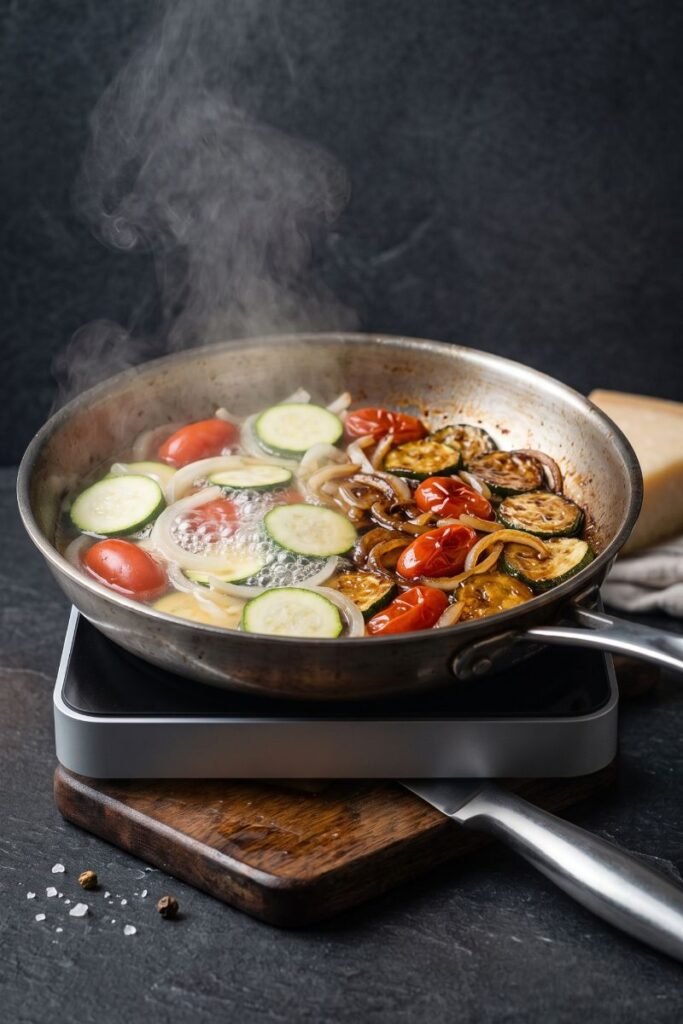
When I drop fresh, raw vegetables into a hot skillet and watch them break down, tracking exactly how water volume affect simmer rates is the ultimate secret to mastering rich reductions. Over my years of home cooking, I have treated the internal moisture levels and cellular walls of my ingredients as critical physical variables rather than simple cooking steps.
Whenever I see casual cooks crowd their pans with water-heavy produce and wonder why their dinner turns into a soggy, grey soup instead of a glossy glaze, I notice how a lack of structural knowledge ruins the meal. For me, executing an authentic regional sauce requires looking past the surface of the food to manage how plant cell walls collapse and release their trapped liquids under heat.
Why Fresh Vegetables Turn Thin and Soupy in the Pan
To understand why raw produce behaves so aggressively on the stovetop, I always analyze the immense volume of liquid hiding inside raw vegetable cells. Most fresh garden ingredients are structurally composed of roughly 90% to 95% water, which is held under pressure inside tiny pockets called vacuoles.
When I apply heat to the pan, the high temperatures cause the internal water to expand rapidly, which shatters the fragile cellular walls and floods the skillet with loose moisture. If I do not leave the lid off my pot to let this sudden rush of steam float away freely, the trapped moisture condenses and drops right back into my cooking oils.
I have watched this pooling liquid permanently dilute my seasonings, a frustrating breakdown that completely prevents the surface sugars from caramelizing properly. Managing this initial water release is the exact technical reason I use high-heat blistering to flash-evaporate internal liquids when prepping my sweet Roasted Red Shepherd Peppers.
The Main Elements That Hold Moisture Inside Plant Walls
Beyond the simple volume of water, the ease with which an ingredient breaks down depends entirely on the toughness of its structural fiber networks. Plant cells are held together by a rigid skeleton made of cellulose, hemicellulose, and pectic substances that act as a firm architectural cement.
I follow the beginner-friendly agricultural science resources and food processing breakdowns published in the official Serious Eats Science of pH and Cooking Vegetables Guide to understand exactly how heat softens these fiber chains. When a vegetable is harvested immaturely, its pectic structures are incredibly tight and filled with water, making the cellular breakdown much slower and more erratic.
Conversely, as fruits and vegetables ripen naturally on the vine, their internal enzymes break down this tough cement prematurely, yielding a softer flesh that releases its juices instantly. Recognizing these structural differences tells me exactly how long a specific ingredient needs to sit on the flame before its firm body transforms into a smooth paste.
How Different Tomato Textures Respond to Heat Levels
Nowhere is the impact of cell walls more obvious in my kitchen than when I am comparing the physical behaviors of different tomato cultivars. Slicing varieties like beefsteaks feature massive, watery cavities and thin cell walls that collapse into a runny puddle the moment they hit hot olive oil.
Plum varieties like Romas carry incredibly thick, dense fleshy walls and tiny seed pockets, giving them a sturdy blueprint that is ideal for creating thick sauces. I dive deeply into these structural cavities and water ratios when evaluating canning yields inside my comparative San Marzano vs Regular Tomatoes resource guide.
When I simmer a plum variety, the heat melts the thick cell walls slowly, releasing high concentrations of natural plant pectins that thicken the pan juices naturally. If I try to use a watery slicing tomato for a long simmer, the thin cell structure collapses too fast, leaving a separate layer of clear water floating over the pulp.
Simple Stovetop Rules to Control Excess Water Patterns
The final step in mastering your pan physics requires setting up the perfect stovetop environment to manage the released water phase effortlessly. I follow a strict personal rule: I never crowd my skillet with raw produce because stacking ingredients traps the steam underneath, forcing the vegetables to boil instead of sear.
I expand my surface area by using wide, shallow pans that expose the liquid directly to the hot air, accelerating the evaporation process dramatically. I watch the liquid closely, waiting for the frothy bubbles of watery steam to change into small, quiet oil pops, which is my visual cue that the water phase has ended.
Once the excess moisture has escaped into my kitchen air, the remaining fibers can finally fuse smoothly with my cooking fats to form a velvety glaze. For me, taking the time to understand the hidden cellular architecture of my ingredients is the ultimate secret to elevating my family table.