
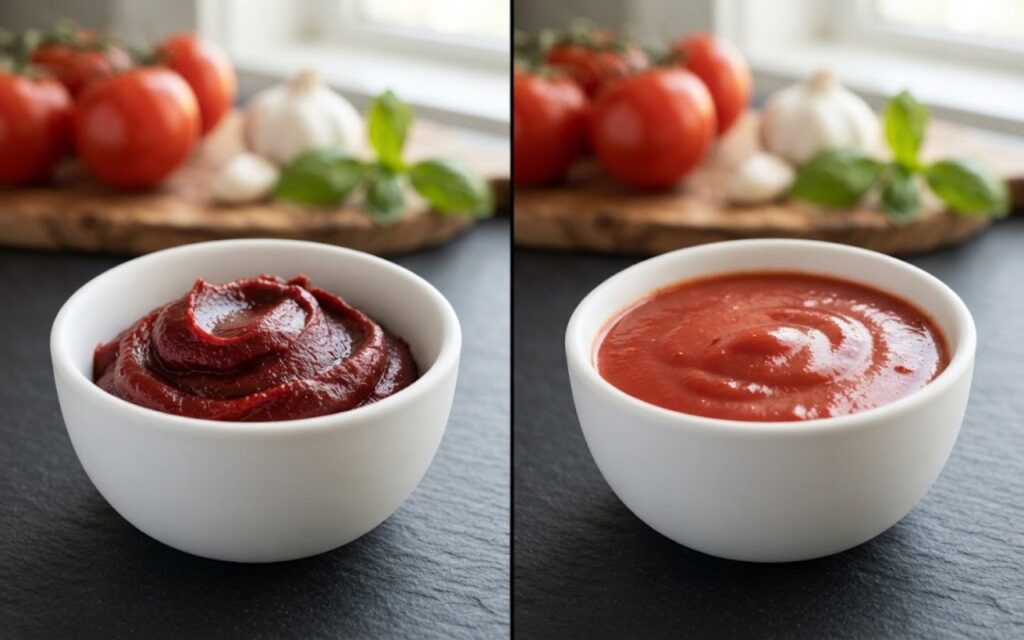
Distinguishing between tomato paste vs tomato puree is vital for proper flavor and moisture balance. Paste is a thick, highly concentrated umami block, while puree is a smooth, pourable liquid. Mistaking one for the other can ruin a sauce’s texture and acidity completely.
The secret to an interchangeable swap lies in adjusting your liquid ratios rather than guessing volumes. Controlling this balance ensures your dishes retain the perfect thickness and depth every time.
Quick-Glance Kitchen Summary
To swap tomato paste for tomato puree, dilute the paste with water at a precise 1:3 ratio by volume to match the lighter body and moisture of puree. When substituting tomato puree for paste, simmer the puree in a wide pan until reduced by approximately two-thirds to evaporate excess water without overcooking your final dish.
- Double-concentrated paste baseline: 24 to 28 Brix concentration (e.g., Mutti, Cento in tubes).
- Standard commercial puree baseline: 8 to 11 Brix concentration (passata or canned puree).
- Paste-to-puree substitution ratio: 1 tablespoon paste whisked with 3 tablespoons warm water yields 1/4 cup puree equivalent.
- Puree-to-paste substitution ratio: 3 tablespoons puree simmered down to 1 tablespoon concentrated paste.
- Gear blueprint: A curved-wall saucier pan prevents bottom-edge scorching during rapid moisture reduction.
Brix Concentration Metrics and Hydrodynamic Viscosity Ratios
Food scientists and processing plants measure tomato density using the Brix scale, which tracks soluble solids primarily composed of natural sugars and fruit pectin. Standard canned puree registers between 8 and 11 Brix, retaining a fluid consistency that flows smoothly across a hot pan.
In contrast, double-concentrated paste sits between 24 and 28 Brix, while premium triple-concentrated Italian imports reach 36 Brix. Because double-concentrated paste contains roughly three times the soluble solid mass of puree, treating them as direct volume equivalents introduces severe moisture imbalances.
Dumping three tablespoons of paste directly into a stew without extra stock creates a gummy, overly concentrated paste trap that binds prematurely to starches.
Conversely, replacing paste with unreduced puree floods the pan with free water, dropping the cooking temperature below the threshold needed for fat emulsification.
- Canned tomato puree contains roughly 90 percent free water, making it a liquid cooking medium.
- Double-concentrated tomato paste contains roughly 70 percent less water by volume than standard puree.
- High-pectin density in paste rapidly binds pan fats, whereas puree requires reduction before fat can emulsify cleanly.
Understanding these ratios lets you adjust your liquid levels instantly before heat touches the pan. Whisking water or low-sodium stock into dense paste recreates the fluid hydrodynamics of puree without sacrificing body.
Compositional Profiles: Puree vs. Paste Operational Parameters
Understanding how these two ingredients diverge in texture and processing helps you select the right tool for your recipe.
| Metric | Tomato Puree | Tomato Paste |
|---|---|---|
| Brix Concentration | Measures 8 to 11 Brix directly from the can. | Measures 24 to 28 Brix for double-concentrated tubes. |
| Moisture Content | Contains high free-water content that thins braises. | Features low moisture designed strictly for binding and body. |
| Primary Kitchen Role | Functions as a liquid simmering base and braising medium. | Functions as an umami booster, thickener, and foundation note. |
| Heat Tolerance | Scorches if sautéed directly in oil without liquid buffers. | Requires direct fat contact to caramelize sugars effectively. |
| Seed and Skin Residue | Filtered smoothly but retains micro-fiber fragments. | Uniformly strained into an ultra-smooth, dense concentrate. |
Canned puree provides high surface area and steady heat transfer, acting as an acoustic conductor for braising meats. Concentrated paste provides intense glutamate density and deep color, acting as a background flavor foundation rather than the primary vehicle.
Pinçage Maillard Browning and Thermal Scorching Mechanics
Professional French and Italian culinary kitchens rely on tomato paste for a technique known as pincer. During this step, you brown the tomato paste in hot culinary fat to trigger Maillard reactions and caramelize natural sugars, producing a savory mixture called a pinçage.
Cooking down tomato paste removes raw, tinny notes and yields a deep brick-red fond across the pan base. Attempting to execute a pinçage with tomato puree inevitably fails because the high moisture level drops the pan temperature.
The excess water prevents the fat from reaching the 300-degree Fahrenheit threshold required for efficient Maillard browning. Puree merely boils in the oil, steaming aromatics like mirepoix or soffritto instead of searing them.
- Heavy-bottomed enameled cast iron distributes heat evenly, preventing the hot spots that ruin a pinçage.
- Carbon steel skillets respond quickly to heat adjustments, helping cooks pull paste off the flame before sugars burn.
- A saucier pan with curved interior corners eliminates the dead zones where thick pastes collect and scorch.
If your recipe calls for browning paste alongside aromatics, do not add raw puree directly to the fat. You must reduce the puree separately in a wide skillet until the water evaporates completely, leaving behind a dense paste that can safely brown without steaming your aromatics.
Acidification and Canning Safety Thresholds for Domestic Preserving
When preserving tomato products at home, swapping paste and puree requires strict adherence to food safety parameters. Home preservation guidelines established by the USDA and the National Center for Home Food Preservation mandate an equilibrium pH below 4.6 to prevent Clostridium botulinum spore outgrowth in boiling-water-bath canners.
Modern commercial tomatoes vary wildly in baseline acidity, making artificial acidification mandatory for plain preserves. For water-bath canning of plain tomato products, you must add exactly 1 tablespoon of bottled lemon juice or 1/4 teaspoon of citric acid per pint jar.
For quart jars, double this measure to 2 tablespoons of bottled lemon juice or 1/2 teaspoon of citric acid. Puree and paste possess different thermal conductivity rates, which directly affects how heat penetrates to the cold spot in the center of the jar.
- Thin puree circulates heat through convection currents during boiling-water processing.
- Dense paste slows internal movement, forcing heat to transfer through slow conduction.
- Never can homemade tomato paste using standard puree processing times, as dense paste requires tested pressure-canning durations.
- Vinegar-based preserves like tomato agrodolce or spiced condiments naturally drop well below the 4.6 pH threshold due to standard 5 percent acidity vinegar.
Always follow tested processing times when packing jars for shelf storage. Swapping dense paste into a canning recipe formulated for fluid puree impedes heat penetration and can leave spores viable in the center of the jar.
Real-World Forum Troubleshooting and Flavor Recovery Solutions
Home cooks frequently encounter metallic or overwhelmingly bitter flavors when swapping between puree and paste. Canned double-concentrates, particularly budget-tier options, often contain concentrated citric acid preservatives that produce a harsh, tinny aftertaste.
Artisan Italian brands like Mutti or tube-packaged Cento often rely solely on ripe summer tomatoes and salt, offering clean sweetness without chemical bitterness.
If an accidental paste overdose makes your pan sauce uncomfortably astringent, avoid masking the mistake with heaps of refined white sugar.
A tiny pinch of baking soda neutralizes surface acidity through an effervescent reaction without blunting the aromatic tomato profile. Alternatively, stirring in a knob of cold unsalted butter buffers sharp acid through fat coating, smoothing out the palate.
- Whisk a quarter teaspoon of baking soda into an over-concentrated sauce to immediately lower perceived acidity.
- Add rich broths like roasted chicken or vegetable stock when converting paste to puree, rather than plain tap water.
- Simmer dilute puree uncovered over medium-low heat for twenty minutes to achieve the density of canned paste.
- Tube-packaged double concentrates allow drop-by-drop adjustments without exposing the remaining paste to oxidation.
Mastering the physical differences between tomato paste and puree gives you complete control over your cooking. With an eye on hydration levels, pan geometry, and acid balance, you can easily pivot between these pantry staples and save any dinner from culinary disaster.