
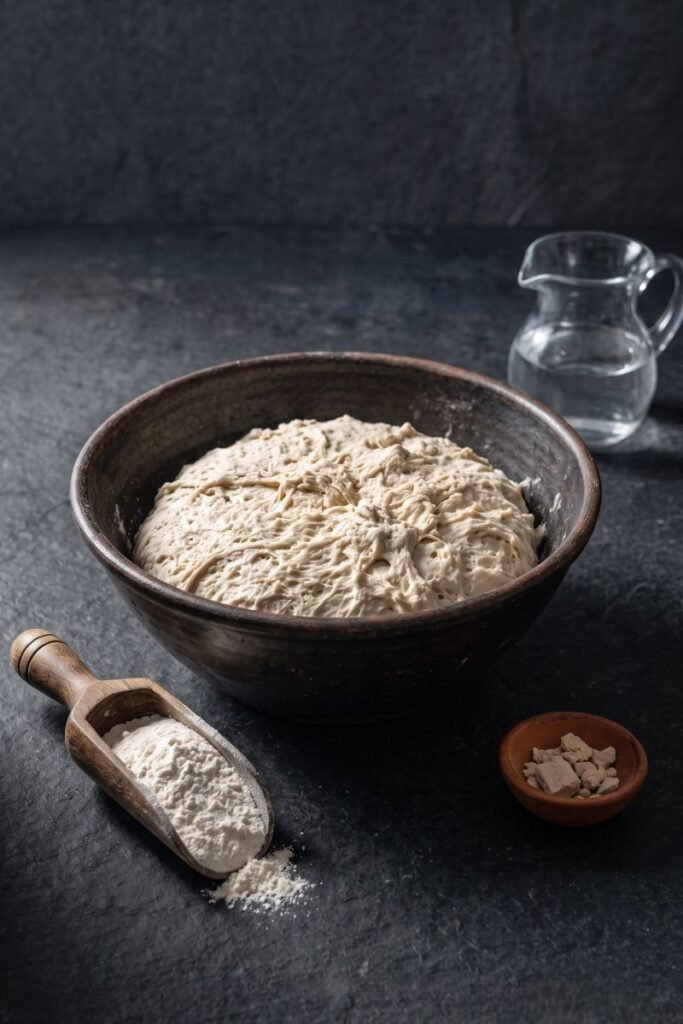
When I step up to my flour bins to prepare a master dough for a rustic batch of ciabatta or an airy Roman tray pizza, learning exactly what is a biga preferment is the absolute baseline secret to achieving an incredible, bubbly interior structure. Over my years of kneading handmade crusts, I have treated biological fermentation windows and wheat hydration ceilings as precise molecular design elements rather than simple, old-school kitchen traditions.
Whenever I see casual home bakers dump all their flour, water, and commercial yeast into a mixing bowl at the exact same time and wonder why their final loaf turns out dense, pale, and completely flavorless, I notice how omitting a proper starter limits the bake. For me, delivering a true restaurant-quality hole structure requires dividing your processing timelines, letting a stiff pre-dough mature overnight to build organic acids that strengthen your gluten sheets.
How Stiff Hydration Windows Slow Down Fermentation Mechanics
To understand why this dry, shaggy pre-dough behaves so differently inside a mixing bowl compared to loose, liquid starters like a French poolish, you have to look closely at hydration ratios. A traditional poolish uses an equal one-to-one balance of flour and water that generates a wet, sloppy liquid cream, a high-moisture environment that causes commercial yeast cells to consume sugars rapidly.
An authentic biga flips those fluid mechanics entirely, dropping the water weight down to a firm 45% or 50% threshold that keeps the mixture dense, rugged, and completely un-kneaded. When you leave this stiff clump of flour and water to mature inside a cool room resting at 64°F, the lack of free-flowing water molecules forces the yeast cells to digest carbohydrates at a incredibly slow pace.
This prolonged maturation process prioritizes the production of complex acetic acids over simple alcohol gasses, building a sharp flavor profile that commercial single-day mixtures can never replicate. Managing these precise dry hydration levels is an essential baseline rule I enforce across my entire baking station, a water-control habit I manage carefully when shaping firm, high-bite wheat ribbons inside my comprehensive Trofie Pasta Guide.
The Chemical Power of Acetic Acid to Reinforce Gluten Chains
The primary reason professional Italian bakers refuse to skip this overnight preferment stage comes down to the deep chemical structural changes that occur inside the wheat protein cells. I follow the historical fermentation timelines, wheat cell stabilization laws, and enzyme management rules documented inside the official Serious Eats Yeast Starter Directory to regulate my dough behaviors.
As the dry starter rests over an 18-hour window, the slow multiplication of acetic acid drops the internal pH balance of the pre-dough, creating an acidic microclimate that slows down damaging protease enzymes. These enzymes are responsible for breaking down wheat proteins over time; by keeping them locked out, your gluten strands can knit together into an incredibly strong, elastic web.
When you incorporate this mature, acidic mass into your final dough well, this increased structural elasticity allows the dough to stretch out to translucent thinness without tearing. The reinforced walls can trap large expanding carbon dioxide pockets during the final bake, yielding that ultra-light interior crumb structure and giant open air holes that define elite rustic baking.
Incorporating the Dry Starter into Final Skillet Dough Pools
The final law for successfully working with a traditional biga requires changing how you physically blend your ingredients during the final mixing session. Because the fermented pre-dough is stiff, cold, and dense, dropping it straight into a bowl with fresh flour and expecting it to dissolve smoothly by hand will leave you with hard, un-blended clumps throughout your dough.
To execute a flawless breakdown, always tear the mature starter into small, walnut-sized fragments using your fingertips and drop them directly into your recipe’s fresh water allocation first. Use a firm wire whisk or your fingers to vigorously whip the water bath until the dense chunks soften and dissolve into a uniform, milky liquid slurry.
Once the starter molecules are safely suspended inside the water phase, you can introduce your fresh double-zero flour and sea salt to build the main dough body. This careful dissolution step ensures every single square inch of your dough carries an identical protein strength, allowing your crusts to expand uniformly when transferred onto a scorching baking stone.
Simple Rules to Track Starter Maturity and Storage Limits
The final law for managing your preferments requires ignoring the clock completely if your room temperature shifts outside the optimal cellar boundaries. If your kitchen runs warm during the summer months, a biga left out on the counter will ferment too fast, collapsing into a sour, alcohol-soaked pool that destroys your gluten.
Keep a close eye on the volume of the container; your starter is perfectly primed for use when it has expanded to roughly double its original size and displays a domed, shaggy top wrinkling with deep fissures. If your schedule delays your baking window past the 18-hour mark, seal the container tightly and slide it into the back of your refrigerator immediately to halt yeast activity.
The cold environment preserves the organic flavor acids safely for up to 48 hours without degrading the structural strength of the wheat. I know my fermentation cycle is completely successful when I cut into the mature starter mass and smell a deeply complex, fruity, and slightly vinegar-like aroma. Taking the extra time to cultivate a stiff overnight pre-dough is the ultimate secret to delivering an elite meal to your family table.