
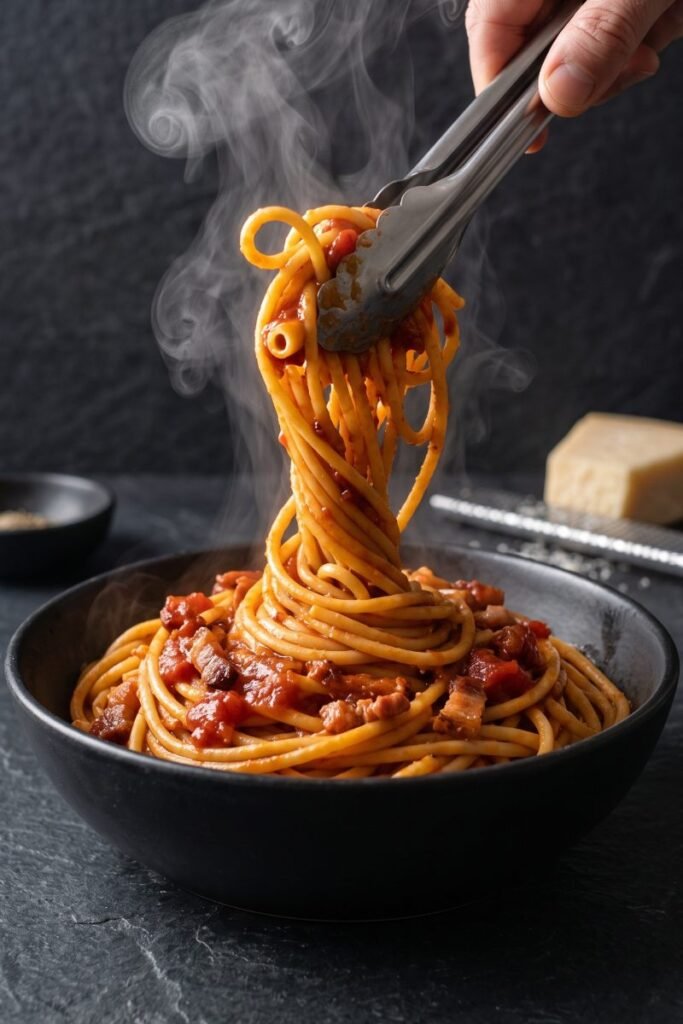
When my guests ask me what is bucatini pasta and why I hold it in such high regard, I always describe it as the absolute crown jewel of Roman noodle shapes. Over my years of exploring central Italian cuisine, I have treated this thick, hollow strand as an entirely unique ingredient rather than a simple variation of standard spaghetti.
Whenever I see un-trained home cooks snap these beautiful long strands in half to force them into a small pot, I notice how it entirely destroys the traditional dining experience. For me, executing an authentic regional meal requires respecting the structural design of the wheat and learning how to submerge the stiff tubes gently without breaking them.
How the Hole in Bucatini Helps It Cook Perfectly
To understand why this noodle holds such a sacred position in my kitchen, I always look closely at the physical mechanics of its extrusion process. The tiny hole passing through the core completely changes how heat and boiling water penetrate the dense durum wheat semolina.
When I boil standard solid strands, the exterior cooks significantly faster than the center, forcing me to watch the pot constantly to avoid a mushy outer layer. With bucatini, however, the boiling water rushes straight through the center tube, cooking the noodle simultaneously from the inside out.
This dual-sided heat transfer allows the thick strand to develop an incredibly uniform, elastic structure across its entire diameter. I love the substantial, springy bounce it delivers on the palate, offering a satisfying chew that thinner shapes can never replicate.
How to Cook Bucatini Evenly
Because bucatini is significantly thicker and more rigid than standard boxed spaghetti, getting it into a boiling pot without snapping the brittle ends requires a specific manual technique. I have learned that trying to force the stiff strands straight down will only result in cracked pieces that ruin the long, winding flow of the plate.
To bypass this issue, I ensure my water is at a violent rolling boil inside a spacious, deep vessel. If managing large volumes of boiling water poses a physical challenge, I highly recommend using a high-walled, accessible strainer vessel like those featured in my guide on the Best Pasta Pot for Arthritis.
I gather the entire dry bundle in my hands, press the bottom tips into the center of the pot, and let them fan out into a wide spiral shape. I stand by the stove with a pair of long tongs, gently pressing down on the softening submerged sections for roughly sixty seconds until the entire strand bends smoothly into the water.
Why Thick Hollow Strands Need Rich Heavy Sauces
What is Bucatini PastaIn my cooking rotation, I respect the strict regional laws that dictate how this hollow straw interacts with classic Italian sauces. According to the historical preservation archives maintained by the official Italian Academy of Cuisine, the traditional blueprint of Rome’s regional pasta variants relies strictly on specific dimension pairings to lock in regional textures.
The thick, heavy wall structure of this noodle is intentionally engineered to capture and hold fat-rich, heavy pan reductions. I find that light, aromatic wine stocks easily get lost inside the massive inner cavity of this wheat profile, making the final bite feel completely un-balanced.
I save those delicate, low-density liquids exclusively for fine, solid strands, which you can see when I simmer the base for my traditional White Wine Mussels. Bucatini demands robust, rich coatings that can flow cleanly into the center hole, serving as the canonical companion for Rome’s legendary Amatriciana sauce where the hollow tube suctions up savory rendered pork fats and sharp cheese flawlessly.
How to Cook Bucatini Al Dente
Because the inner hole changes the cooking speed, checking for doneness requires a different sensory observation than standard long pasta shapes. I never rely on the loose time approximations printed on commercial cardboard boxes, as they often result in an overcooked, floppy noodle.
Instead, I fish a single strand out of my pot two minutes early and cut it cleanly in half with a small knife to inspect the cross-section. I am looking for a tiny, pale ring surrounding the inner hole, which indicates the core gluten matrix is still firm and elastic.
I immediately transfer these under-cooked strands directly into my simmering sauce pan using my tongs, allowing the hollow core to suck up the seasoned gravy as it finishes cooking over the flame. This final two-minute pan toss allows the starch and sauce to fuse completely, delivering a cohesive, glossy, and beautifully structured Roman masterpiece to my family table.