
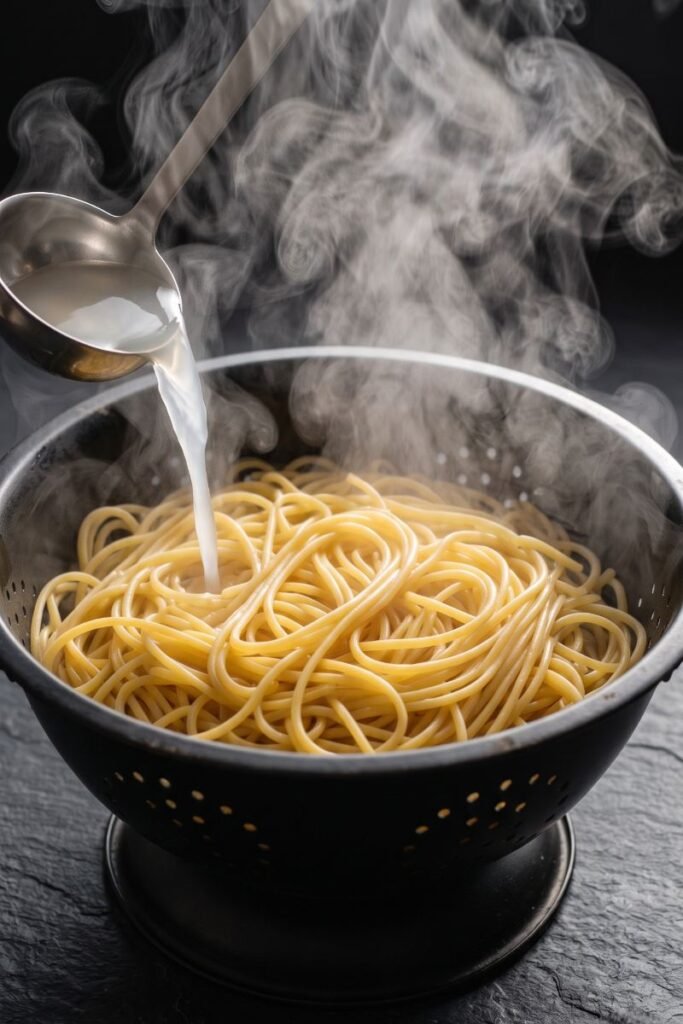
When I stand over my sink lifting a steaming pot of boiled noodles, my absolute golden rule is that I never rinse pasta after draining it into a colander. Over my years of mastering regional Italian dishes, I have treated the fine, starchy coating left on the surface of the wheat as an essential ingredient.
Whenever I watch casual home cooks run cold tap water over their fresh colander loads to stop the cooking process, I cringe at how it completely alters the texture of the final plate. For me, achieving a flawless restaurant-quality marriage between a noodle and its coating requires keeping that delicate, cloudy film completely intact.
Why the Cloudy Film on Your Pasta Is Crucial for Sauce
To understand why I guard that surface residue so fiercely, I always look closely at the chemical properties of boiled durum wheat. During the boiling phase, the starch granules inside the dough swell up and rupture, releasing a fine layer of amylose molecules into the surrounding liquid.
When I drain my pot, this released amylose dries slightly, forming a rough, invisible, and highly absorbent film over the entire length of the noodle. If I blast that delicate film with tap water, I am stripping away the natural binding agent that holds my meal together.
I have watched rinsed noodles turn incredibly slick, cold, and glassy within seconds. This slippery state forces my olive oils and pan reductions to slide right past the pasta fibers instead of hugging them.
Furthermore, running tap water over my hot pasta shocks the exterior of the dough, washing away the fine microscopic ridges created by traditional bronze-die extrusion molds. I rely heavily on those tiny, rough imperfections to mechanically trap my minced herbs and grated cheeses.
When I eliminate that natural structural friction, my sauce completely loses its anchor point. I find that a rinsed noodle acts like an impermeable plastic shield, rejecting flavors instead of drawing them inward.
How Unrinsed Strands Naturally Lock Onto Olive Oil
Because my minimalist pasta creations rely entirely on pan-fried fats and moisture balances, losing my surface starches completely breaks the cohesion of my dishes. I strictly require that rough, powdery exterior to pull my light pan juices up into a uniform coating.
I love how un-rinsed long strands naturally lock onto spicy oil networks without requiring heavy flour thickeners. This precise starch-driven friction is the exact secret I use to bind the fragrant garlic oils anchoring my traditional Spaghetti Aglio e Olio e Peperoncino.
By dropping my strands straight from the colander into my sizzling pan, the residual starches instantly emulsify with my cooking fats. This creates a uniform, silky glaze that coats every single noodle perfectly.
I have learned from trial and error that attempting this oil coat with rinsed noodles results in a greasy, separated disaster. The oil simply slides to the bottom of my serving bowls, leaving the top strands bare and dry.
Keeping the pasta un-rinsed guarantees a chemical link where oil and water blend smoothly over my burners. For me, that beautiful, clinging shine is the true mark of a technically perfect plate.
Why You Should Toss Pasta with the Sauce Right Away
When I set out to execute complex, dairy-driven emulsions, the value of my un-rinsed pasta starches multiplies instantly. I rely on the technical cooking parameters verified by the master blending experts at the official Barilla Culinary Academy to guide my starch extractions.
The dry, concentrated amylose resting on my warm noodles acts as a structural bridge when it hits aged cheeses and hot fats. I watch this powdery film melt directly into my pan liquids, creating a natural, velvety cream matrix that prevents clumping.
This exact mechanical fat-and-starch binding technique is how I achieve the legendary, ultra-smooth coat on my signature Cacio e Pepe Recipe. Rinsing my dough would completely short-circuit this chemical bond, leaving me with a clumpy, separated mess of hard cheese strings.
When I add un-rinsed pasta directly into a hot cheese mixture, the residual heat of the starches helps melt the fats gently without breaking them. This specific temperature and chemical harmony is what gives authentic Italian pasta its signature silkiness.
If I used rinsed, cooled noodles, the sudden temperature drop would cause my sharp Pecorino Romano cheese to instantly seize up into rubbery clumps. I guard my starches like gold because they are my ultimate insurance policy against broken sauces.
How to Toss Pasta for Even Sauce Coverage
Once my un-rinsed strands are cleanly transferred into my skillet, I immediately ladle in a small splash of my reserved, cloudy cooking water. I use this starchy water addition to continuously adjust the moisture balance while aggressively tossing my pan.
I avoid adding raw cooking oils to my empty colander because I know it blocks my starches from interacting with my sauce layers. Instead, I let the natural starches do the heavy lifting, ensuring my components fuse smoothly over low heat.
I know my skillet is officially ready when the liquid changes into a glossy, perfectly bound reduction that clings to the pasta. This physical transformation occurs right before my eyes as the starch molecules absorb the moving cooking oils.
For me, respecting these natural wheat behaviors is the ultimate secret to elevating my family table. I find that skipping the rinse cycle completely fundamentally upgrades the taste and texture of every single recipe I create.