
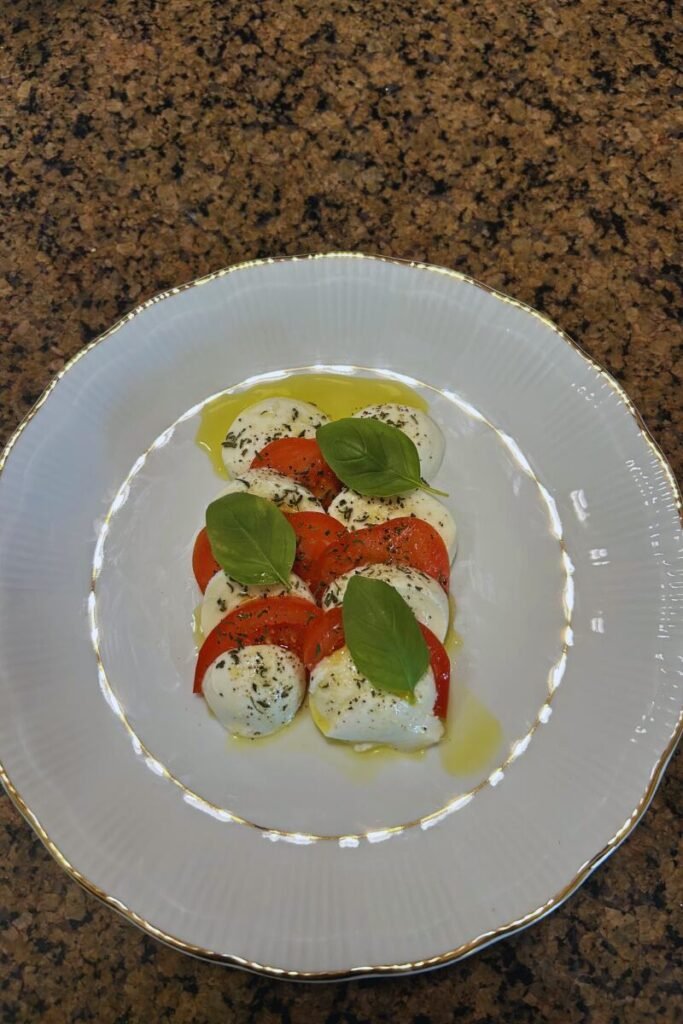
There is no salad more immediately recognizable, more deeply Italian, or more quietly demanding than a proper caprese salad. Three ingredients, a drizzle of oil, and a handful of fresh basil. That is the entire premise. And yet a truly great caprese salad, one that stops the table cold and gets talked about long after the plates are cleared, is one of the hardest simple things to get right.
This Easy Caprese Salad Recipe guide covers everything: the history, the ingredients, the technique, the science of why it works, and the most common mistakes that turn a beautiful idea into a flat, watery disappointment. Whether you are making it for the first time or the five hundredth, there is something here worth knowing.
The Origin and Cultural Meaning of Caprese Salad
Where It Comes From
The caprese salad takes its name from the island of Capri, the famously beautiful rocky outcrop off the Sorrentine Peninsula in the Bay of Naples.
The dish is claimed to have been invented sometime in the early twentieth century, with some accounts placing its creation in the 1920s at the Hotel Quisisana on Capri, reportedly as a patriotic gesture by a Caprese bricklayer who wanted to compose a dish in the colours of the Italian flag.
Red tomatoes, white mozzarella, green basil. It is one of those origin stories that may be entirely apocryphal but feels too good to dismiss. What is not apocryphal is the dish’s roots in Campanian food culture.
The region surrounding Naples has produced two of the most celebrated ingredients in Italian cooking: the San Marzano tomato, grown in volcanic soil near Mount Vesuvius, and mozzarella di bufala campana, made from the milk of water buffalo raised in the wetlands of Campania and Lazio.
Long before anyone composed them on a plate and called it insalata caprese, these two ingredients were appearing together in Neapolitan kitchens as a matter of practical abundance.
What It Represents
The caprese is, at its core, a statement about Italian food philosophy. It asks the cook to step back and trust the ingredients. It refuses complexity. There is no dressing to prepare, no technique to master beyond slicing, no heat involved.
The dish is a direct argument that exceptional produce, handled with restraint and served at the right temperature, needs nothing added to it. In this way the caprese sits alongside the best bruschetta and a perfect bowl of cacio e pepe as a kind of manifesto: the cooking is in the sourcing.
For authoritative context on the cultural and geographic heritage of the dish’s key ingredients, the Consortium for the Protection of Mozzarella di Bufala Campana provides detailed documentation on what authentic Campanian mozzarella actually is and why geography matters.
Understanding the Ingredients
Tomatoes: The Non-Negotiable Foundation
If there is a single variable that determines whether a caprese salad will be memorable or forgettable, it is the tomatoes. Not the mozzarella, not the olive oil, not the basil. The tomatoes.
A caprese made with supermarket tomatoes picked underripe and refrigerated in transit will taste of almost nothing regardless of what else surrounds them. The sugars have not developed, the cell walls are intact and watery rather than collapsing into juice, and the aromatic compounds that make a ripe tomato taste like a ripe tomato have never had the warmth and time they need to form.
What you are looking for in a caprese tomato is weight relative to size, which signals juice content; skin that gives slightly under pressure without feeling soft; and smell. A properly ripe tomato smells like a tomato from the stem end. If it smells like nothing, it will taste like nothing.
The variety matters less than ripeness, though certain types perform consistently well in this preparation. Beefsteak tomatoes offer thick, meaty slices with low seed-to-flesh ratios. Heirloom varieties bring colour variation and complex, sometimes almost sweet flavour.
Vine-ripened tomatoes from a farmers market in late summer will generally outperform any supermarket variety at any time of year. And if you have access to genuine San Marzano or Cuore di Bue tomatoes, use them without question.
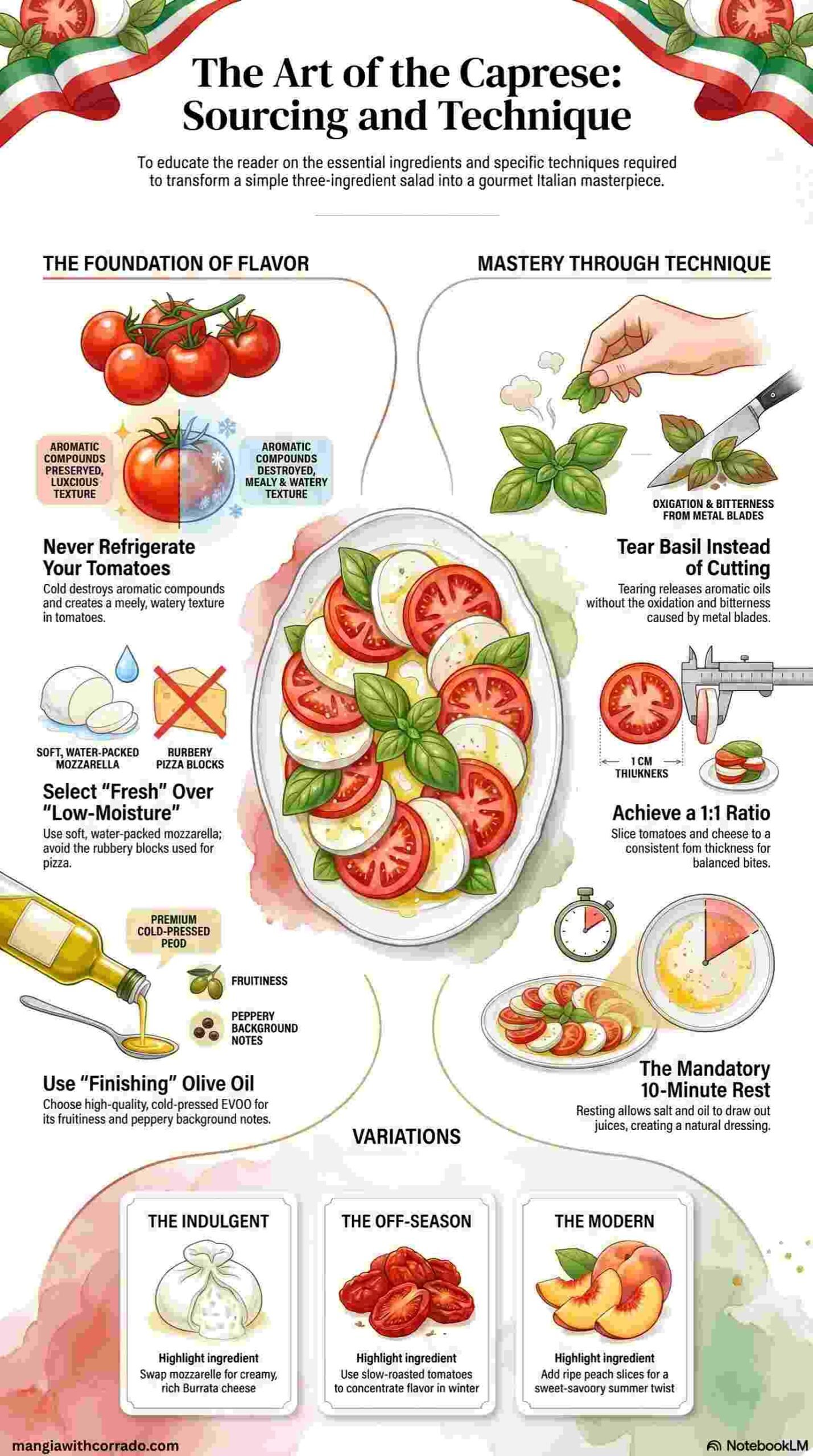
Temperature is critical. Never refrigerate tomatoes you intend to use in a caprese. Cold destroys the aromatic volatile compounds responsible for tomato flavour and firms the texture in a way that does not recover at room temperature. Buy your tomatoes the day you plan to use them and leave them on the counter.
Mozzarella: Fresh, Cold, and the Right Kind
The bocconcini specified in this recipe are small fresh mozzarella balls, typically sold packed in water or whey. They are a practical choice for a caprese because their size aligns well with medium tomato slices and they require no cutting. For a more traditional presentation using large mozzarella rounds, the same principles apply.
The distinction that matters most here is between fresh mozzarella and low-moisture mozzarella. Low-moisture mozzarella, the kind sold in solid blocks for pizza or grating, has had most of its water content removed and will not work in a caprese. It is rubbery, lacks the milky freshness that defines the dish, and its flavour profile is entirely different. You want fresh mozzarella that is soft, wet, and tears rather than cuts cleanly.
If you can find mozzarella di bufala campana, buy it. Buffalo milk mozzarella has a richer, slightly tangier flavour than cow’s milk fior di latte, more complex fat content, and a creamier interior texture. It is the traditional choice and the superior one. Fior di latte, made from cow’s milk, is an acceptable and widely used alternative, particularly when it is very fresh and locally made.
Unlike tomatoes, mozzarella benefits from being cold until the last possible moment. Remove it from its liquid shortly before assembling, slice or arrange it, and allow it to come only slightly toward room temperature as the dish rests. This contrast between the room-temperature tomato and the cool, yielding cheese is part of what makes the dish work texturally.
Extra-Virgin Olive Oil: The Finishing Agent
In a dish with this few components, the olive oil is not a background note. It is a primary flavour, and it needs to be good. Extra-virgin olive oil is a legal designation indicating that the oil was produced by mechanical means only, without heat or chemical extraction, and that its free acidity is below 0.8 percent. Within that category, quality varies enormously.
For a caprese, you want a finishing olive oil rather than a cooking oil. Finishing oils are typically cold-pressed from hand-harvested olives and meant to be tasted directly rather than heated. They will carry fruitiness, varying degrees of pepper and bitterness depending on origin, and a complexity that bulk cooking oils cannot match.
Italian extra-virgin olive oils from Campania, Puglia, or Sicily work beautifully with the flavours of this dish for obvious regional coherence. Ligurian oils tend to be lighter and milder. Tuscan oils run peppery and assertive. Any of these can work well. What will not work is a cheap blended olive oil sold in a large plastic container, regardless of what the label says.
For detailed guidance on olive oil classification, production standards, and how to evaluate quality, the North American Olive Oil Association (naooa.org) maintains comprehensive consumer resources grounded in industry and regulatory standards.
Fresh Basil: Torn, Never Cut
Fresh basil is not interchangeable with dried basil in this preparation. Dried basil has a muted, almost dusty herbal quality that bears little resemblance to the bright, slightly anise-forward perfume of fresh leaves. Use fresh basil, and use enough of it.
The method matters: tear the leaves by hand rather than cutting them with a knife. Cutting basil with a blade bruises the cells along the cut edge and causes rapid browning and a slight metallic bitterness. Tearing produces a rougher edge that releases the aromatic oils without the same oxidation response. The difference is visible within minutes and noticeable on the palate.
Use the larger leaves whole or torn in half. Very small leaves can go on intact. Add the basil toward the end of assembly and just before the oil goes on so it does not wilt completely into the dish.
Salt, Pepper, and Oregano
Salt in a caprese does two jobs: it seasons the ingredients, and it draws moisture from the tomato slices, which pools at the base of the plate and mixes with the olive oil to form a natural, intensely flavoured dressing. Use good-quality flaky sea salt if you have it. Kosher salt works well. Fine table salt will do the job but lacks the texture that makes each bite slightly different.
Pepper should be freshly ground. Pre-ground pepper loses its volatile aromatics quickly and contributes only sharpness without the woodsy, complex quality of freshly cracked black pepper.
Dried oregano in a caprese is an authentic Campanian addition that not everyone uses. It is decidedly not mandatory, but a very small pinch brings an earthy herbal backdrop that supports the basil without competing with it. Use less than you think you need.
The Complete Caprese Salad Recipe Ingredients
Ingredients
Serves 4 as a starter or side.
- 3 to 4 large ripe tomatoes, preferably beefsteak or heirloom varieties
- 250g big bocconcini or large fresh mozzarella rounds
- A generous handful of fresh basil leaves
- 3 to 4 tablespoons best-quality extra-virgin olive oil
- Flaky sea salt to taste
- Freshly ground black pepper to taste
- A small pinch of dried oregano (optional)
Instructions
Step 1 — Prepare the tomatoes and bocconcini
Slice the tomatoes into rounds approximately 1cm thick. Thinner slices collapse under the weight of the cheese and become difficult to lift with a fork; thicker slices are unwieldy and the proportions feel off. Slice the bocconcini to a similar thickness. If your bocconcini are small, slice them into two or three rounds each. The goal is for each bite to contain a roughly equal ratio of tomato to cheese.
Step 2 — Arrange the plate
Arrange the tomato and bocconcini slices on a large serving plate, alternating them in a slightly overlapping sequence. You can arrange them in a straight line across an oval platter, in a circular pattern on a round plate, or in a loose, informal scatter if you prefer a less composed look. The key is that every slice of tomato is adjacent to a slice of mozzarella. Leave a little space at the edge of the plate so the olive oil pools attractively rather than running straight off onto the table.
Step 3 — Season
Sprinkle the arranged slices evenly with flaky salt and freshly ground black pepper. If you are using dried oregano, add it now, very sparingly. The seasoning at this stage draws moisture from the tomatoes and begins to work its way into the surfaces of both the tomato and cheese before the oil is added.
Step 4 — Add the basil
Tear the basil leaves by hand and scatter them across the plate. Do not arrange them too precisely. The slightly casual placement looks more natural and means the basil is distributed so every portion of the dish gets some.
Step 5 — Drizzle the olive oil
Drizzle the extra-virgin olive oil generously across the entire plate. Do not be timid. The oil is not a garnish here; it is a primary flavour element and it will combine with the tomato juices to form the dressing. Three to four tablespoons for a four-person plate is a reasonable starting point.
Step 6 — Rest before serving
Let the assembled salad sit at room temperature for five to ten minutes before it goes to the table. During this time the salt draws liquid from the tomatoes, the oil and tomato juice begin to combine at the base of the plate, the basil wilts slightly and releases more of its perfume, and the mozzarella warms just enough to soften. This resting period is not optional. It is the step that turns an assembly of ingredients into a dish.
Technique, Timing, and Common Mistakes
Why Temperature Is Everything
The single most common reason a caprese salad disappoints is that one or more of its components was served cold. Cold tomatoes taste of nothing. Cold mozzarella is rubbery and withholds its creaminess. Cold olive oil goes thick and loses much of its fruitiness. The entire dish is designed to be experienced at room temperature, where the fats in the cheese are soft, the aromatic compounds in the tomatoes are volatile and present, and the olive oil flows freely across everything.
If your tomatoes have been in the fridge, take them out at least an hour before you plan to serve. Drain your mozzarella from its liquid and let it sit for twenty to thirty minutes before slicing.
Slicing Consistently
Uneven slices create a plate that looks careless and that eats unevenly. Use a sharp knife. A serrated bread knife works well on ripe tomatoes without crushing them. For mozzarella, a thin, sharp blade makes cleaner cuts. If your mozzarella is very soft and tears as you slice, chill it for fifteen minutes first, cut it, then let the slices come back to temperature on the plate.
Not Overdressing
The opposite failure mode from not enough olive oil is drowning the plate. The oil should coat and pool, not flood. Taste a tomato slice before adding oil to assess how much moisture the tomatoes are already releasing. Very juicy tomatoes need less oil than drier ones.
Seasoning at the Right Moment
Salt applied to the tomatoes immediately before serving draws moisture rapidly and can leave the surface of the slices looking slightly wet and leached within a few minutes. The five-to-ten minute rest window is intentional: long enough for the salt to do its work and for the resulting liquid to combine with the oil, but short enough that the tomatoes do not fully deflate.
Variations Worth Knowing
With Burrata
Replacing bocconcini with burrata, a fresh mozzarella shell filled with stracciatella and cream, produces a richer, more indulgent version of the dish. Burrata is served whole or torn open at the centre of the plate with the tomatoes arranged around it. The interior cream spills out and combines with the olive oil and tomato juices to create something closer to a sauce. It is exceptional.
With Roasted Tomatoes
For a version that works outside peak summer tomato season, halve the tomatoes and roast them cut-side up at 160°C for forty-five minutes to an hour with olive oil, salt, and a little sugar. The slow roasting concentrates flavour dramatically and produces a caprese that works even when fresh tomatoes are mediocre.
With Peaches
In late summer when white or yellow peaches are at peak ripeness, replacing half the tomato slices with peach slices creates a sweet-savoury variation that is more common in modern Italian-American cooking than in Italy itself but is genuinely delicious. The basil, salt, and olive oil translate perfectly to peach.
With Flaky Sea Salt and Aged Balsamic
A small amount of properly aged balsamic vinegar, not the thin, sharp, cheap variety but a genuine aged aceto balsamico tradizionale from Modena or Reggio Emilia, adds sweetness, acidity, and extraordinary depth to the plate. A few drops across the finished salad is all that is needed. More than that and it becomes a different dish.
Serving and Pairing Suggestions
When to Serve It
Caprese is most at home as an antipasto, the first course of a meal, where its freshness and lightness set the tone without competing with what follows. It also works as a side dish alongside grilled fish or chicken, or as a light lunch with good bread.
Do not serve it as a side to heavily sauced pasta. The delicacy of the salad is flattened by anything too robust. It belongs in a meal that respects its quietness.
Bread
A caprese without bread nearby is a missed opportunity. The oil and tomato juices that pool at the base of the plate are one of the best things on the table, and good crusty bread is the right instrument for collecting them. Ciabatta, a rustic sourdough, or a simple baguette all work well.
Wine
The regional instinct is right here. A crisp, mineral-driven white from Campania or the broader southern Italian tradition pairs naturally with the bright acidity of the tomatoes and the milkiness of the mozzarella. Falanghina, Fiano di Avellino, and Vermentino are all excellent choices. A light, dry rosé from Provence or Sicily also works well. Avoid heavy, oaky whites, which overwhelm rather than complement.
A Final Word on Simplicity
The caprese is a useful reminder that cooking at its best is not about complexity. The skill it requires is not technical but curatorial: finding the right tomatoes at the right moment in the season, choosing a mozzarella that tastes like something, using an olive oil worth drizzling cold onto a plate.
These are purchasing decisions and sourcing decisions as much as they are cooking decisions, and in that sense the caprese is one of the most honest dishes in any cuisine. There is nowhere to hide and no technique to fall back on. Either the ingredients are good enough to speak for themselves or they are not. When they are, this salad is one of the finest things a kitchen can produce.