
When I lift the lid off my simmering pot and notice a loose, translucent puddle separating from my tomato solids, troubleshooting why a homemade tomato sauce too watery consistency occurred becomes my immediate focus. Over my years of perfecting classic red bases, I have learned that a runny sauce is almost always caused by excess water hiding inside the whole fruits or dropping too many raw vegetables into the pan early on.
Whenever I see casual home cooks panic and dump tablespoons of cornstarch or heavy wheat flour into their skillets to artificially tighten the liquid, I notice how it completely ruins the clean, vibrant profile of the meal. For me, achieving a flawless restaurant-quality texture requires using natural evaporation and chemical reductions to bind the liquid phase with my cooking oils cleanly.
Why Your Tomato Sauce Is Too Watery
To understand why a sauce turns runny on the burner, I always look closely at the biological cellular structures of the tomato fruit itself. Tomatoes are naturally composed of roughly 94% water, which is trapped tightly inside the fragile plant cell walls along with a structural carbohydrate known as pectin.
When I crush the fruits and apply gentle heat, those cell walls rupture, releasing massive amounts of loose moisture directly into my cooking pan. If I leave a heavy lid resting tightly over my pot during a simmer, that moisture cannot escape into the air, forcing it to condense on the underside of the lid and rain back down into my sauce.
I have watched this trapped condensation permanently thin out my reductions, separating the rich pulp from the liquid and causing a watery halo to form around my pasta. Removing the cover completely allows that steam to float away freely, which collapses the liquid volume and naturally thickens the remaining solids into a rich glaze.
Simmer the Sauce Uncovered
My absolute baseline rule when dealing with an overly thin reduction is to immediately ditch the lid and expand the surface area of my cooking vessel. I prefer to pour my runny tomatoes into a wide, shallow skillet rather than keeping them trapped inside a tall, narrow soup pot.
The increased horizontal surface area forces the water phase to evaporate at a significantly faster rate over a steady, medium-low flame. This natural reduction process concentrates the organic sugars and acids evenly, intensifying the deep savory depth of the fruit without requiring any thickeners.
I use this exact open-skillet technique whenever I need to tighten up thin, seasoned purees before baking them, a moisture-control habit I rely on to prevent a soggy crust when preparing my rustic Potato Pizza Recipe. Keeping the heat controlled ensures the bottom sugars do not scorch while the top moisture escapes into my kitchen air.
Add a Small Amount of Tomato Paste
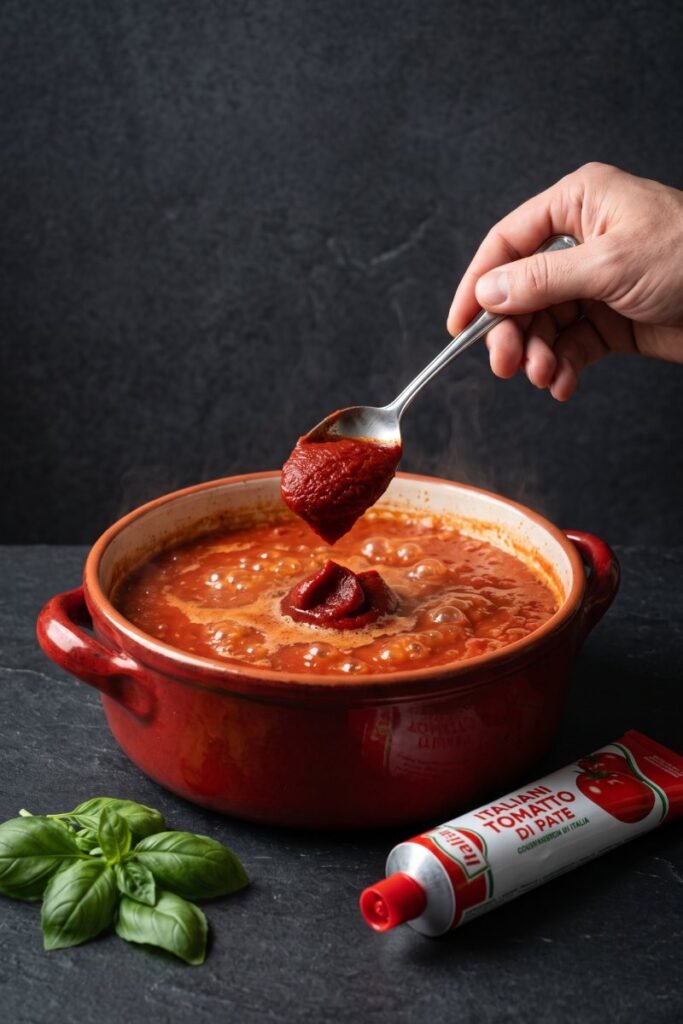
If an open simmer cannot fully rescue my pot due to excessively watery canned batches, I rely on a simple culinary shortcut sitting right in my pantry. I stir in a small amount of double-concentrated tomato paste, which acts as a powerful structural bridge to lock up loose water molecules instantly.
I follow strict food composition and agricultural moisture parameters tracked by the official USDA FoodData Central Database to understand how vacuum-evaporated tomato pastes behave under high heat. Because high-quality paste is already reduced down to a minimum moisture threshold, it is packed with dense networks of highly concentrated, intact plant pectins.
When I whisk this concentrated paste into my bubbling pot, those dense pectins act like microscopic sponges, absorbing the excess water phase and unifying the texture within minutes. I make sure to let the paste simmer alongside my tomatoes for at least ten minutes to cook out any raw, metallic tin profiles before my final taste test.
When to Use Starch (and When Not To)
Once I have successfully adjusted the core density of my pot, I focus on how the remaining moisture interacts with the other components of my meal. I avoid using chemical binders like arrowroot because they dull the bright acidity and leave a slimy film on the tongue.
Instead, I prefer to leverage the natural starches released by my companion dishes to absorb the lingering water phases effortlessly. I love to let my red reductions finish simmering directly alongside dense, starch-heavy proteins that can drink up the liquid layer while cooking.
This mechanical starch extraction is exactly why I drop my seared meats directly into my bubbling sauces, a technique that thickens my pan juices naturally when crafting my comforting Meatballs and Potatoes Recipe. By letting natural evaporation and pure fruit concentrations do the heavy lifting, I guarantee my Italian sauces retain their authentic depth.