
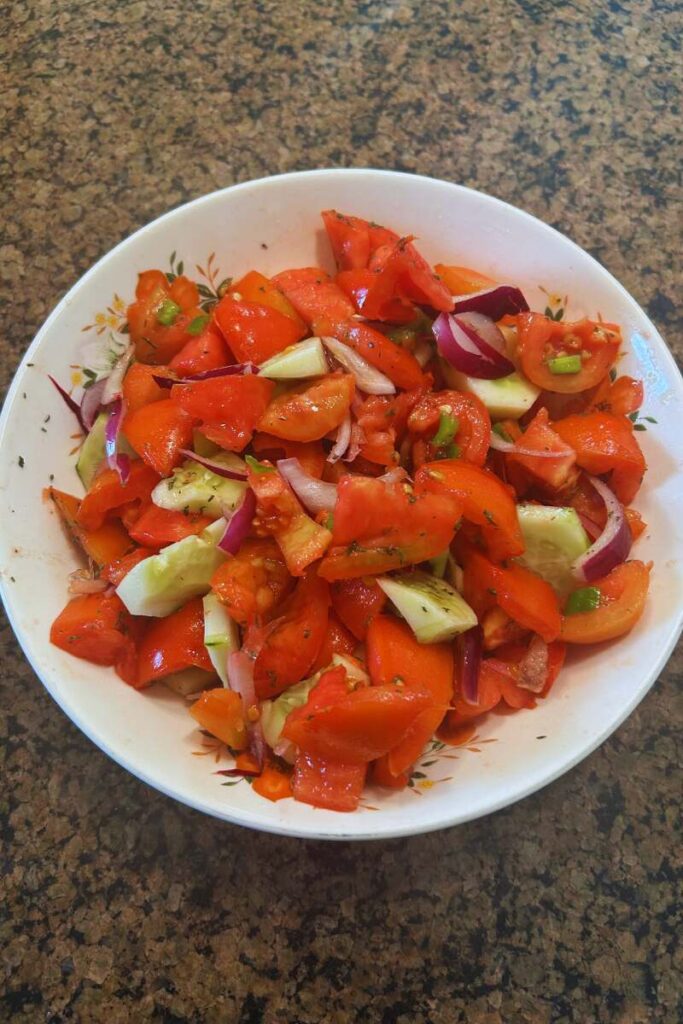
This Simple Tomato Salad with Cucumber And Red Onion perfectly highlights a core secret of great home cooking. When your raw ingredients are high in quality and treated with care, minimal effort creates a massive impact. The vibrant mix of ripe tomatoes, crisp cucumber, sharp red onion, and mild banana pepper delivers a dish that is both incredibly refreshing and deeply satisfying.
The true magic happens when basic pantry staples like dried oregano, rich olive oil, and sharp red wine vinegar transform fresh vegetables into a cohesive masterpiece. Letting the salad rest on the counter before serving is a crucial step in the process. This downtime allows the tomatoes to release their natural juices, creating a light and savory dressing that coats every single bite perfectly.
Understanding Simple Salad Fundamentals
The most challenging aspect of creating excellent simple salads isn’t technique—it’s ingredient selection and understanding how flavors develop over time. Unlike composed salads with multiple components and complex dressings, simple vegetable salads succeed or fail based entirely on ingredient quality and proper seasoning balance.
This salad follows the Italian tradition of “insalata semplice” (simple salad), where vegetables speak for themselves without elaborate preparation masking or overwhelming their natural character. The preparation method—cutting, seasoning, and allowing rest—represents the entire technique. The focus shifts entirely to ingredient quality and the chemistry of how vegetables, salt, acid, and oil interact over time.
The resting period serves multiple functions beyond convenience. Tomato cells contain considerable liquid held in cellular structure by pectin and other compounds. When salt is applied to tomato flesh, osmosis draws water from cells into the surrounding liquid, concentrating tomato flavor in the released juices.
These juices mingle with olive oil and vinegar, creating a light emulsion that coats other vegetables while infusing them with tomato’s concentrated essence.
Ingredients
Core Components
- 3 large tomatoes, ripe and in-season (approximately 600-750g)
- ½ red onion, medium-sized
- 1 small cucumber (approximately 150-200g)
- ½ banana pepper (approximately 50-75g)
- Fresh oregano, to taste (approximately 1-2 teaspoons dried or 2-3 tablespoons fresh)
- Salt, to taste
- Freshly cracked black pepper, to taste
- Red wine vinegar, to taste (approximately 1-2 tablespoons)
- Extra-virgin olive oil, to taste (approximately 3-4 tablespoons)
Ingredient Selection and Quality
Tomato Selection—The Foundation
Tomato quality determines this salad’s success more than any other factor. The ideal tomato for this salad is vine-ripened, in-season (typically summer months in most climates), and picked at peak ripeness. These tomatoes possess maximum sugar content, complex flavor development, and sufficient acidity to balance the olive oil.
Look for tomatoes that yield slightly to gentle pressure—overripe tomatoes are mushy and lack structural integrity for cutting, while underripe tomatoes remain firm and lack essential sweetness and acidity. The tomato’s scent provides additional guidance; properly ripened tomatoes smell distinctly tomato-like, fruity and slightly herbal, while underripe or hothouse tomatoes smell green or have no notable aroma.
Heirloom tomato varieties offer superior flavor compared to modern hybrid tomatoes developed for uniform appearance and extended shelf life rather than taste.
eefsteak, Cherokee Purple, San Marzano (when available fresh), or other open-pollinated varieties provide complex flavor with balanced acidity. However, quality matters more than specific variety—a ripe, well-grown modern tomato exceeds a mediocre heirloom.
According to research from the USDA Agricultural Research Service, tomato flavor depends on the balance between sugars, acids, and volatile compounds that develop during ripening. Lycopene, the pigment responsible for tomato’s red color, develops as fruit ripens and correlates with flavor development.
Tomatoes picked at peak ripeness and allowed to rest at room temperature develop optimal flavor as enzymes continue breaking down cell walls and developing volatile compounds.
Avoid refrigerating raw tomatoes before serving, as cold temperatures halt ripening processes and inhibit flavor development. Tomatoes stored below 15°C lose flavor compounds and develop mealy texture. For this simple salad, tomatoes should be at room temperature when cut, ensuring optimal flavor and juiciness.
Cucumber Quality and Preparation
The cucumber’s role in this salad is to provide crisp textural contrast and mild, refreshing flavor rather than dominant taste. English cucumbers (sometimes called hothouse or seedless cucumbers) offer superior quality compared to standard slicing cucumbers—they contain fewer large seeds, thinner skin, and more delicate flavor.
Look for cucumbers that feel firm and unblemished, with bright green color and no soft spots or yellowing. Avoid cucumbers that feel rubbery or have visible wrinkles, indicating dehydration and inferior texture.
The decision to peel or leave skin on depends on cucumber variety and personal preference. English cucumber skin is tender and edible, contributing color and nutrients (the skin contains most of the cucumber’s modest fiber content). Standard slicing cucumber skin may be thicker and slightly bitter; peeling improves texture and flavor for these varieties.
For this salad, thin slicing or dicing creates more surface area for seasoning absorption. Thin-sliced cucumber provides delicate texture that complements the salad’s simplicity, while diced cucumber creates more substantial texture and greater surface contact with dressing components.
Red Onion Selection and Preparation
Red onions provide sharp, slightly spicy bite that balances tomato’s sweetness and adds aromatic complexity. Red onions contain anthocyanins (the pigments that create their color), which have antioxidant properties and contribute subtle sweetness compared to white onions’ harshness.
Slice red onion thinly—approximately 3-4mm thick—to create delicate texture and allow the onion’s pungent compounds (which are released when cells are damaged) to distribute evenly throughout the salad. Very thin slicing also encourages osmosis, allowing the onion’s raw bite to soften as it marinates in the tomato liquid and vinegar.
The raw onion bite mellows considerably during the salad’s resting period as the vinegar and salt begin breaking down the onion’s cell walls and converting harsh sulfur compounds into milder flavor compounds. After 10-15 minutes, raw onion develops sweeter, more subtle character while retaining textural crisp.
Banana Pepper Characteristics
Banana peppers, also called yellow peppers or Hungarian wax peppers, offer mild heat (2-8,000 Scoville units, compared to bell peppers’ zero and jalapeños’ 2,500-8,000) and subtle sweetness. Their thin walls make them tender and easy to eat raw, and their pale yellow or greenish color provides visual interest to the red tomato and purple onion.
Select firm banana peppers with unblemished skin and bright color. Avoid any with soft spots or wrinkled appearance. The pepper should yield slightly to pressure but feel structurally firm.
Oregano Selection and Intensity
Oregano appears in this recipe as the primary seasoning herb, contributing aromatic, slightly peppery flavor. Fresh oregano offers bright, more delicate character, while dried oregano provides concentrated, more assertive flavor.
For this simple salad, dried oregano often works better than fresh—its concentrated flavor distributes more evenly through the salad, and it’s more forgiving if over-applied (whereas fresh oregano can overwhelm with too much added).
Quality matters significantly in dried herbs. Oregano loses flavor compounds during drying and storage; herbs more than a year old lose substantial aromatic character. Look for dried oregano with bright green color and strong aroma—dull, gray oregano has lost flavor during extended storage.
If using fresh oregano, use approximately 3 times the amount of dried oregano (since fresh is approximately one-third the strength): approximately 6-9 tablespoons fresh rather than the 2-3 tablespoons dried mentioned in measurements.
Oil and Vinegar Quality
Extra-virgin olive oil forms the salad’s fat component, providing richness, mouthfeel, and flavor complexity. Extra-virgin designation means the oil is cold-pressed (not chemically extracted) and comes from the first pressing of olives, capturing maximum aromatic compounds. Quality varies considerably; oils from reputable producers offer superior flavor to commodity oils often found in supermarkets.
Look for extra-virgin olive oil that appears golden-green (not brown, which indicates age and oxidation) and has a distinct olive aroma when you smell it. Italian, Spanish, and Greek oils all offer excellent quality; price often correlates with quality, though expensive doesn’t automatically mean superior.
Red wine vinegar provides acidity that brightens flavors and helps soften raw onion while balancing tomato’s sweetness. Quality red wine vinegar lists only grape wine and sometimes salt as ingredients, with no added sugars or colorings. Aged red wine vinegar offers more complex, smoother acidity compared to young vinegars, which can taste harsh and one-dimensional.
Method
Prepare the Vegetables
1. Cut the tomatoes: Wash the 3 large tomatoes under cool running water to remove any soil or debris. Using a sharp knife and a cutting board, cut tomatoes into wedges or bite-sized chunks approximately 2-3cm in size. Uniform cutting ensures even seasoning absorption and creates pleasing visual consistency.
The cutting technique matters more than you might expect. A sharp knife creates clean cuts with minimal cell damage, reducing juice loss during cutting. A dull knife crushes cells, releasing juice prematurely and reducing the juiciness of the final salad. Cut slowly and deliberately rather than rushing through cutting.
Cut tomatoes directly over the serving bowl to capture any juice that escapes during cutting. This tomato liquid forms the foundation of the dressing and should not be wasted. Reserve all accumulated liquid.
2. Slice the red onion: Cut the ½ red onion in half again, creating quarter sections. Lay flat-side down on the cutting board and slice thinly, approximately 3-4mm thick. Keep the cut onion separate from tomatoes during this stage.
3. Prepare the cucumber: Wash the 1 small cucumber under cool running water. If using a standard slicing cucumber and preferring to remove skin, use a vegetable peeler to remove thin strips of peel in a checkerboard pattern for visual interest and to preserve some nutrients and color. If using English cucumber with tender edible skin, washing thoroughly is sufficient.
Slice or dice the cucumber into pieces approximately the same size as the tomato chunks (2-3cm). If the cucumber contains large seeds (common in standard slicing cucumbers), scoop them out with a small spoon and discard—the seed cavity is mostly water and contributes little flavor.
4. Prepare the banana pepper: Wash the ½ banana pepper. Slice lengthwise in half and remove the stem and any remaining seeds. Slice thinly, approximately 3-4mm thick. The thin slicing provides delicate texture and allows even distribution of the pepper’s subtle heat and sweetness.
Combine and Season
1. Combine vegetables in bowl: Place the cut tomatoes (with their juices) in a large serving or mixing bowl. Add the sliced red onion, diced cucumber, and sliced banana pepper. The bowl should be large enough to allow comfortable tossing later; approximately 4-5 liter capacity works well for these quantities.
2. Add oregano: Sprinkle the oregano generously over the vegetables. For dried oregano, use approximately 1-2 teaspoons; for fresh, use 2-3 tablespoons (approximately 3 times the dried amount). Oregano’s intensity should be noticeable but not overwhelming—tasting the finished salad should identify oregano as present rather than dominating.
3. Season with salt: Add salt to taste, starting with approximately ½ teaspoon and adding more as needed. The salt serves multiple functions: it seasons directly, but more importantly, it begins drawing liquid from the tomato cells through osmosis. This liquid becomes the salad’s dressing as it accumulates. Do not under-salt; this salad requires generous seasoning to develop properly.
4. Add black pepper: Grind fresh black pepper directly over the vegetables to taste. Black pepper should be visible throughout the salad, adding small bursts of peppery flavor and aromatic character. Approximately ¼ teaspoon freshly cracked pepper is typical, but adjust to preference.
Add Acid and Fat
1. Drizzle with red wine vinegar: Add red wine vinegar to taste, starting with approximately 1 tablespoon and adjusting based on your preference and the salad’s current balance. The vinegar’s acidity brightens flavors and begins breaking down the raw onion’s harsh compounds. Drizzle over the vegetables rather than pouring, ensuring even distribution.
2. Drizzle with olive oil: Add extra-virgin olive oil to taste, typically 3-4 tablespoons for this quantity of vegetables. The oil provides richness, helps dissolve fat-soluble flavor compounds, and creates a light emulsion when combined with the tomato liquid. Drizzle over the vegetables, distributing as evenly as possible.
Toss and Rest
1. Toss gently: Using a large spoon or rubber spatula, gently but thoroughly toss the salad to combine all ingredients. The tossing should be gentle enough to avoid crushing the delicate vegetables but vigorous enough to ensure the seasonings and dressing components coat everything evenly. Toss until all vegetables glisten with oil and the tomato chunks are distributed throughout.
2. Rest the salad: Allow the salad to sit at room temperature for 10-15 minutes before serving. During this time, multiple critical processes occur:
- Tomato cells continue releasing liquid into the bowl through osmosis stimulated by salt
- The released tomato liquid combines with the oil and vinegar to create a cohesive dressing
- Salt, vinegar, and oil penetrate all vegetable surfaces
- Raw onion’s harsh bite mellows as vinegar begins breaking down sulfur compounds
- Oregano’s essential oils fully hydrate and distribute throughout the salad
- All flavors begin harmonizing through these chemical and physical processes
The resting period is not optional convenience; it’s essential to the salad’s flavor development. A salad eaten immediately after combining lacks the depth that develops during this resting time.
Taste and Adjust
1. Taste before serving: After resting, taste the salad. You should be able to identify distinct tomato sweetness balanced by vinegar acidity, olive oil richness, oregano’s aromatic quality, and subtle heat from the red onion and banana pepper. No single flavor should dominate; instead, they should blend harmoniously.
2. Adjust seasoning: Based on your tasting, adjust seasonings:
- If flavors taste flat or muted, add additional salt (approximately ¼ teaspoon at a time) to brighten and balance
- If the salad tastes too acidic and sharp, add additional olive oil to round and soften the vinegar’s bite
- If lacking brightness or sharpness, add additional red wine vinegar (approximately 1 teaspoon at a time)
- If lacking herbaceous character, add additional oregano (approximately ¼ teaspoon at a time)
Proper seasoning should create complexity and balance rather than any single flavor dominating. If you find yourself adding only one ingredient to fix the salad’s taste, you’re likely approaching proper balance.
Serve
1. Transfer to serving dish if desired: You can serve the salad directly from the mixing bowl for casual meals, or transfer to a decorative serving platter for more formal presentations.
2. Serve at room temperature: This salad is best served at room temperature, when all flavors are fully developed and the vegetables maintain crisp texture. Cold salad mutes flavors and makes olive oil congealed and unpleasant. Remove from refrigeration 15-20 minutes before serving if it’s been chilled.
3. Optional finishing touches: Immediately before serving, you can add:
- Additional fresh oregano leaves for brightness and visual interest
- A few torn fresh basil leaves for additional herbaceous complexity
- Crumbled feta cheese for tangy richness (optional, though not traditional for this simple preparation)
- A final small drizzle of premium extra-virgin olive oil for luxury
Technical Notes on Flavor Development
Osmosis and salting: When salt (sodium chloride) is applied to plant tissue, it creates a concentration gradient that draws water from the cells through osmosis—a process where water molecules move across cell membranes toward the higher salt concentration outside the cells. This process concentrates the tomato’s flavors in the released liquid while gradually softening the vegetable’s texture.
Acid and sulfur compounds: Red onion contains volatile sulfur compounds that create the sharp, pungent “raw onion” flavor. When vinegar (acetic acid) contacts these cells, it begins breaking down the sulfur compounds into different, milder compounds with sweeter character. This chemical transformation occurs gradually during the salad’s resting period, with the onion’s bite progressively mellowing while retaining textural crispness.
Emulsification: The combination of oil, vinegar, and water (from tomato juice) creates a light emulsion—an otherwise unstable mixture where these incompatible liquids remain suspended through the physical action of tossing and the presence of emulsifying compounds in tomato juice (primarily pectin and other compounds). This emulsion coats all vegetable surfaces, carrying flavor throughout the salad.
Essential oil hydration: Oregano’s flavor compounds include essential oils that are hydrophobic (water-repelling) and only partially dissolve in water or vinegar alone. When these oils contact the combination of oil (olive oil), water (tomato juice), and time, they disperse throughout the salad, releasing flavor more completely than if oregano were added just before serving.
Troubleshooting Common Issues
Salad tastes flat or bland: This typically indicates insufficient salt or acid. Add additional salt incrementally (approximately ¼ teaspoon at a time), tasting after each addition. Salt is the primary flavor enhancer in a simple salad; under-salting is the most common mistake.
Salad too acidic or sharp: The vinegar’s acidity is overwhelming the other flavors. Add additional olive oil to balance and round the vinegar’s bite, or dilute by adding additional cucumber or vegetables.
Raw onion too harsh: Allow additional resting time (up to 20-25 minutes total) for the vinegar to soften the onion’s pungent compounds. Alternatively, blanch the thinly sliced onion in boiling water for 30 seconds, then drain and chill before adding to the salad.
Vegetables too soft/mushy: The salad has rested too long. Limit resting time to 10-15 minutes for crisp texture. If using particularly soft or overripe tomatoes, reduce resting time to 5-10 minutes.
Not enough liquid/dressing: Tomatoes aren’t releasing sufficient juice, often because they’re underripe or lacking flavor. The solution is to ensure you’re using truly ripe, flavorful tomatoes. Additionally, increase salt content, which stimulates osmosis and draws more liquid from tomato cells.
Excessive liquid/watery salad: This indicates over-resting or extremely juicy tomatoes. Drain excess liquid before serving if desired, or allow the salad to drain in a colander for 5-10 minutes. Alternatively, reduce the amount of oil or vinegar in the initial dressing.
Understanding Regional Variations
Italian traditions: This preparation, common throughout Italy, varies by region:
- Southern Italian versions often include more aggressive seasoning and additional vegetables
- Northern versions tend toward simplicity with minimal additions
- Sicilian versions sometimes incorporate additional herbs and sometimes include capers or olives
Greek salad: A related preparation (horiatiki) incorporates feta cheese, olives, and oregano, using lemon juice instead of vinegar and providing more assertive Mediterranean character.
Spanish gazpacho tradition: When this salad is blended with additional tomatoes and liquid, it becomes gazpacho—a cold tomato soup served throughout Spain and Portugal.
Turkish variations: Similar fresh vegetable salads (coban salatasi) incorporate parsley, mint, and sometimes pomegranate molasses instead of vinegar, creating different flavor profiles with similar simplicity principles.
This simple tomato salad represents a cornerstone of Mediterranean cuisine—not because of complexity but because of how perfectly it demonstrates that quality ingredients prepared simply, with understanding of basic flavor principles, create dishes that satisfy completely.
For those interested in exploring similar simple salad preparations, easy caprese salad showcases similar principles with tomato and mozzarella, while traditional Sicilian orange salad demonstrates how the same technique applies to different produce.
The power of this salad lies in its honesty: no technique masks inferior ingredients, no complexity distracts from insufficient quality. When tomatoes are ripe, oil is excellent, vinegar is properly aged, and seasonings are judicious, this humble combination becomes sublime—proof that the best food is often the simplest.